Key Takeaways
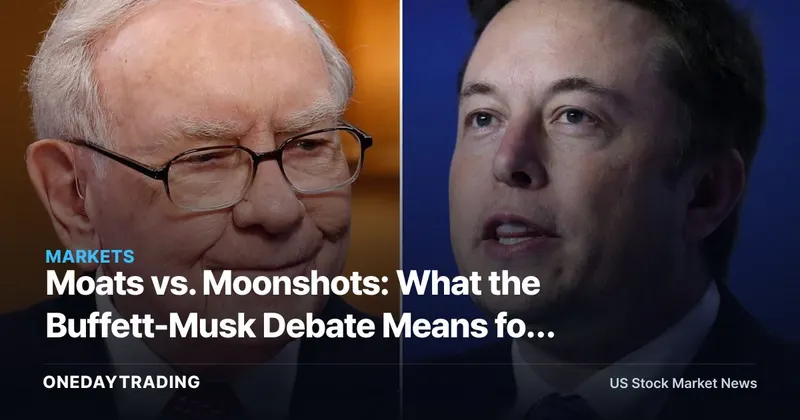
In 2018, Warren Buffett and Elon Musk staked out opposing views on what protects a business over time. Buffett championed durable competitive advantages — economic moats — while Musk argued that the pace of innovation matters more than any defensive barrier. The disagreement still frames how retail investors choose between stability and growth today.
What Happened
Buffett has long built Berkshire Hathaway around companies with wide moats: pricing power, brand strength, low-cost production, and switching costs that keep rivals at bay. To him, a strong moat is the single most important sign of a business worth owning for decades.
Musk pushed back, suggesting that moats can breed complacency and that the only real protection is moving faster than competitors. In his view, continuous innovation — not a static barrier — is what keeps a company ahead. The exchange became a shorthand for two investing worldviews: defend what you have, or outrun everyone else.
Background and Context
The debate is not merely academic. Berkshire's portfolio leans on entrenched franchises and consumer staples, while Tesla's valuation has rested on the expectation of rapid technological leaps in electric vehicles, batteries, and autonomy. Each approach has produced enormous returns at different times, and each carries a distinct risk profile that investors must understand before allocating capital.
Market and Stock Impact
- BRK.B — Embodies the moat philosophy; benefits when investors prize stable cash flows and pricing power during uncertainty.
- TSLA — Represents the innovation-first bet; its valuation depends on sustained breakthroughs rather than defensive barriers.
- AAPL — A Buffett holding that blends both worlds, pairing a powerful ecosystem moat with steady product innovation.
- KO — A classic wide-moat consumer staple illustrating brand-driven durability over decades.
- Growth versus value rotation can shift sentiment between these two camps as interest rates and risk appetite change.
Investor Checkpoints
- Decide whether your time horizon favors durable cash flows or high-growth optionality.
- Assess whether a moat is widening or eroding — barriers can decay when technology shifts.
- Watch how rising or falling rates reprice innovation-heavy stocks versus stable compounders.
- Consider blending both styles to balance defense and offense within a portfolio.
Outlook
The optimistic case is that both philosophies can win: moat-rich businesses compound steadily while innovators capture new markets, and a balanced investor captures both. The risk is that moats erode faster in a fast-moving tech landscape, while innovation-led names can stumble if breakthroughs slow or competition intensifies. Neither approach is foolproof, and the durability of any advantage ultimately must be tested by results.
📊 Analysis
Signal Neutral
Why The piece revisits an investing-philosophy debate rather than reporting a directional catalyst for any single stock.
Tickers$BRK.B$TSLA$AAPL$KO
This article was independently written by OneDayTrading from public reporting. Read the original (CNBC)