Key Takeaways
Bonuses worth millions of won flowing to South Korea's semiconductor workforce are less a labor story than a tell on profitability — confirming that the AI-driven memory cycle is generating cash fast enough to lift wages economy-wide. The Bank of Korea's warning that this adds upward pressure on inflation is the macro counterweight investors should track alongside chip earnings.
What Happened
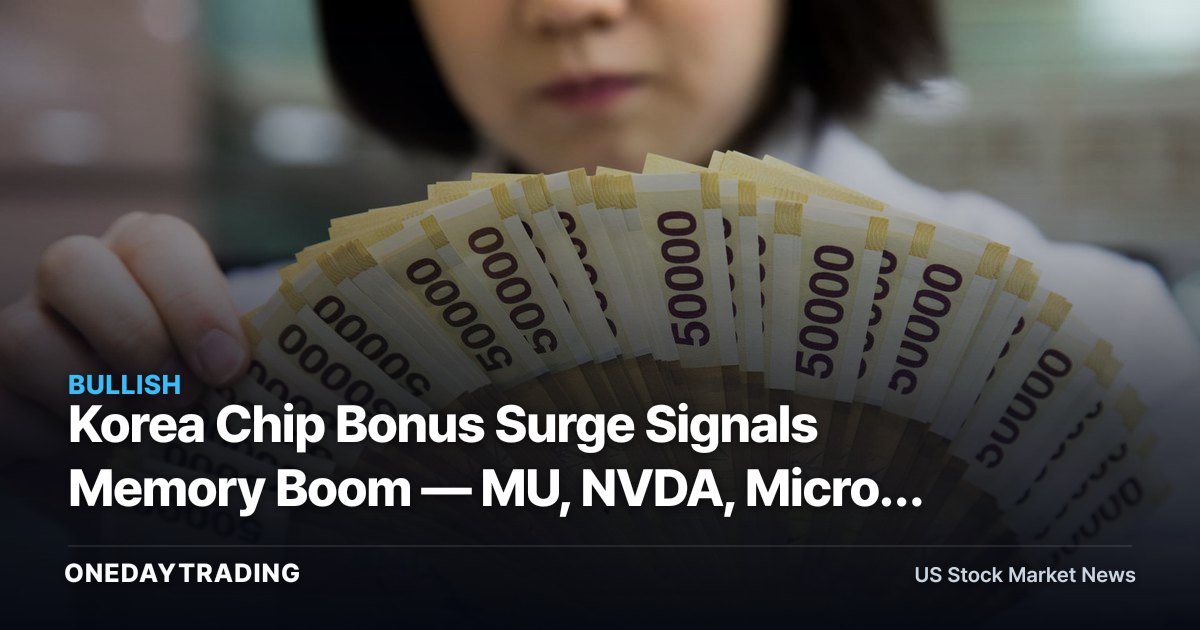
Workers across South Korea's chip industry are receiving outsized year-end and performance bonuses, each running into the millions of won. The scale was large enough to draw a public caution from the Bank of Korea, which flagged the payouts as a source of upward inflationary pressure as the windfall feeds into household spending.
For markets, the signal matters more than the mechanics. Bonuses of this magnitude are typically tied to profit-sharing formulas, so the size implies that memory makers are once again printing strong operating margins after the brutal 2023 downturn. That profitability is being driven by high-bandwidth memory (HBM) and advanced DRAM demand from AI accelerators.
Background & Context
South Korea is the center of gravity for memory chips, home to the two largest DRAM and HBM suppliers. When their margins recover, it shows up first in capacity utilization and pricing, and then in worker compensation. A bonus surge therefore tends to lag — but corroborate — a real upturn in memory ASPs and demand from AI server buildouts.
The inflation angle introduces a policy variable: if chip-sector wealth stokes domestic prices, it complicates the Bank of Korea's room to cut rates, with knock-on effects for the won and for global memory pricing translated into dollars.
Market & Stock Impact
- Micron (MU) — the only US-listed pure-play memory maker; the same HBM and DRAM pricing strength lifting Korean peers flows directly through Micron's revenue mix and gross margin.
- NVIDIA (NVDA) — the demand engine; robust HBM consumption confirms accelerator shipments are pulling memory through, supporting the AI hardware thesis but also tightening a key supply input.
- Broadcom (AVGO) and AMD (AMD) — custom AI silicon and GPU makers that compete for the same constrained HBM allocation, where supply tightness can pressure cost of goods.
- Semiconductor equipment names — sustained memory profitability typically funds the next capex wave, a positive read-through for tool suppliers exposed to DRAM and HBM packaging.
Investor Checkpoints
- Micron's next quarterly results and guidance on DRAM and HBM pricing — the cleanest US-listed proxy for the cycle the bonuses reflect.
- Bank of Korea rate decisions and inflation prints; a hawkish hold signals the wealth effect is real and persistent.
- HBM capacity and qualification updates tied to next-generation AI accelerators, which gate memory upside.
- The won versus the dollar, since currency shifts move reported memory ASPs and competitiveness.
Outlook
The bull case is straightforward: bonus inflation is a coincident indicator that the memory upcycle has real earnings behind it, not just sentiment, and that strength is shared by Micron and the broader AI hardware chain. The risk is symmetry — memory is famously cyclical, and a profit peak is also where the next supply response begins. If utilization and pricing have front-run end demand, the same operating leverage that funds bonuses today can reverse quickly, while a stickier Korean inflation backdrop limits policy support if the cycle turns.
Market data check: MU
MU last traded near $1,133.99 (+8.70%). Our composite signal — blending price momentum and news flow — reads 🟡 neutral. Price momentum scores 95/100 (firm).
Data as of publication. Price via market feeds; for reference only, not investment advice.
📊 Analysis
Signal Bullish
Why Outsized chip-sector bonuses corroborate a strong AI-driven memory profit cycle that supports Micron and the broader HBM supply chain.
This article was independently written by OneDayTrading from public reporting. Read the original (CNBC)