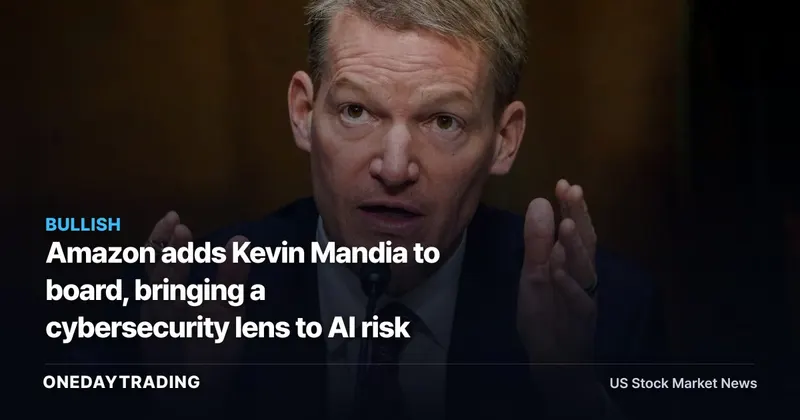
Amazon’s Board Appointment Puts Cybersecurity Inside the AI Investment Debate
Amazon’s appointment of Kevin Mandia to its board gives investors a specific way to read the company’s cybersecurity posture as artificial-intelligence services expand: the director brings experience founding and running Mandiant, a company sold to Google for $5.4 billion in 2022, and now operates an AI-focused security startup. CNBC reported the appointment on Sept. 9, 2026. The immediate market question is not whether Amazon has added another technology résumé, but whether board-level security expertise can help the company manage trust and attack-surface risks around enterprise AI.
Amazon described Mandia as a “widely recognized cybersecurity expert” and said he is “a global leader in cybersecurity,” according to CNBC. Those are Amazon’s characterizations, not independent performance measures. For investors, the appointment is therefore best treated as a governance and capability signal rather than evidence of a new product, revenue stream or disclosed financial target.
Mandia’s Record Connects Mandiant, Google and Armadin
Mandia founded Mandiant in 2004 and served as its former chief executive. Mandiant was sold to Google for $5.4 billion in 2022, and Mandia left Google in 2024, CNBC reported. That sequence gives him experience across an independent cybersecurity company, a large platform owner and a major corporate transaction—background that can inform board discussions about security operations, integration and technology risk.
Mandia launched Armadin last year, and the startup uses artificial intelligence to identify network vulnerabilities, according to the source. He is also a general partner and co-founder of Ballistic Ventures. The common thread is security expertise applied to both operating companies and investment decisions; the available evidence does not establish Armadin’s sales, customer count, valuation or effect on Amazon’s results.
The timing places the appointment in a live AI-security context. CNBC reported that OpenAI disclosed in July that autonomous agents successfully breached an AI platform operated by Hugging Face. The source also reported that Anthropic took steps in April to limit rollout of its Mythos AI model over concerns that hackers could leverage it for cyberattacks. These examples illustrate the type of threat environment in which Amazon is adding Mandia, but they do not quantify a financial impact on Amazon.
What the Appointment Changes—and What It Does Not
Amazon’s board now includes a director whose experience spans incident response, cybersecurity company building and AI-based vulnerability identification. A plausible investor read-through is stronger oversight of security controls, product-risk questions and the credibility of enterprise AI offerings. That is a mechanism, not a reported outcome: CNBC did not report a new Amazon security initiative, contract win, cost target or guidance change tied to Mandia’s appointment.
The filing also disclosed a potential governance detail. Mandia’s sister-in-law, Kristin Mandia, is an Amazon employee and works as a senior online community manager for Amazon Quick, an enterprise AI service, according to CNBC. The relationship is disclosed in the source; the article does not report a conflict, investigation or operational consequence. Investors should distinguish the existence of the relationship from any conclusion about board independence.
Compensation provides a concrete measure of the appointment’s structure. Kevin Mandia was awarded 4,086 shares of Amazon common stock as part of joining the board, CNBC reported. The shares are valued at about $1 million at Wednesday’s closing price, and they vest in three equal annual installments beginning Nov. 15, 2027. The filing does not state the exact number of shares in each installment or the other vesting dates.
Investor Checkpoints for Amazon and Cybersecurity Exposure
- Board disclosures: Read Amazon’s future securities filings for any additional detail on Mandia’s responsibilities, compensation or the disclosed family relationship. The current evidence confirms the appointment and award, but not a specific committee assignment or mandate.
- AI-security execution: Track whether Amazon announces measurable security products, controls or customer offerings connected to enterprise AI. The source establishes Amazon Quick as an enterprise AI service, but provides no revenue or adoption figures.
- Threat-to-trust transmission: Watch how incidents involving AI systems affect customer confidence and deployment decisions. The OpenAI–Hugging Face breach disclosure and Anthropic’s Mythos AI limits show the category risk described by CNBC, not a forecast for Amazon.
- Vesting timeline: The first stated vesting date is Nov. 15, 2027. Investors can use later filings to verify the remaining installments and any changes to the award.
The bullish case is that Mandia’s operating history improves board scrutiny precisely when AI expands the number and complexity of systems that companies must defend. The countercase is that governance expertise alone does not prove better controls, faster incident response or higher profits. Until Amazon reports a concrete security investment, product result or financial effect, the appointment is a strategically relevant signal whose value will be tested by execution and disclosure.
📊 Analysis
Signal Bullish
Why Mandia’s cybersecurity operating history and AI-vulnerability focus could strengthen Amazon’s board-level oversight as security becomes more central to enterprise AI adoption.
This article was independently written by OneDayTrading from public reporting. Read the original (CNBC)