Brazilian Markets Price a Harder Fiscal Test After Lula’s Victory
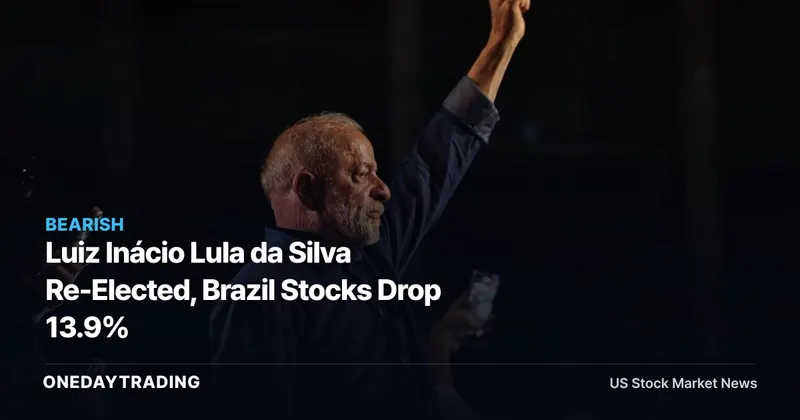
Luiz Inácio Lula da Silva was re-elected as Brazil’s president on Sunday, and investors immediately marked down Brazilian risk assets. According to CNBC, Brazil’s benchmark stock index fell 13.9% on Monday, the Brazilian real lost nearly 8% against the U.S. dollar, and the yield on Brazil’s 10-year government bond rose 2.46 percentage points.
The message is broader than a one-day equity decline. Stocks, the currency and government bonds moved adversely together, indicating that the central question for investors is whether Lula can reconcile his campaign commitments with fiscal restraint. The market has already priced greater uncertainty; it has not priced a known policy package, because the measures to be enacted, their funding and their prospects for approval remain unspecified.
What the 13.9% Stock Drop Really Says
A benchmark equity index compresses many expectations into one price. Its 13.9% Monday decline, as reported by CNBC, followed the Sunday re-election of Luiz Inácio Lula da Silva and coincided with stress in both the real and sovereign bonds. That combination matters because a weaker currency and rising government yields can reinforce a higher required return for owning equities, reducing the valuation investors are willing to assign even before company-level effects become visible.
The yield move is the clearest transmission channel. A government-bond yield is the return demanded by investors to hold sovereign debt; when that required return rises sharply, equities must compete against a more demanding benchmark. Russ Mould, investment director at AJ Bell, argued on Tuesday that the 10-year bond yield could make Brazilian equities relatively less attractive while questions remain over who would finance proposed welfare spending and a debt moratorium for small enterprises.
This does not establish that every campaign pledge will become policy or that every Brazilian business faces the same exposure. It does show that the market’s hurdle rate changed before those details were settled. For equity investors, that separates what the tape already reflects—a larger risk premium—from what remains unresolved: enacted spending, funding choices and the durability of any fiscal restraint.
Lula’s Campaign Commitments Meet the Bond Market
Lula promised protections for existing benefits, minimum-wage increases ahead of inflation, broader housing and education support, tax cuts on food essentials, and a 40-hour working week without pay cuts. These commitments speak directly to household finances, while their fiscal effect depends on which proposals are enacted and how they are funded. The available reporting does not establish either point.
Rafael Ch, senior analyst for Latin America and emerging markets at Signum Global Advisors, described the policy challenge on Tuesday as one that would “revolve around a central tension.” Voters seek “tangible improvements in household finances,” while an insufficiently funded expansion could limit interest-rate cuts and offset some of the relief Lula wants to provide, Ch said.
That conditional link is crucial. If spending expands without credible funding, the bond market could continue to demand compensation for fiscal risk, constraining the room for monetary relief. If the administration instead pairs its priorities with convincing restraint, some of the premium embedded after Monday’s moves could prove excessive. Neither path is confirmed by the election result alone.
Bond-Auction Cancellation Raises the Near-Term Bar
The Brazilian Treasury canceled 2 planned bond auctions for this week on Monday, CNBC reported. The source does not disclose buyers, demand levels or the exact yield after the 2.46-percentage-point increase in Brazil’s 10-year government bond, so the cancellation should not be treated as proof of a specific demand outcome.
It nevertheless gives investors a concrete checkpoint. The next planned government-debt sale, whenever announced, can test whether the market will absorb issuance under acceptable conditions. The relevant evidence will be the auction’s completion and terms, not reassurance by itself.
Currency behavior belongs in the same framework. The Brazilian real’s nearly 8% Monday decline against the U.S. dollar shows that the repricing extended beyond domestic securities. Stabilization across the real, government bonds and equities would offer broader evidence of confidence than a rebound in only one instrument.
The Political Clock Behind Brazil’s Fiscal Choices
Lula has held office since Jan. 1, 2023, after previously serving as president from 2003 to 2011. His latest victory followed Flávio Bolsonaro’s first-round win in early October. The final vote totals and victory margin are not provided, limiting any attempt to infer the size of Lula’s mandate from the result.
Elizabeth Johnson, managing director of Brazil research at TS Lombard, said on Tuesday that the fiscal danger was “largely of his own making” and that the outcome “hinges on Lula’s willingness to cut spending.” Her base case is a modest fiscal reform that helps avert a major fiscal crisis in 2027. That is an analyst scenario, not an approved measure or assured outcome.
February is the next identified political marker because the new legislature convenes then. Any effort to advance reforms before that point would be more informative if it produces specific, assessable proposals. Investors still lack confirmation about which fiscal measures will be approved, who will become finance minister and which campaign commitments will take effect.
Bull and Bear Paths for Brazilian Assets
Bull case: The administration advances a credible fiscal package and demonstrates that its social agenda can coexist with spending restraint. That could reduce the compensation demanded in government bonds, ease pressure on the real and improve the relative valuation setting for Brazilian equities. Johnson’s modest-reform base case provides an attributed version of this scenario, with 2027 as the stated fiscal horizon.
Bear case: Campaign commitments move forward without funding that investors consider sufficient. In that path, elevated government yields could restrict monetary relief and keep equity discount rates demanding. The canceled auctions would then look less like an isolated scheduling decision and more like an early warning requiring confirmation from subsequent debt sales.
Risk also extends beyond Brazil’s benchmark. Russ Mould noted that the MSCI Latin America index reached a 12-year high this year and said Brazil’s decline may weigh on wider pan-Latin American indices accessed through exchange-traded funds. The implication is conditional: regional exposure can transmit Brazil’s repricing, although the supplied evidence does not quantify that effect.
Investor Checkpoints After the Election Shock
- Fiscal substance: Look for a defined proposal that explains how campaign commitments would be financed and whether spending restraint accompanies them.
- Government-debt demand: Examine the next announced bond auction after the Brazilian Treasury canceled 2 planned sales for this week.
- Cross-market confirmation: Track whether the real, the 10-year government bond and Brazil’s benchmark stock index stabilize together rather than relying on a single-market rebound.
- Political execution: Assess concrete reform progress before the new legislature convenes in February, while keeping the proposed 2027 fiscal objective distinct from an approved outcome.
The next decisive signal will not be another campaign promise. It will be whether a specific fiscal proposal changes the price investors demand to hold Brazilian government debt—and whether that shift carries through to the real and equities.
📊 Analysis
Signal Bearish
Why The simultaneous selloff in Brazilian stocks and the real, alongside sharply higher government-bond yields, signals an immediate increase in perceived fiscal and valuation risk.
This article was independently written by OneDayTrading from public reporting. Read the original (CNBC)