Key Takeaways
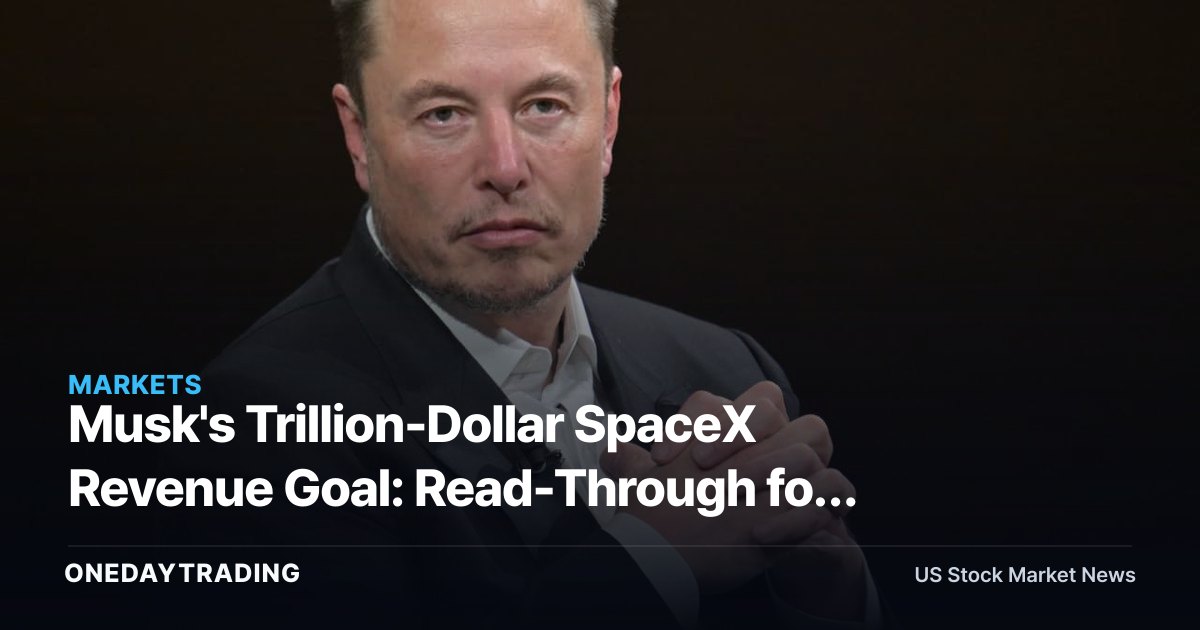
Elon Musk has set a trillion-dollar long-range revenue target for the privately held SpaceX, a figure more than double what his own bankers reportedly modeled. Because SpaceX is not publicly listed, the cleanest investable read-through runs through Musk-linked equity Tesla, listed launch and satellite peers, and the broader space-economy theme rather than the company itself.
What Happened
According to MarketWatch, Musk publicly framed a path toward roughly one trillion dollars in SpaceX revenue, materially above the expectations held by the bankers who help value and finance the company. The gap matters: it is not a small upward revision but a doubling of the internal base case, which tells investors the target rests on aggressive assumptions about Starlink subscriber scale, launch cadence, and adjacent businesses.
The report also flags Musk's documented pattern of announcing bold numerical goals and then missing the timeline or the magnitude. That history is the core analytical tension here—the headline number is a signal of ambition and addressable-market framing, not a contracted forecast.
Background and Context
SpaceX revenue today is anchored by two engines: launch services dominated by reusable Falcon vehicles, and Starlink satellite broadband, which has become the larger and faster-growing line. A trillion-dollar target implicitly assumes Starlink reaches consumer-telecom scale globally, plus upside from direct-to-cell connectivity, defense contracts, and eventually Starship-class heavy lift. Each leg carries execution and regulatory risk.
Market and Stock Impact
- Tesla (TSLA): The only liquid way most retail investors express a Musk-venture view. Bullish SpaceX framing can lift sentiment toward Musk-led entities, but it also raises the perennial concern that his attention and capital are split across SpaceX, xAI, and Tesla.
- Rocket Lab (RKLB): A direct listed launch competitor. An ever-larger SpaceX intensifies pricing and cadence pressure on smaller launch providers, though a expanding total space market can also lift demand for second-source capacity.
- AST SpaceMobile (ASTS) and Globalstar (GSAT): Direct-to-device satellite plays that compete with Starlink's cellular ambitions; a more aggressive SpaceX roadmap raises the competitive bar for spectrum and carrier deals.
- Iridium (IRDM): Established satellite connectivity incumbent whose niche IoT and safety-of-life services could be encroached on as Starlink broadens its product set.
- Defense and aerospace primes: Lockheed Martin and Boeing face a low-cost launch and constellation rival, pressuring legacy government launch economics.
Investor Checkpoints
- Watch any disclosed Starlink subscriber and revenue milestones, plus secondary-market SpaceX valuation marks, for evidence the trajectory supports the target.
- Track Starship orbital test progress and FAA approvals, the gating factor for heavy-lift economics.
- For listed peers RKLB and ASTS, monitor launch backlog, contract wins, and cash runway in upcoming quarterly reports.
- Note Musk's allocation of time and capital across his ventures, a recurring TSLA governance variable.
Outlook
The bull case is that SpaceX is genuinely redefining launch cost and satellite broadband, and that a large addressable market makes even a fraction of the target highly valuable to the private equity holders. The risk case is concrete: the figure doubles banker estimates, sits on unproven Starship and direct-to-cell assumptions, and comes from a founder with a track record of stretched timelines. With no public SpaceX stock, investors are pricing a narrative through proxies, which can decouple from fundamentals quickly.
Market data check: TSLA
TSLA last traded near $106.5 (+4.01%). Our composite signal — blending price momentum and news flow — reads 🟡 neutral. Price momentum scores 82/100 (firm).
Data as of publication. Price via market feeds; for reference only, not investment advice.
📊 Analysis
Signal Neutral
Why An aspirational private-company revenue target with no listed SpaceX equity offers no clear directional catalyst for any single tradable stock, and Musk's history of missed targets cuts both ways.
Tickers$TSLA$RKLB$ASTS$IRDM$GSAT
This article was independently written by OneDayTrading from public reporting. Read the original (MarketWatch)