Summary
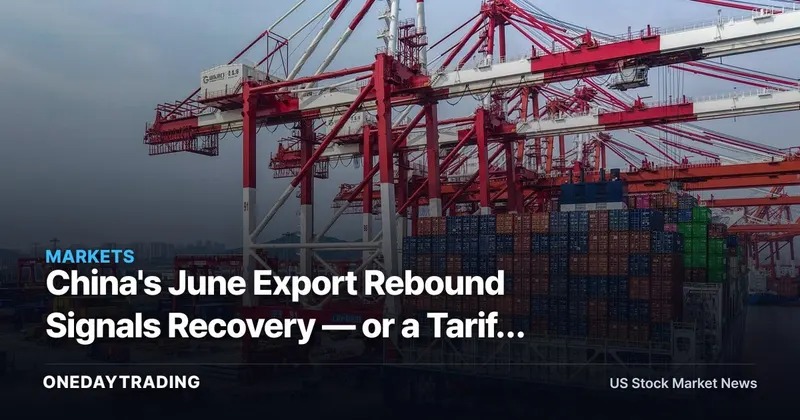
China's economy is showing signs of a genuine June recovery, with analysts pointing to a rebound in U.S.-bound shipments as a primary driver after months of sluggish activity. The headline improvement is real — but the mechanism behind it carries a timing risk that separates a sustainable growth revival from borrowed demand. How Q3 export data lands will determine which read was correct, and the market has already chosen a side.
The Full Story
The signal out of China's June figures is exactly the kind that splits a trading desk. A rebound in shipments to the U.S. market, after a protracted soft patch, is being read by some analysts as confirmation that demand-side stress was temporary and that global growth momentum has reasserted itself. That reading lifts risk assets, commodity proxies, and China-exposed equities simultaneously — and it may be right. The counter-read matters just as much: China's exporters have a well-documented history of front-loading volumes when tariff policy windows open or approach a review date, pulling Q3 demand into Q2 and flattering current-period figures while compressing the next cycle.
After a sluggish few months that weighed on manufacturing output and industrial activity, the June pickup spans multiple sectors, per analysts tracking the data. Breadth alone, however, does not distinguish between a durable demand recovery and a coordinated pull-forward by Chinese manufacturers hedging against potential trade policy shifts. The two have the same signature in monthly export data; they diverge sharply in Q3, when front-loaded volumes leave a crater rather than a trend.
Structural Background
China's domestic recovery has been uneven beneath the export headline. Property sector stress remains unresolved, consumer confidence has lagged the industrial improvement, and credit demand from small and mid-sized enterprises has stayed soft. A shipment surge driven by external demand — specifically U.S.-bound orders — lifts manufacturing utilization and PMI readings without necessarily signaling a broad consumption revival. For commodity markets, that asymmetry is material: copper and industrial metals absorb construction and infrastructure demand, not export-assembly activity, which is more labor-intensive than materials-intensive. A China pickup driven by U.S. exports is therefore a structurally weaker signal for base-metal demand than a domestic-consumption-led rebound would be.
The fixed-income read-through adds a further complication for U.S. equities. A stronger China growth narrative reduces the urgency for Fed easing, since global optimism narrows the window for a cut that domestic U.S. data alone might not yet justify. The 10-year yield responds to China industrial momentum with a lag — the more direct channel runs through energy and materials prices, which feed into headline CPI six to eight weeks later. If the June rebound is durable, rate-sensitive multiples face renewed pressure even as the growth story improves.
Stock & Sector Ripple
- BABA (Alibaba) — Broadest U.S.-listed proxy for China economic health; a confirmed demand recovery lifts domestic consumption and cloud monetization expectations, but structural discounts from regulatory risk and U.S. delisting concerns do not disappear on one month of positive trade data.
- PDD (Pinduoduo/Temu) — Direct beneficiary and the highest-beta risk in one ticker: Temu's U.S. shipping volumes are an active contributor to the rebound, but the model faces acute exposure if de minimis exemptions or small-parcel tariff rules tighten, making PDD the clearest policy binary in the group.
- FCX (Freeport-McMoRan) — Copper is the canonical China growth barometer, but an export-assembly-driven rebound is structurally weaker for metals demand than a domestic infrastructure cycle, limiting FCX upside relative to a consumption-led scenario.
- JD (JD.com) — More domestically focused than BABA or PDD; benefits from a China macro recovery narrative and sees its valuation discount to BABA compress when growth data prints positive, though the U.S.-export channel is a secondary driver.
- AAPL (Apple) — China is simultaneously Apple's second-largest revenue market and its primary manufacturing base; a stronger Chinese economy supports local iPhone demand while the shipment surge underscores supply-chain dependency that any tariff escalation would stress bilaterally.
Bull vs Bear Scenarios
Bull: The June rebound reflects genuine demand recovery — U.S. consumers restocking, Chinese factories running at improving utilization, and a trade environment stable enough to sustain the trend into Q3. In this scenario, China-exposed equities re-rate, commodity demand broadens into domestic channels, and the global growth case supports risk appetite even if the Fed delays cuts.
Bear: The shipment surge is a front-load — exporters accelerating deliveries ahead of tariff policy uncertainty, compressing Q3 volumes and producing a June optical beat that inverts by September. In this scenario, the commodity bid fades, China-exposed stocks give back the gains, and a Fed reading stronger global data keeps rates higher for longer than the futures strip currently prices, pressuring growth multiples at exactly the wrong moment.
Investor Action Points
- July and August China export data releases are the first real test: a sustained shipment trend validates the recovery thesis; sequential deceleration confirms front-loading and triggers a reassessment of China-exposed positions.
- Monitor U.S. tariff policy announcements and any de minimis rule changes — these are the binary catalyst that determines whether PDD's U.S. volume is structural or at acute risk.
- Track industrial metals prices (copper, aluminum) for confirmation: if the China rebound is construction- and consumption-driven, base metals should hold; if it is export-assembly-only, metals may lag the equity sentiment.
- Watch the 10-year Treasury yield into the next U.S. CPI print — if China's export rebound feeds goods price stabilization, the disinflation narrative softens and the rate-cut timeline the market is pricing gets pushed further out.
📊 Analysis
Signal Neutral
Why The June rebound is a genuine positive signal, but the pull-forward risk from tariff-driven export front-loading creates an offsetting downside scenario that makes the net directional impact ambiguous until Q3 data clarifies.
Tickers$BABA$PDD$FCX$JD$AAPL
This article was independently written by OneDayTrading from public reporting. Read the original (CNBC)