Key Takeaways
A reported $20 million from AI-aligned political action committees flooded a single Manhattan House Democratic primary, signaling that the industry now treats regulatory outcomes as a balance-sheet variable worth defending with hard cash. For investors, the read-through is less about one congressional seat and more about which policy regime — permissive or restrictive — shapes the cost of building and deploying large models over the next several years.
What Happened
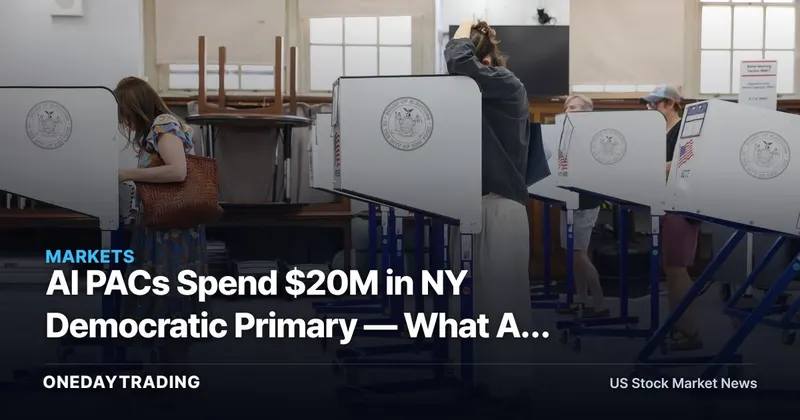
According to CNBC, companies are spending heavily to influence AI policy at the federal level, and that money is now showing up in down-ballot races. The Manhattan House Democratic primary is being framed as a test of where voters actually stand on AI regulation, with AI-focused PACs deploying roughly $20 million to back favored candidates.
The scale matters: $20 million is an extraordinary sum for a single primary contest, where total spending often runs a fraction of that. Concentrating that much capital in one race is a deliberate signal — the industry wants to demonstrate it can reward allies and punish skeptics, shaping how future candidates position themselves on liability, safety mandates, and disclosure rules.
Background and Context
The policy channel here is concrete. Federal rules on model liability, training-data transparency, compute reporting, and safety testing directly affect the operating cost and legal exposure of firms that train frontier models or sell AI infrastructure. A lighter-touch federal framework lowers compliance overhead and litigation risk; a stricter one raises both and can slow product release cycles.
Market and Stock Impact
- NVDA — As the dominant supplier of AI training chips, Nvidia benefits most from any policy outcome that keeps model-builders investing aggressively in compute; friction-heavy regulation that delays deployment would soften data-center GPU demand at the margin.
- MSFT and GOOGL — Hyperscalers monetizing AI through cloud and enterprise software face direct compliance costs under stricter rules, while a permissive regime protects their pace of feature rollout and capex returns.
- META — With an open-weight model strategy, Meta is especially exposed to rules on model release, transparency, and downstream liability that could constrain how freely it distributes systems.
- PLTR — Government and enterprise AI deployment vendors can cut both ways: heavier oversight expands demand for compliance and audit tooling even as it raises customer caution.
Investor Checkpoints
- The primary result itself — a win for the AI-backed candidate validates the spending playbook and likely invites more industry capital into future races.
- Any federal AI legislation or executive action on liability, safety testing, or disclosure that converts lobbying into enforceable rules.
- Hyperscaler capex commentary on next earnings calls — whether management flags regulatory cost as a swing factor.
- State-versus-federal preemption fights, which determine whether firms face one rulebook or fifty.
Outlook
The bull case is that industry mobilization tilts policy toward a predictable, light-touch federal standard, preserving the current investment cycle in compute and AI software. The risk is symmetry: visible $20 million interventions can trigger a public and political backlash that hardens calls for stricter oversight, and a single primary tells investors little about national sentiment. The near-term market impact is muted — this is a process story, not an earnings event — but it marks how directly regulatory risk now sits inside AI equity valuations.
Market data check: NVDA
NVDA last traded near $202.2 (-3.09%). Our composite signal — blending price momentum and news flow — reads 🟡 neutral. Price momentum scores 25/100 (soft).
Data as of publication. Price via market feeds; for reference only, not investment advice.
📊 Analysis
Signal Neutral
Why A single primary and unresolved federal AI policy fight carry no immediate earnings or demand catalyst, even as the spending highlights regulatory risk embedded in AI valuations.
Tickers$NVDA$MSFT$GOOGL$META$PLTR
This article was independently written by OneDayTrading from public reporting. Read the original (CNBC)