Key Takeaways
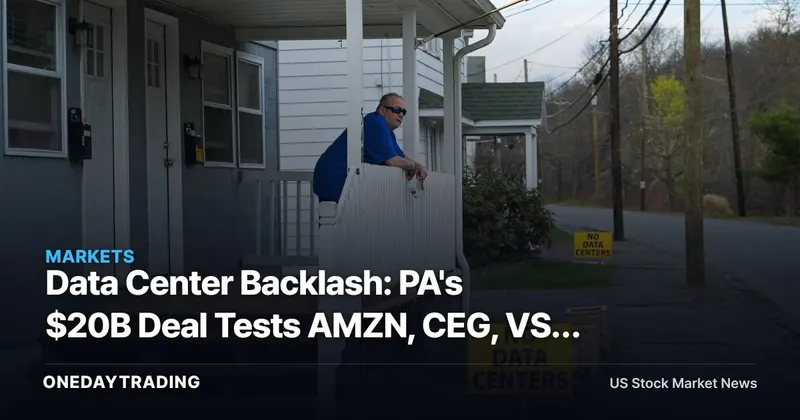
The fight over data center permitting is shifting from a corporate convenience issue to a political risk that can slow the AI buildout at the state level. Pennsylvania's record $20 billion economic development deal, announced last June by Governor Josh Shapiro, has become a flashpoint between companies pushing to cut red tape and residents wary of the projects landing in their communities. For investors, the takeaway is that the bottleneck for AI infrastructure is increasingly land, power, and local consent, not just chips.
What Happened
Shapiro promoted the deal as the largest in state history, a marquee win for jobs and capital investment. Instead of a clean political victory, it has drawn sustained criticism, illustrating how data center growth collides with local concerns over land use, electricity prices, water, and noise.
The broader pattern is companies lobbying states to streamline approvals and speed construction, while a growing bloc of voters wants more scrutiny, not less. That tension matters because hyperscalers need predictable, fast permitting to hit aggressive capacity timelines, and any slippage pushes capacity online later and raises siting costs.
Background and Context
AI demand has turned electricity into the scarce input for compute. Each large campus can draw the equivalent of a small city, forcing operators toward states with available grid capacity and friendly policy. Pennsylvania, with its mix of nuclear and gas generation, is a natural magnet, which is exactly why a single $20 billion project carries outsized symbolic and economic weight.
Market and Stock Impact
- AMZN, MSFT, GOOGL: Hyperscalers are the buyers driving these deals; permitting friction lengthens lead times on capacity that underpins their cloud and AI revenue, pressuring return timelines on record capex.
- CEG, VST, TLN: Independent power producers benefit most directly, since data centers sign long-term contracts for firm power; local pushback that limits load growth or invites rate scrutiny is the key downside to that thesis.
- EQIX, DLR: Data center REITs monetize speed-to-power; slower approvals constrain new supply, which can support pricing for existing inventory but cap development pipelines.
- NVDA: Compute demand still flows through accelerators, but stranded or delayed power is the physical ceiling on how fast that silicon can be deployed.
Investor Checkpoints
- Watch state-level permitting and zoning votes in Pennsylvania and other hyperscale hubs for signs of tightening or moratoria.
- Track whether utility rate cases tie data center load to residential bill increases, the issue most likely to mobilize voters.
- Monitor hyperscaler capex commentary on next earnings for any language on siting delays or power procurement constraints.
- Follow power-purchase announcements from CEG, VST, and TLN as the clearest read on contracted demand.
Outlook
The bull case is intact at the demand level: capital this large rarely reverses, and operators will pay premiums for guaranteed power, supporting generators and infrastructure owners. The risk is that local politics becomes a durable cost and timing variable, raising the price of power, extending build cycles, and concentrating winners in states that resolve the consent problem first. The deciding factor is whether policymakers can route benefits to residents fast enough to keep approvals flowing.
Market data check: AMZN
AMZN last traded near $232.79 (-4.75%). Our composite signal — blending price momentum and news flow — reads 🟡 neutral. Price momentum scores 12/100 (soft).
Data as of publication. Price via market feeds; for reference only, not investment advice.
📊 Analysis
Signal Neutral
Why The story centers on political and permitting friction that creates both a long-term demand tailwind and a near-term siting and cost risk for data center and power names, with no clear directional resolution.
Tickers$AMZN$CEG$VST$TLN$EQIX$NVDA
This article was independently written by OneDayTrading from public reporting. Read the original (CNBC)