At a Glance
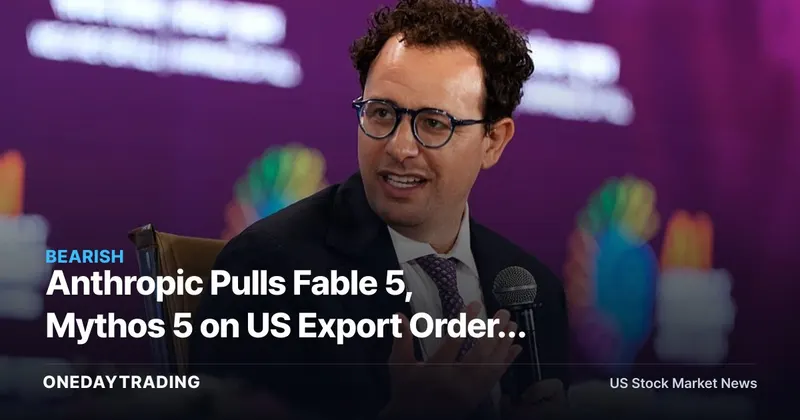
Anthropic said it disabled access to its Fable 5 and Mythos 5 models to comply with a US government export control directive. The move marks one of the first clear cases of a leading AI lab restricting model access at the government's instruction rather than over capacity or safety. For investors, it signals that AI software, not just hardware, is now squarely inside the export-control perimeter.
Why It Matters Now
Until recently, US export controls on artificial intelligence focused mainly on advanced semiconductors and the equipment used to make them. Anthropic acting on a directive to switch off two specific models extends that logic to the model layer itself, where the value of frontier AI increasingly sits. That broadens the surface area of regulatory risk for the entire AI stack.
Anthropic is privately held, with deep commercial and investment ties to large listed technology platforms. When a flagship lab has to disable products to stay compliant, the read-through reaches its cloud partners, its chip suppliers, and rival model providers that may face similar directives. The episode also underlines how quickly access to AI capabilities can change for reasons that have nothing to do with demand.
The strategic backdrop is the ongoing US effort to limit the flow of advanced AI capability to certain foreign markets. Each new control adds compliance cost and can fragment global product availability, a structural theme retail investors in AI names should track closely.
FAQ
- What happened: Anthropic disabled access to its Fable 5 and Mythos 5 models to satisfy a US government export control directive.
- Is Anthropic publicly traded: No. Exposure is taken indirectly through its listed cloud backers, chip suppliers, and competitors.
- Why does it matter for markets: It shows export controls now target AI models, not only chips, raising compliance risk across the AI supply chain.
- Does it cut current earnings: There are no disclosed revenue figures tied to this action, so the near-term effect is more about sentiment and policy direction than reported numbers.
Related Stocks and Sectors
- NVDA: As the dominant supplier of AI training and inference chips, any tightening of AI export rules adds uncertainty to its addressable market.
- AMZN: A major Anthropic partner and investor through its cloud business, exposed to how restricted models affect AI service demand.
- GOOGL: Another large Anthropic backer with its own frontier models, facing similar potential directives.
- MSFT: A leading AI cloud and model distributor that could see comparable compliance obligations.
- Semiconductors and AI software broadly: Policy risk now spans both hardware and the model layer.
What to Watch
- Policy headlines can move AI names sharply without changing reported fundamentals, so separate sentiment from earnings.
- Anthropic is private, so any exposure is a proxy through partners and suppliers, not a direct bet.
- Export controls can expand in scope and timing is unpredictable, adding regulatory overhang to the sector.
- Avoid assuming a single directive defines the long-term demand trend for AI compute.
Overall Outlook
The optimistic case is that disciplined compliance protects US AI leaders from harsher penalties and preserves their dominant position in core markets, keeping demand for chips and cloud intact. The risk case is that a widening web of model-level export controls raises costs, fragments global availability, and pressures growth expectations for AI infrastructure names. Investors should treat this as a regulatory milestone to monitor rather than a one-off event.
📊 Analysis
Signal Bearish
Why Extending US export controls from chips to AI models adds fresh regulatory and compliance risk across the AI supply chain.
Tickers$NVDA$AMZN$GOOGL$MSFT
This article was independently written by OneDayTrading from public reporting. Read the original (CNBC)