What Changes
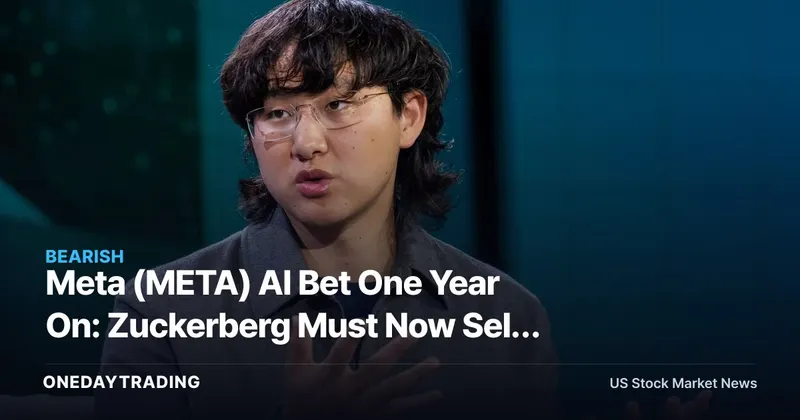
The narrative around Meta is shifting from ambition to accountability. When Zuckerberg recruited Alexandr Wang, the founder of a high-profile data labeling business, the goal was to reset Meta's AI direction and ship a model that could compete with leaders in the field. A year later, the central question for shareholders is no longer whether Meta will spend, but whether that spending produces a product capable of winning users and developers.
For a company that has framed itself as an AI-first platform, a model that lands below expectations is more than a research setback. It complicates the messaging Zuckerberg must deliver to investors who have tolerated rising costs on the promise of a payoff. The pressure to sell the model, both literally to enterprises and figuratively to the market, now sits squarely on management.
It also feeds a broader Big Tech debate: enormous AI budgets are being committed faster than clear monetization has emerged, and Meta's experience becomes a test case for how patient public markets will be.
By the Numbers
The article frames the effort in time rather than disclosed dollar figures: the spending spree began about a year ago with the Wang hire. The key quantitative takeaway investors should hold is duration. A full year of elevated AI investment with results characterized as underwhelming raises the bar for the next product cycle and for any commentary on capital expenditure cadence.
Winners & Losers
- META — the core stock; near-term sentiment risk if AI returns stay unconvincing, but optionality remains if the next model lands.
- NVDA — sustained Meta AI spending supports continued demand for accelerators, a relative positive.
- MSFT, GOOGL — rivals that can frame their own AI roadmaps as further along if Meta's model disappoints.
- AMD — secondary beneficiary of ongoing AI infrastructure buildout across hyperscalers.
Risk Check
- Execution risk: a single high-profile hire does not guarantee a competitive model.
- Cost discipline: heavy outlays without clear monetization can pressure margins and sentiment.
- Competition: rivals are shipping rapidly, narrowing any window for Meta to differentiate.
- Narrative risk: the underwhelming label, once attached, can weigh on the stock until disproven.
Bottom Line
Meta still has scale, distribution and the balance sheet to fund another swing at a leading AI model, which keeps long-term upside intact. But after a year of aggressive spending with results that have not impressed, the burden of proof has shifted to Zuckerberg, and until a clearly competitive product arrives, investors should treat the AI thesis as promising but unproven.
📊 Analysis
Signal Bearish
Why A year of heavy AI spending with results described as underwhelming raises execution and cost concerns that pressure near-term sentiment on META.
Tickers$META$NVDA$MSFT$GOOGL$AMD
This article was independently written by OneDayTrading from public reporting. Read the original (CNBC)