AI Exposure Puts the Labor Transition Ahead of the Investment Narrative
CNBC Markets examined on 2026-10-19 why artificial intelligence may expose women to greater employment disruption, drawing on research involving AT&T, IBM and office software. The investor relevance lies less in a proven job-loss total than in where automation first lands: routine clerical and administrative tasks heavily performed by women.
Artificial intelligence, in this context, is technology that can perform or assist with routine work, numerical processing and pattern finding. Ariane Hegewisch, a senior research fellow at the Institute for Women's Policy Research, said those capabilities overlap with clerical and administrative occupations and noted that women account for 90% of secretaries and clerical workers.
The International Labour Organization concluded in March that nearly 1 in 10 women in high-income countries work in occupations at the highest risk from AI. That is a measure of occupational exposure, not a forecast that the same share will lose employment. The distinction is central for investors assessing AI adoption: exposed tasks can be eliminated, transferred to other employees or combined with higher-value human work.
AT&T Shows Why Incumbent Workers Bear the First Shock
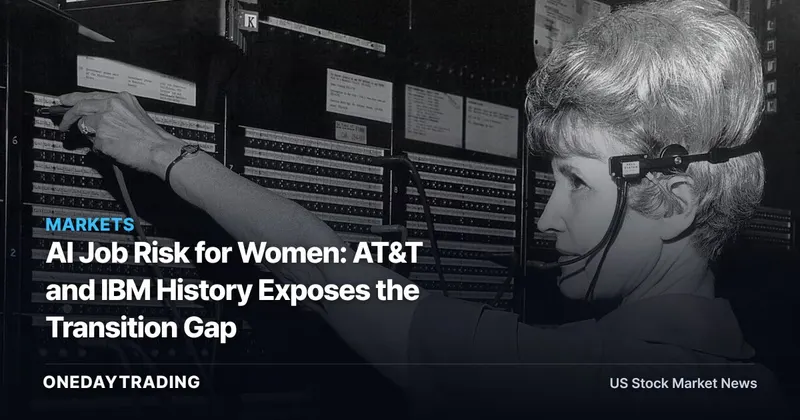
The automated telephone switch offers the clearest historical warning in the evidence. CNBC Markets reported that nearly 95% of America's telephone operators were female in the 1940s, and operators could process several hundred calls per hour at peak times after extensive training.
AT&T introduced the automated switch and expanded switch investment across the United States. In the decades after the technology was popularized, 75,000 operator jobs disappeared. The change did not merely improve an existing tool; it removed the need for many workers who had built careers around manually connecting calls.
James Feigenbaum of Boston University and Daniel P. Gross of Duke University's Fuqua School of Business wrote in 2020 that the shock stripped many incumbent operators of their jobs and careers. Their research also found a different outcome for later generations: future workers moved into other fields and often secured work of similar quality.
That split defines the transition risk. Workers already committed to an occupation may have fewer attractive alternatives when its value declines, while people entering the labor market can choose around the new technology. David Autor emphasized the constraint plainly: “Most people are not changing careers very often.”
Household Technology Expanded the Supply of Paid Work
The washing machine provides a different automation channel. In the 1950s, washing machines and other appliances reduced the time women spent on unpaid housework, allowing more time to move toward paid employment even as household responsibilities remained.
Jeremy Greenwood, identified as a University of Pennsylvania economist, studied this technological shift. From 1950 to 1980, the number of employed U.S. women increased by more than 25 million, while the female labor-force participation rate rose from 34% in 1950 to 52% in 1980.
Over the same period, 16 million more men found work, while the male participation rate declined by 5 percentage points. David Autor said substantial new U.S. work was created from 1940 to 1980, including office and clerical positions accessible to workers with a high school education. The episode shows that labor supply can expand alongside job creation, though the fact sheet does not establish that AI will reproduce that outcome.
IBM and Microsoft Word Shifted Office Tasks Rather Than Erasing Them
The personal-computer transition more closely resembles today's concern about administrative work. In 1980, nearly 4.7 million Americans worked as secretaries, stenographers and typists, and more than 98% of them were women.
IBM introduced the personal computer in 1981, and Microsoft Word followed two years later. Writing, filing and editing continued, while a large share of those tasks shifted from dedicated clerical employees to other office workers. The technology therefore changed who performed the work as well as which roles remained necessary.
This history complicates a simple displacement thesis. Personal computers eliminated some roles, while women also used new computing tools in their work and adapted their responsibilities around the technology. AI could similarly remove particular tasks without eliminating every job containing those tasks, leaving workers to concentrate on activities the technology does not perform.
Office Software Evidence Points to Uneven Economic Gains
A 2022 paper by Marcus Dillender and Eliza Forsythe found that adoption of office and administrative software was associated with a 1% decline in employment in that sector and a 3% increase in wages for college graduates. The paired findings matter because they show employment pressure and wage gains can appear in the same technology transition while accruing to different groups.
For investors, that pattern creates a more useful framework than counting exposed occupations alone. Software adoption may reduce demand for a category of administrative labor while increasing the value of workers able to use the technology in more advanced roles. The evidence supports that mechanism for the software studied; it does not supply projected AI wage effects or identify employers that will reduce headcount.
Hegewisch's concise warning—“AI can learn.”—marks the key difference in the current debate. If capabilities extend beyond routine tasks, exposure could move further into work that appeared protected under earlier forms of office automation. The direction is plausible within the reported concern, while its scale and timing remain unquantified.
Implications for AT&T, IBM and Microsoft
- AT&T: The company is relevant as the operator of the historical switch rollout. That episode demonstrates how infrastructure automation can eliminate a specialized occupation, but it provides no evidence of a current earnings effect or AI-driven employment plan at AT&T.
- IBM: Its 1981 personal-computer introduction anchors the office-technology comparison. The historical record shows that computing redistributed writing, filing and editing across the workplace; it does not establish a present revenue or margin outcome for IBM.
- Microsoft: Microsoft Word represents the software layer that helped other office workers perform tasks once assigned to dedicated clerical staff. The supplied evidence establishes that relationship, not a forecast for Microsoft demand, pricing or financial performance.
- Office and administrative work: This is the most directly exposed labor segment in the analysis because of its concentration of routine tasks and pattern-based work. Any stock-level conclusion would require employer disclosures that the evidence does not provide.
Investor Checkpoints for the AI Employment Debate
- Task transfer versus job removal: Company disclosures should be assessed for whether AI shifts clerical work to other employees, eliminates individual tasks or removes whole positions.
- Effects on incumbent workers: The AT&T history makes retention, reassignment and movement into lower-quality work important indicators of transition costs.
- Outcomes for future entrants: Feigenbaum and Gross found later generations adapted more successfully than incumbent telephone operators, making entry-level occupational movement a distinct signal from current-worker displacement.
- Employment and wages together: The Dillender-Forsythe findings show why sector employment and graduate wages should be read jointly rather than treated as interchangeable measures of technological benefit.
What the Historical Record Cannot Settle About AI
The evidence supports a neutral market stance because it establishes exposure without quantifying the eventual AI outcome. No total is provided for jobs AI will eliminate or create, no date is given for when employment effects will occur, and no individual employer is identified as planning AI-related reductions.
The constructive scenario is task-level automation: workers use AI to increase the time available for responsibilities that still require human judgment, echoing parts of the personal-computer transition. The adverse scenario is occupational displacement concentrated among incumbent clerical workers, closer to the experience of telephone operators.
The next decisive evidence will come from employment, wage and task-allocation disclosures surrounding actual adoption. Until those measures emerge, the strongest conclusion is distributional rather than directional: AI may create value while imposing its largest transition costs on workers whose existing roles contain the greatest concentration of automatable tasks.
Market data check: AT&T Inc.
AT&T Inc. last traded near $20.93 (-7.96%). Our composite signal — blending price momentum and news flow — reads 🟡 neutral. Price momentum scores 5/100 (soft).
Data as of publication. Price via market feeds; for reference only, not investment advice.
📊 Analysis
Signal Neutral
Why Historical automation displaced incumbent workers while opening different opportunities later, but the evidence provides no company-level forecast or clear sector direction for AI.
This article was independently written by OneDayTrading from public reporting. Read the original (CNBC Markets)