Key Takeaways
The G7 signaling a coordinated push against China's dominance in critical minerals reframes rare earths and battery metals as a national-security supply chain, not just a commodity trade. The clearest equity channel runs through Western-listed miners and processors that can fill the gap China currently controls. The catch: building non-Chinese supply is slow and capital-heavy, so the policy tailwind is structural rather than an overnight earnings event.
What Happened
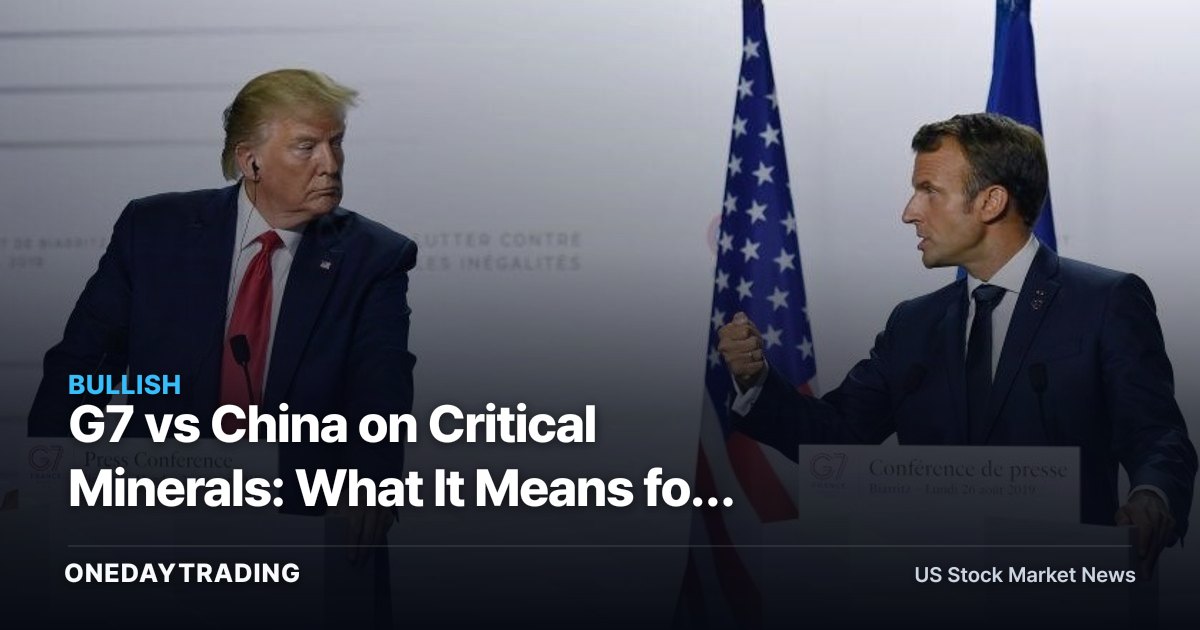
The G7 group of advanced economies is taking aim at China's control over critical minerals, the raw inputs behind electric-vehicle batteries, wind turbines, defense systems and advanced electronics. The move treats supply concentration as a strategic vulnerability and points toward coordinated measures to diversify sourcing and processing away from a single dominant supplier.
The significance for investors is the policy direction itself. When the largest industrial democracies frame mineral supply as a security problem, the typical follow-through is some combination of stockpiling, price floors, offtake guarantees, permitting acceleration and procurement preferences for friendly-nation output. Each of those mechanisms tends to improve the economics of producers operating outside China.
Background and Context
China's leverage is not in the mining of these minerals so much as in refining and processing, where it has built dominant share across rare earths and several battery metals. That processing chokepoint is why prior export-control episodes have rattled automakers, defense contractors and chipmakers. The G7 angle matters because it widens a single-country effort into a bloc-level one, which raises the odds of durable demand for alternative supply.
Market and Stock Impact
- MP Materials (MP) operates the main U.S. rare-earth mine and is expanding into domestic magnet production, positioning it as a direct beneficiary of friend-shoring policy and government-backed offtake.
- Albemarle (ALB) is leveraged to lithium; Western supply-security policy supports non-Chinese battery-material capacity, though its near-term earnings still hinge on weak lithium pricing.
- Energy Fuels (UUUU) is building rare-earth processing alongside uranium, giving it exposure to the processing bottleneck the G7 is targeting.
- Defense and EV end-users such as Lockheed Martin and Tesla face the flip side: secure supply lowers strategic risk but a Western premium chain can raise input costs versus Chinese sourcing.
Investor Checkpoints
- Watch for concrete G7 follow-through: price-floor mechanisms, stockpiling budgets or procurement mandates with hard dates, not communique language.
- Track rare-earth and lithium spot prices, since policy intent only converts to margins if pricing supports new projects.
- Monitor MP Materials magnet-output ramp and any new government or automaker offtake agreements in upcoming earnings.
- Watch China's response, including any tightening of export controls that could spike prices and re-rate Western producers.
Outlook
The bull case is a multi-year demand floor for ex-China supply backed by policy, which de-risks projects that markets once viewed as uneconomic against cheaper Chinese output. The counter-case is real: these stocks often trade more on volatile mineral prices than on policy headlines, build-outs take years and capital, and a single Chinese pricing move can undercut Western economics. Treat the G7 stance as a structural support for the theme while sizing positions around commodity-price swings and execution risk.
Market data check: MP
MP last traded near $60.99 (+0.18%). Our composite signal — blending price momentum and news flow — reads 🟡 neutral. Price momentum scores 51/100.
Data as of publication. Price via market feeds; for reference only, not investment advice.
📊 Analysis
Signal Bullish
Why G7 coordination to diversify away from China is a structural policy tailwind for Western-listed rare-earth and critical-mineral producers and processors.
Tickers$MP$ALB$UUUU$LMT$TSLA
This article was independently written by OneDayTrading from public reporting. Read the original (Yahoo Finance)