Department of Justice Escalates the California Ballot Case
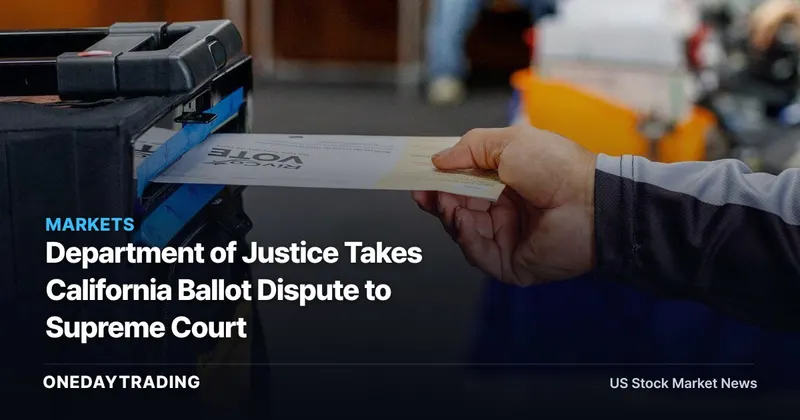
The Department of Justice asked the Supreme Court to temporarily stop California from counting challenged mail-in ballots associated with about 20,000 voters, CNBC reported in material published 2026-11-02. The request arrived a day before Election Day, making the court’s next procedural step the immediate point of uncertainty for investors following the midterm elections and control of both chambers of Congress.
The central analytical point is narrow: this is a live election-law dispute, not evidence of a confirmed change in an election result or a measurable effect on any listed company. The facts establish an emergency request, two lower-court decisions against the Department of Justice’s requested relief and several unresolved questions. They do not establish whether the challenged voters are U.S. citizens, whether their ballots were counted or how the litigation will end.
What the Supreme Court Has Been Asked to Decide
A temporary block would pause California’s counting of the challenged ballots while the dispute proceeds. It would not, on the supplied facts alone, establish the citizenship status of any voter or decide the final outcome of the underlying litigation.
The Department of Justice reached the Supreme Court three days after the 9th Circuit U.S. Court of Appeals rejected its attempt to overturn the District Court ruling that permitted the ballots to be counted. That sequence places the focus on whether the Supreme Court acts on the petition; the fact sheet does not establish that it has done so.
D. John Sauer framed the requested pause around the difficulty of separating ballots after counting, stating: “Once California commingles the challenged ballots with lawful ones, there is no way to get the challenged ballots back.” His statement presents the Department of Justice’s case for temporary intervention. It does not resolve the disputed voters’ citizenship or prove that any challenged ballot was counted.
How the California Litigation Reached This Point
The Department of Justice sued California in U.S. District Court in Los Angeles on Oct. 15. David Carter denied its request to set aside the challenged ballots and temporarily withhold them from counting.
Carter described the dispute in voter-rights terms: “This case is about the right of every American citizen to vote in a free and fair election.” The ruling therefore left the ballots eligible for counting at that stage, while the Department of Justice continued its challenge through an appeal.
The appeal went to a three-judge panel of the 9th Circuit U.S. Court of Appeals, which denied it in a 2-1 ruling on Friday. The majority’s stated concern was direct: “There is a material risk that granting the United States its requested relief would result in disenfranchisement.” Mark Bennett and Gabriel Sanchez are identified with the appellate proceeding in the supplied record.
These rulings explain why the Department of Justice sought emergency relief from the Supreme Court. They do not supply a final judgment on the California litigation, and the fact sheet does not state that the Supreme Court endorsed either the Department’s position or the lower courts’ reasoning.
The Disputed Evidence and Competing Risks
- Scale of the challenge: CNBC reported that California’s disputed mail-in ballots relate to about 20,000 voters. D. John Sauer separately referred to more than 20,000 individuals whom the United States viewed as likely not to be U.S. citizens.
- Citizenship remains unverified: The available facts describe the voters as people who may not be U.S. citizens. They do not confirm that characterization.
- Ballot handling is contested: The Department of Justice argues that challenged ballots cannot be recovered after being combined with lawful ballots. The lower-court record identifies a competing risk that granting the requested relief could disenfranchise voters.
- Judicial status is incomplete: David Carter rejected the requested separation, and the 9th Circuit U.S. Court of Appeals denied the appeal. Whether the Supreme Court acted on the petition is unknown.
Los Angeles County appears in the dispute alongside a list prepared by the Department of Homeland Security, according to the supplied account. The record provided here does not establish that the list conclusively determined citizenship, so the list and the legal consequences sought from it must be treated as separate issues.
Why the Case Has Macro Relevance Without a Stock Call
The midterm elections will determine which parties hold majorities in both chambers of Congress. That gives the litigation institutional relevance, though the fact sheet provides no final election result, policy outcome, market move, company exposure, price change or sector-specific earnings channel.
For that reason, assigning a bullish or bearish direction to U.S.-listed stocks would exceed the evidence. No individual company is directly tied to the case, and the supplied facts do not support selecting a beneficiary, a victim or a representative equity ticker.
The appropriate investor stance is therefore procedural rather than directional. A Supreme Court action would update the legal status of the requested pause. Confirmation about whether the disputed ballots were counted would update the operational status. A final ruling would update the litigation status. None of those answers is available in the fact sheet.
Alaska Adds a Separate Election-Law Development
A federal judge dismissed a separate Department of Justice lawsuit concerning certification of Alaska’s U.S. Senate election result. Dan Sullivan is the Senate candidate identified in connection with that separate matter.
The California petition and the Alaska dismissal should not be merged into one inferred outcome. The supplied record confirms separate proceedings, while leaving the final result of Alaska’s U.S. Senate election unknown. It also provides no basis for concluding that either case determines the other.
Next Confirmed Checkpoints
- Supreme Court response: Check whether the justices act on the Department of Justice petition to block California’s counting temporarily.
- Ballot status: Look for confirmation of whether the challenged California mail-in ballots were counted.
- Citizenship findings: Distinguish any verified determination from the existing claim that the voters may not be U.S. citizens.
- Final case outcomes: Track the conclusion of the California litigation separately from the final result of Alaska’s U.S. Senate election.
Balanced Assessment of the California Ballot Dispute
The Department of Justice’s strongest stated argument is that counting could make later separation impossible. The counterweight is the lower courts’ refusal to grant the requested relief, including the 9th Circuit’s 2-1 ruling and the majority’s stated concern about disenfranchisement.
Neither side’s asserted risk supplies the missing facts. The Supreme Court’s action, the citizenship status of the challenged voters, the ballots’ counting status and the final California outcome remain unresolved. Until one of those checkpoints changes, the case supports a neutral market assessment and close attention to verified judicial developments, not a company-level investment conclusion.
📊 Analysis
Signal Neutral
Why The dispute has no confirmed stock-specific effect, and the Supreme Court’s response, ballot status and litigation outcome are unknown.
This article was independently written by OneDayTrading from public reporting. Read the original (CNBC)