Key Takeaways
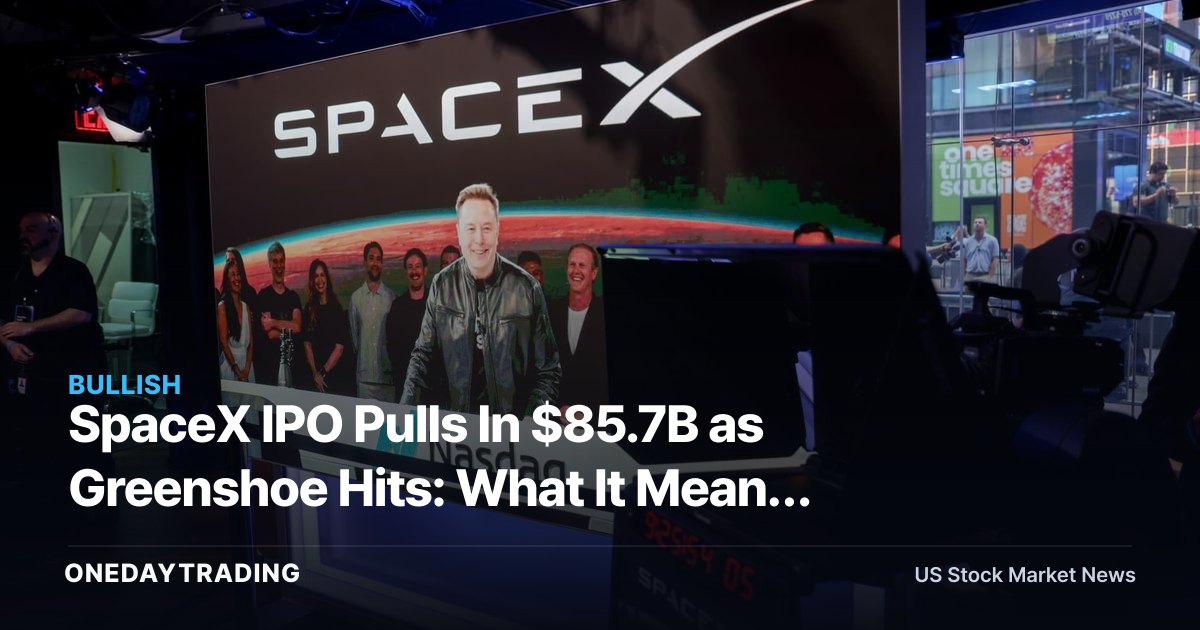
SpaceX's offering swelled to $85.7 billion after underwriters exercised the greenshoe overallotment on top of the $75 billion raised initially, one of the largest equity raises ever. The size signals deep institutional appetite for space and AI exposure, which reprices listed launch and satellite peers and creates a new benchmark against which they will be valued.
What Happened
Elon Musk's space and artificial intelligence company priced its initial public offering on Thursday at $75 billion, and the final tally rose to $85.7 billion once underwriters exercised the 15 percent greenshoe option. A fully exercised overallotment typically indicates demand outran the base deal and that bankers wanted extra shares to stabilize trading.
For a company that has spent years as the most prized name in private markets, a raise of this magnitude converts paper valuation into public-market price discovery. Every launch provider, satellite operator and component supplier now has a liquid, daily-marked comparable for reusable rockets, Starlink-style broadband and government contracting.
Background and Context
SpaceX dominates commercial launch cadence and runs the largest low-Earth-orbit broadband constellation, two businesses that listed peers chase at far smaller scale. A successful mega-IPO tends to pull capital toward the whole theme first, then force a sorting between profitable operators and cash-burning hopefuls.
Market and Stock Impact
- Rocket Lab (RKLB): The clearest listed launch comp; a richly valued SpaceX sets a multiple ceiling and floor that investors will apply to RKLB's launch plus space-systems revenue mix.
- AST SpaceMobile (ASTS) and Globalstar (GSAT): Direct-to-device and satellite-broadband names compete with Starlink for spectrum, partners and capex narrative; sentiment can swing on Starlink's disclosed economics.
- Tesla (TSLA): Musk's flagship is the most-watched proxy for his enterprises; an $85.7 billion event reshapes how the market frames his time, capital and cross-company ties.
- Intuitive Machines (LUNR): Smaller lunar and services player whose contract pipeline is judged against SpaceX's launch pricing and reliability.
Investor Checkpoints
- First-day trading and whether shares hold above the $75 billion-implied level after the greenshoe stabilization window closes.
- Any Starlink subscriber, ARPU or margin figures disclosed in the prospectus, the key variable for ASTS and GSAT comparisons.
- Launch cadence and backlog updates at RKLB's next earnings versus SpaceX-set pricing.
- Lockup expiry dates and post-IPO insider selling signals.
Outlook
The bull case is straightforward: a blockbuster raise validates the space-economy thesis and lifts the entire group's access to capital. The risk is the mirror image. A dominant, well-funded SpaceX can compress pricing and crowd out subscale competitors, and a deal priced for perfection leaves little room for disappointment if early trading fades or Starlink economics underwhelm. Position sizing should respect that the same scale that excites can also pressure margins across the peer set.
Market data check: RKLB
RKLB last traded near $106.84 (+4.35%). Our composite signal — blending price momentum and news flow — reads 🟡 neutral. Price momentum scores 85/100 (firm).
Data as of publication. Price via market feeds; for reference only, not investment advice.
📊 Analysis
Signal Bullish
Why A record $85.7B raise with a fully exercised greenshoe signals strong demand for the space and AI theme, lifting sentiment across listed launch and satellite peers.
Tickers$RKLB$ASTS$GSAT$TSLA$LUNR
This article was independently written by OneDayTrading from public reporting. Read the original (CNBC)