What Changes
Putin’s remarks create a diplomatic headline without supplying a ceasefire timetable, negotiating framework or enforcement mechanism. NATO’s warning supplies the counterweight: the alliance sees Russian behavior as becoming more reckless, so markets have no confirmed basis to discount the security risk embedded in European defense planning.
The event is a signaling contest: Russia is presenting peace as possible while condemning Kyiv, and NATO is emphasizing risk rather than progress. That combination can restrain any immediate de-risking in defense equities because the physical requirement for surveillance, air defense and ammunition capacity does not disappear when political language turns less hostile.
Defense contractors would therefore trade on probability, not a single diplomatic phrase. A credible negotiation process could reduce urgency at the margin, while a new incident involving Russian or Ukrainian airspace could reinforce procurement priorities. The source provides no company earnings, contract awards or budget figures, so any stock reaction should be read as expectation-driven rather than fundamentals-driven.
By the Numbers
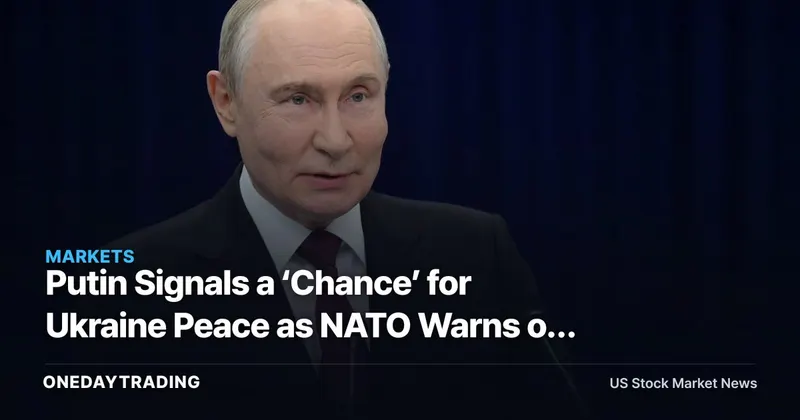
The source reports two qualitative signals rather than a new market statistic. Vladimir Putin described peace with Ukraine as still possible, while NATO’s chief characterized Russia as increasingly reckless; the contrast is the investable fact.
Putin also called Kyiv’s warning on Russian airspace state terrorism. That language raises the political cost of compromise and makes headline volatility more likely even without a confirmed change in military posture.
Winners & Losers
- European defense sector: Continued NATO concern supports the strategic case for air-defense, intelligence and munitions investment, although the source gives no order or revenue data.
- Defense-budget beneficiaries: Contractors exposed to alliance procurement could retain a risk premium while NATO describes Russia as increasingly reckless; the premium is vulnerable to a verified de-escalation process.
- European industrial planners: A genuine peace framework could improve visibility for civilian investment and reduce geopolitical risk, but Putin’s accusation against Kyiv complicates that scenario.
- Broad risk assets: A credible diplomatic channel could ease the geopolitical discount, while renewed airspace tension would push investors back toward defensive positioning.
Risk Check
- No ceasefire date, terms or verification process were reported, so “peace remains possible” is not equivalent to an actionable settlement.
- NATO’s warning that Russia is becoming increasingly reckless leaves open the possibility that rhetoric and military behavior diverge.
- Putin’s state-terrorism accusation could harden negotiating positions and produce sharper headline swings.
- Without company-specific results or contracts, defense-stock moves can outrun measurable cash-flow changes.
Bottom Line
Putin’s peace signal can support a tactical relief trade, but NATO’s recklessness warning prevents a clean withdrawal of the defense-risk premium. The next meaningful checkpoint is a concrete negotiating step—such as a ceasefire framework or verification plan—alongside any new airspace incident that would quickly reset expectations.
FAQ
What did Putin say about peace with Ukraine?
Vladimir Putin said peace with Ukraine remains possible, according to the source’s report. Putin simultaneously accused Kyiv of engaging in what he called state terrorism over a warning related to Russian airspace.
Why is NATO warning that Russia is becoming increasingly reckless?
NATO’s chief said Russia is becoming increasingly reckless, signaling that the alliance still views escalation risk as active. The statement offsets the diplomatic impact of Putin’s peace language because it does not confirm a change in Russian conduct.
What does the Ukraine peace signal mean for defense stocks?
A credible peace process could reduce the urgency investors assign to some defense spending assumptions, while continued NATO concern would support demand for security capacity. The source contains no contractor earnings, contracts or valuation figures, so any immediate stock move would reflect geopolitical expectations rather than reported fundamentals.
📊 Analysis
Signal Neutral
Why Putin’s peace language introduces potential de-escalation, but the absence of concrete terms and NATO’s risk warning prevent a directional fundamental conclusion for listed stocks.
This article was independently written by OneDayTrading from public reporting. Read the original (CNBC)