At a Glance
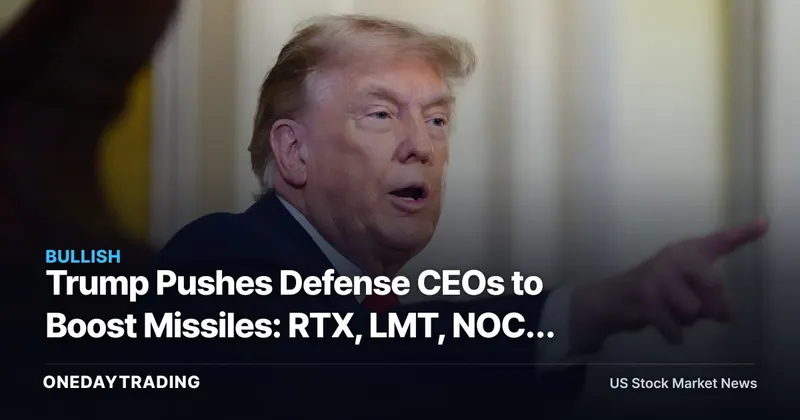
President Trump's meeting with defense chief executives, aimed at lifting missile and munitions production as Iran-related operations draw down U.S. weapons stockpiles, reframes the demand story for the prime contractors. The signal is not a single contract but a structural one: the Pentagon's industrial base is being told to build capacity, and capacity expansion is where multi-year backlog and margin durability come from.
Why It Matters Now
Interceptors and precision munitions are consumables. When they are fired in real operations, they have to be replaced, and replacement orders flow to a narrow set of suppliers. The companies that dominate air-defense interceptors and guided munitions stand to convert a stockpile shortfall directly into book-to-bill above one, which is the metric investors use to judge whether revenue is being refilled faster than it is recognized.
The deeper point is who owns the production lines. Raytheon's parent and Lockheed Martin sit at the center of interceptor manufacturing, while General Dynamics anchors artillery and tactical munitions. A White House push to expand output tends to favor incumbents with existing, certified lines because new entrants cannot qualify munitions quickly. That competitive moat is exactly why a stockpile-replenishment cycle accrues disproportionately to the primes rather than spreading evenly across the sector.
The channel to watch is the budget and supplemental-funding mechanism. Production-rate increases need appropriated dollars and multi-year procurement authority; without those, CEO commitments stay aspirational. The催alyst for the stocks is the conversion of political pressure into funded, contractual demand.
FAQ
- Why do defense stocks react to stockpile concerns? Depleted munitions must be replaced, creating order flow that lands almost entirely with a few qualified producers.
- Is this already priced in? Partly — defense names have run on geopolitical risk, so valuation leaves less room for disappointment if funding lags.
- Who benefits most? Makers of interceptors and precision munitions with existing production lines, since capacity, not design, is the bottleneck.
- What is the main risk? Political pressure that is not backed by appropriated multi-year funding can fade without translating into booked revenue.
Related Stocks & Sectors
- RTX — Air-and-missile-defense interceptors put it at the core of any replenishment push; revenue mix is heavily defense and munitions.
- LMT — Interceptor and missile programs make it a direct beneficiary of rate increases, with a large existing backlog.
- GD — Ordnance and tactical-munitions lines benefit if the order extends from interceptors to artillery and shells.
- NOC — Munitions, solid rocket motors, and missile components give it upstream exposure to higher output.
- LHX — Subsystems and munitions content provide secondary leverage to a broad production ramp.
What to Watch
- Whether the administration's push is matched by a funded supplemental or multi-year procurement request, the real demand trigger.
- Book-to-bill and backlog figures in the next quarterly results from RTX, LMT, and GD.
- Management commentary on production-rate guidance for interceptors and munitions on upcoming earnings calls.
- The trajectory of Iran talks, since a de-escalation could slow the replenishment urgency.
Overall Outlook
The bull case is straightforward: a stockpile shortfall plus a White House mandate to expand output points to a sustained, incumbent-favoring replenishment cycle for the primes. The counterweight is timing and funding. Defense valuations already embed geopolitical premium, the orders depend on appropriations that move slowly, and any diplomatic thaw with Iran could ease the pressure that is driving the narrative. The deciding variable is whether political will becomes contracted, funded demand on the production lines.
Market data check: RTX
RTX last traded near $185.06 (-0.71%). Our composite signal — blending price momentum and news flow — reads 🟡 neutral. Price momentum scores 44/100.
Data as of publication. Price via market feeds; for reference only, not investment advice.
📊 Analysis
Signal Bullish
Why A White House push to expand missile and munitions output amid stockpile depletion points to a replenishment demand cycle favoring incumbent defense primes.
Tickers$RTX$LMT$GD$NOC$LHX
This article was independently written by OneDayTrading from public reporting. Read the original (CNBC)