At a Glance
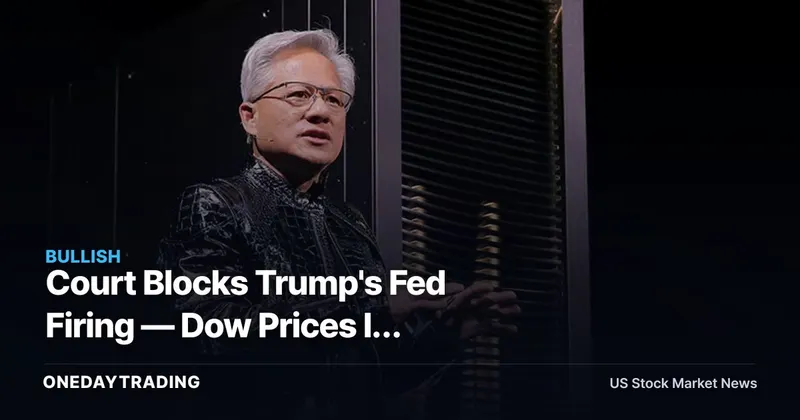
A federal court blocking the Trump administration from removing Federal Reserve officials handed equity markets a meaningful tailwind on Monday, with the Dow advancing as one of the most structurally consequential tail risks of the cycle partially unwound. The session's split tape — blue-chip strength against Nvidia sliding toward a pivotal technical level — reflects two distinct re-pricing events running in parallel, not a single coherent macro trade.
Why It Matters Now
Central bank independence is not an abstraction — it is the credibility floor under every discount rate, and therefore under every equity multiple. When the plausibility of politically driven Fed leadership removal entered the market's risk calculus, term premiums widened and the equity risk premium rose proportionally. Monday's ruling does not alter the Fed's actual rate path by a single basis point, but it narrows the uncertainty band around what that path can plausibly be. The Dow's advance is a valuation restoration, not a growth upgrade: investors are willing to pay a marginally higher multiple when the institution setting the discount rate is perceived as insulated from executive override.
The distinction matters because what the tape is not pricing is an accelerated easing cycle. Paradoxically, the ruling secures the Fed's ability to hold rates at restrictive levels without political interference — which is precisely the condition markets need to trust that the next cut, whenever it arrives, reflects genuine disinflationary progress rather than forced accommodation. That read is cleaner positive for financials and rate-sensitive sectors whose valuations hinge on credible policy signals. For long-duration growth equities, the read is more mixed: certainty about the path is good, but certainty about a higher-for-longer path is not a multiple expander.
Nvidia's concurrent slide to a key technical level adds a separate, important data point. In a session where macro risk compresses, AI hardware names should benefit from multiple expansion alongside the broader tape. That they did not signals that profit-taking or position rotation specific to Nvidia is applying downward pressure independently of the macro tailwind. Whether the current support level holds determines whether this is orderly consolidation within an intact AI capex cycle or the beginning of a more meaningful valuation reset across the semiconductor complex.
FAQ
- What did the court specifically block? The court prevented the Trump administration from removing Federal Reserve officials, reinforcing the legal framework that insulates Fed leadership from executive interference — a protection markets treat as load-bearing for rate policy credibility.
- Why does Fed independence move stock prices? The Fed's authority to set rates on economic data rather than political direction anchors inflation expectations and reduces the risk premium embedded in long-duration assets. When that authority is in legal dispute, multiples compress; when confirmed, that uncertainty premium dissolves.
- Why is Nvidia falling while the Dow rises? The two moves are not in conflict — they reflect different risk factors. The Dow reprices macro institutional certainty; Nvidia faces sector-level technical pressure and position unwinding independent of the broader improvement.
- What is the single biggest risk to Monday's move? A successful appeal of the ruling reinstates the institutional risk premium the market just shed, potentially at a moment when AI-sector names are already showing technical fragility — compounding two negative signals at once.
Related Stocks & Sectors
- NVDA: The most direct single-name read from the session — testing a key technical support while the macro backdrop improves; if the level breaks, broader semiconductor sentiment deteriorates regardless of AI capex demand fundamentals.
- JPM, BAC: Major banks are direct beneficiaries of rate-policy credibility — a predictable Fed path anchors net-interest-margin forecasting and reduces credit-market volatility, improving earnings visibility heading into the next reporting cycle.
- Regional Banks: More sensitive to the long end of the curve than money-centers; Fed independence confirmation compresses the policy uncertainty premium that had been steepening their cost of funds assumptions.
- AI/Semiconductor Sector: Nvidia's slide warns that AI hardware valuations carry their own gravity regardless of macro improvement; AMD and other infrastructure names face correlated downside risk if Nvidia fails to hold current support.
What to Watch
- Nvidia technical level: Whether NVDA holds or breaks current support this week will signal whether semiconductor positioning is in consolidation or active de-risking — the outcome drives direction for the broader SOX index.
- Appeal timeline: Any move by the administration to fast-track an appeal of the court ruling would restore the institutional uncertainty premium the market just priced out, with rates and rate-sensitive equities the first to re-reprice.
- Next CPI print: With Fed independence reaffirmed, the next inflation report becomes a clean read on the actual rate path — free of executive override noise. A hot print reopens the higher-for-longer case and tests today's multiple expansion.
- FOMC communications: Now operating under confirmed independence, any shift in Fed language will carry cleaner signal. Chair Powell's next scheduled remarks deserve extra weight given the institutional context just established by the court.
Overall Outlook
The bull case is structurally sound: removing a tail risk with no clean historical precedent restores a credibility premium that directly supports equity multiples, particularly for financials and any sector sensitive to the term structure of rates. A Fed that can set policy on economic merit — whether that means holding, hiking, or cutting — is more valuable to long-duration assets than one perceived as operating under executive pressure in either direction. The Dow's move prices exactly that restoration, not an imminent pivot.
The risk is equally concrete. A successful appeal reverses Monday's compression in institutional risk premium at a moment when Nvidia and the AI trade are already exhibiting technical fragility. If legal uncertainty returns while the AI sector's leading name breaks key support, the session's divergent signals could converge into a unified selloff. Separate the macro tail-risk relief from any rate-cut thesis: Monday's ruling secures the Fed's independence — not an easier stance.
📊 Analysis
Signal Bullish
Why Judicial preservation of Federal Reserve independence removes a structural uncertainty premium from equity markets, directly supporting the Dow's advance and improving rate-policy credibility for rate-sensitive sectors.
This article was independently written by OneDayTrading from public reporting. Read the original (Yahoo Finance)