Jamie Dimon’s Conditional Trade Proposal at a Glance
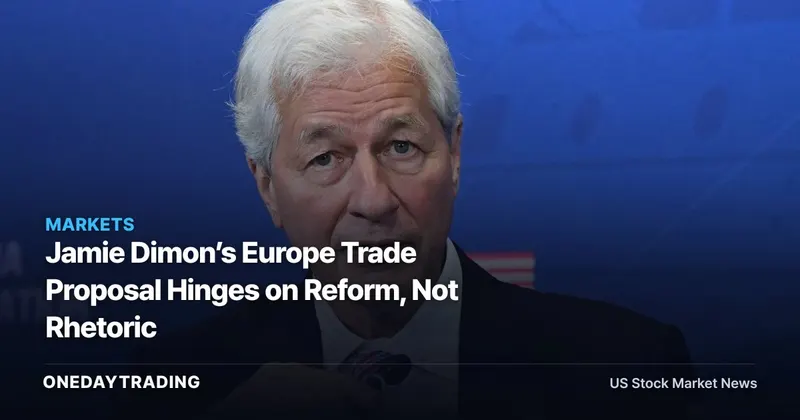
Jamie Dimon, the boss of JPMorgan Chase, proposed that the U.S. negotiate a major economic and free-trade agreement with Europe if Europe carries out meaningful economic and military reforms. CNBC presented the proposal in an article dated 2026-09-29, after Dimon published it in a Wall Street Journal opinion piece.
For investors, the important word is conditional. The proposal connects broader trade integration to changes in European capital markets, banking, defense, manufacturing and energy independence. It does not establish that negotiations will begin, that the required reforms will occur or that JPMorgan Chase will receive a measurable financial benefit.
Why Jamie Dimon Put European Reform Before a Trade Deal
The proposed agreement is a reform-for-access framework: Europe would make economic and military changes, and the U.S. would then negotiate a broad economic and free-trade pact. That sequence separates the idea from an approved trade policy. It also makes European implementation, rather than the scale of Dimon’s language, the first test of whether the proposal can move toward reality.
Dimon urged the European Union to complete its Capital Markets Union and Banking Union and fulfill the recommendations of the Draghi report. Capital Markets Union and Banking Union refer here to the European Union initiatives that Dimon wants completed as part of a wider competitiveness agenda.
He also called for stronger European defense, manufacturing and energy independence. These demands make the proposal wider than a conventional discussion of trade barriers: the stated conditions span the way Europe mobilizes capital, supports physical production and strengthens its military and energy position.
Dimon framed the potential prize in generational terms. CNBC reported that Jamie Dimon said renewed American values and alliances, combined with bold European reforms, could secure the Western world’s strength for the next 250 years.
The 250-Year Ambition Versus the Investable Evidence
The 250-year vision attributed by CNBC to Jamie Dimon describes the Western world’s prospective strength, not the duration or guaranteed result of a signed agreement. It is a statement of ambition, and investors should not convert it into a forecast for trade volumes, bank earnings or economic growth.
The investable thesis therefore has two layers. The strategic layer is broad: a U.S.-Europe agreement could connect trade negotiations with more integrated European banking and capital markets. The security layer is equally explicit: Dimon wants Europe to reinforce defense, manufacturing and energy independence.
Neither layer currently supplies the inputs required for company-level modeling. The fact sheet provides no detailed terms, timetable or quantified economic impact, and it does not identify which specific reforms would satisfy the conditions. Any estimate of revenue, margins, capital requirements, market share or valuation would go beyond the available evidence.
That gap matters especially for JPMorgan Chase. Dimon’s role makes the bank the central listed company associated with the story, while the proposal itself is a policy argument published in the Wall Street Journal. It is not a disclosed JPMorgan Chase operating target, financial forecast or transaction.
The Core Debates Inside Dimon’s U.S.-Europe Framework
- Reform before negotiation: Dimon’s plan asks Europe to undertake meaningful economic and military reforms before the U.S. negotiates the proposed agreement. The unresolved issue is what would count as sufficient implementation.
- Capital integration: Completion of the European Union’s Capital Markets Union and Banking Union is central to his prescription. The proposal offers no timetable for either initiative.
- Economic breadth: Defense, manufacturing and energy independence sit beside banking and capital-market reform. That breadth may increase the plan’s strategic reach while also creating more conditions that would need to be addressed.
- Political adoption: The fact sheet does not establish that the U.S. or Europe will adopt the proposal. Until either side acts, the plan remains advocacy rather than policy.
JPMorgan Chase and the Sectors Directly Named
- JPMorgan Chase: JPM is the directly connected U.S.-listed company because Dimon is its boss. The connection supports monitoring the stock in relation to the debate, but the available facts do not establish an earnings, capital or revenue consequence for the bank.
- Banks and capital markets: Dimon specifically called for completion of the European Union’s Banking Union and Capital Markets Union. These are policy channels in the proposal, not documented financial catalysts for a named company.
- Defense and manufacturing: Stronger European capabilities in both areas are explicit reform objectives. No individual defense or manufacturing company is identified, so assigning company-specific beneficiaries would be unsupported.
- Energy: European energy independence is another stated condition. The evidence does not specify technologies, projects, suppliers or investment amounts.
The proposal could also expand beyond Europe. Dimon said a future pact could include Canada, Mexico, Japan, South Korea, Australia and the Philippines. That list defines the possible geographic reach; it does not confirm participation by any of those countries.
What Would Turn Dimon’s Proposal Into a Market Signal
- Formal U.S. engagement: Look for evidence that the U.S. has chosen to negotiate the proposed agreement, rather than relying on the Wall Street Journal opinion piece as a policy commitment.
- European action: Track whether the European Union completes its Capital Markets Union and Banking Union and advances the Draghi report recommendations identified by Dimon.
- Defined reform conditions: A concrete list of acceptable economic and military reforms would clarify the threshold Europe must meet.
- Negotiating substance: Detailed terms, a timetable and a quantified economic assessment would be necessary before investors could evaluate effects across banking, defense, manufacturing or energy.
Outlook for Jamie Dimon’s Europe Trade Thesis
The constructive case is straightforward. A broad agreement, if pursued after the requested reforms, could connect closer U.S.-Europe trade ties with deeper European capital markets and stronger defense, manufacturing and energy capabilities. Extending the pact to the named friendly democracies would enlarge the framework envisioned by Dimon.
The countercase is equally important: none of those outcomes is confirmed. Adoption by the U.S. and Europe is unknown, the qualifying reforms are not fully specified, and the agreement lacks detailed terms, timing and quantified impact.
For JPM investors, the disciplined reading is neutral. Dimon has supplied a strategic thesis, not a bank-specific earnings catalyst. The signal changes only when governments define the conditions, Europe demonstrates the requested reforms, or negotiations produce terms that can be connected to actual corporate economics.
📊 Analysis
Signal Neutral
Why The proposal could broaden long-term economic integration, but it has no confirmed adoption, timetable, detailed terms or quantified impact on JPMorgan Chase.
This article was independently written by OneDayTrading from public reporting. Read the original (CNBC)