What Changes
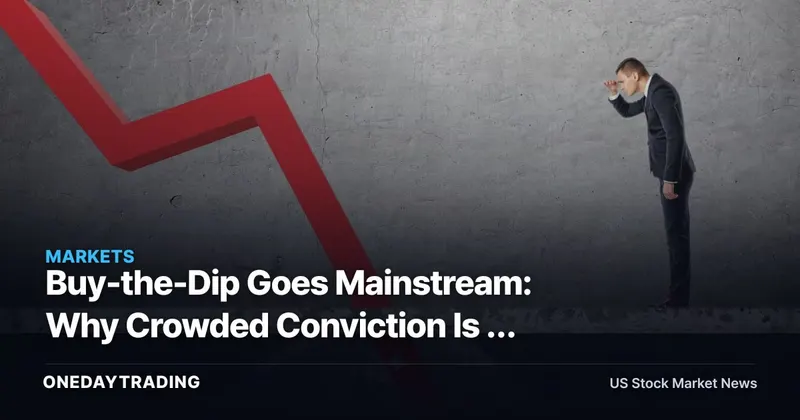
The interesting part of this story is not the math of any single trade but the positioning it reveals. When every investor is conditioned to treat every pullback as a gift, sellers disappear at exactly the moments when discipline matters most. That dynamic compresses the depth and duration of corrections, which is precisely what makes dip-buying feel infallible — until a drawdown does not bounce on schedule.
For holders of broad index vehicles such as SPY, VOO and QQQ, the practical implication is about how new money is deployed. A dip-buying habit implies holding cash on the sidelines waiting for a decline. In a market that grinds higher, that idle cash is an opportunity cost: the investor sits out gains while waiting for a discount that may be shallow or never arrive. Over a full cycle, that timing tax is what causes the strategy to lag a fully invested approach.
The structural signal here is complacency. A market where dip-buying is the consensus reflex is a market with thinner risk premia and less natural hedging, leaving it more exposed if a shock turns an ordinary pullback into a sustained repricing.
By the Numbers
The source frames its conclusion qualitatively rather than with a single headline figure: it asserts that dip-buying underperforms the broad stock market over the long term despite feeling like free money. The mechanism is the gap between staying invested and waiting in cash — every dollar held back for an entry that does not come forfeits compounding, and that shortfall accumulates across years rather than showing up in any one trade.
Winners & Losers
- Buy-and-hold index funds (VOO, SPY) — relatively favored, because full-time exposure captures the long upward drift that dip-timers partially miss while holding cash.
- Cash-heavy tactical investors — disadvantaged in a trending market, since their reserved capital earns money-market yield instead of equity returns.
- High-beta growth (QQQ) — most sensitive to the complacency signal, because crowded dip-buying inflates valuations and amplifies the downside if conviction cracks.
- Volatility and hedging products — structurally cheap when nobody fears a real correction, which is when protection is least expensive to own.
Risk Check
- This is an opinion and behavioral argument, not a dated catalyst — there is no earnings print or policy date to act on.
- Buy-and-hold also suffers in genuine bear markets; the comparison favors it only across full cycles, not every window.
- Crowded positioning can persist far longer than it looks sustainable, so complacency is a poor market-timing signal on its own.
- The conclusion depends on the path of returns; a market that does see deep, frequent dips would reward disciplined buyers.
Bottom Line
The value in this argument is the reminder that a strategy stops paying once everyone runs it — the edge in dip-buying came from being early and contrarian, not from the act itself. For long-horizon investors, the cleaner lesson is to keep new capital working rather than hoarding it for a discount that consensus has already arbitraged away, while accepting that the same complacency could keep this market rising well past the point skeptics expect.
📊 Analysis
Signal Neutral
Why The piece is a behavioral critique of a crowded strategy rather than a directional catalyst for any specific stock or the index.
This article was independently written by OneDayTrading from public reporting. Read the original (MarketWatch)