Summary
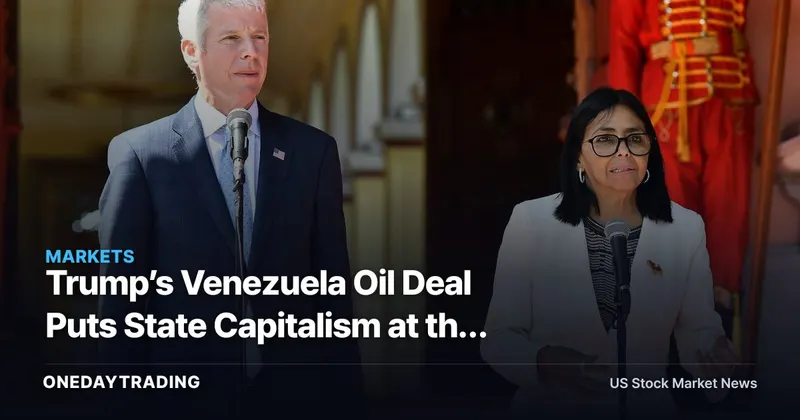
Trump’s unprecedented Venezuela deal matters because it brings direct U.S. state involvement into an oil industry shaped by sanctions, regime change and control of national resources. The immediate investment question is not a production forecast—the source provides none—but whether Washington’s new role changes who controls Venezuelan barrels and how private oil companies compete for access.
The agreement arrives eight months after Washington removed former President Nicolás Maduro in a military raid. That timing links the commercial arrangement to a political transition, making policy authority and execution risk as important as crude economics.
The Full Story
The Venezuela deal represents state capitalism at the wellhead: the U.S. government is no longer only setting rules for the oil market, but is directly associated with a country-level commercial arrangement. The source does not disclose the deal’s financial terms, production targets, participating companies or sanctions timetable, so investors should separate the confirmed political mechanism from assumptions about additional supply.
That distinction matters for oil equities. Producers, refiners and oilfield-service firms benefit from reliable access to crude only when contracts, infrastructure and payment channels function. A headline agreement can improve the strategic outlook while leaving operating cash flow unchanged until shipments, ownership rights and project decisions are documented.
Structural Background
Venezuela is being repositioned through a U.S.-backed political framework after Maduro’s removal in a military operation. The eight-month gap between the raid and the deal suggests that Washington treated political control as a prerequisite for commercial terms, rather than announcing an ordinary licensing change.
For the oil market, the structural issue is governance. State participation can accelerate capital and market access, but it can also impose political conditions that private operators cannot price from a standard supply contract. The source gives no evidence that Venezuelan output has changed, so any immediate crude-price reaction would reflect expectations rather than reported barrels.
Stock & Sector Ripple
- U.S. integrated oil companies: Exxon Mobil and Chevron could gain strategic relevance if the agreement eventually opens investment or trading channels, but neither company is named in the source and no award should be inferred.
- Oilfield services: Halliburton and SLB would need actual drilling or maintenance orders before the deal affects revenue; a political announcement alone does not create utilization.
- Refiners: Valero and Marathon Petroleum could benefit from new heavy-crude availability only if Venezuelan shipments resume through enforceable, compliant channels.
- Oil prices: Additional Venezuelan supply would normally pressure prices, while implementation delays or renewed geopolitical friction would support a risk premium. The source confirms neither outcome.
Bull vs Bear Scenarios
The bullish case is a durable U.S.-managed framework that converts political control into transparent contracts, restored logistics and incremental Venezuelan supply. That outcome would broaden feedstock options for refiners and create a clearer capital path for oil operators.
The bear case is that state control substitutes for commercial certainty. Disputes over ownership, sanctions, security or revenue allocation could delay investment, leaving the deal as a geopolitical signal rather than an operating catalyst. Oil stocks could then trade on headline volatility without measurable earnings impact.
Investor Action Points
- Track the next formal release for named companies, contract terms, sanctions treatment and payment rules.
- Look for evidence of physical execution: export cargoes, refinery intake and disclosed production changes.
- Compare crude-price moves with company guidance; do not treat a Venezuela headline as an earnings estimate.
- Monitor the next policy announcement from Washington for enforcement details and ownership rights.
FAQ
What is Trump’s Venezuela oil deal?
Trump’s Venezuela oil deal is described by CNBC as an unprecedented U.S. state-capitalist arrangement involving the Venezuelan oil industry. The source does not provide financial terms, production volumes or participating companies.
Why does the Venezuela deal matter for oil stocks?
The agreement could affect oil stocks by changing access to Venezuelan crude, investment rights and sanctions compliance. Those effects require documented contracts and physical shipments before they can be translated into revenue or margins.
When could Venezuelan oil affect prices?
Venezuelan oil would affect prices only after the agreement changes actual exports or market expectations about future supply. The source reports no production increase, so the current signal is political rather than a measured supply shock.
📊 Analysis
Signal Neutral
Why The deal is strategically significant, but the source provides no terms, companies or production data to establish a directional earnings impact.
This article was independently written by OneDayTrading from public reporting. Read the original (CNBC)