Summary
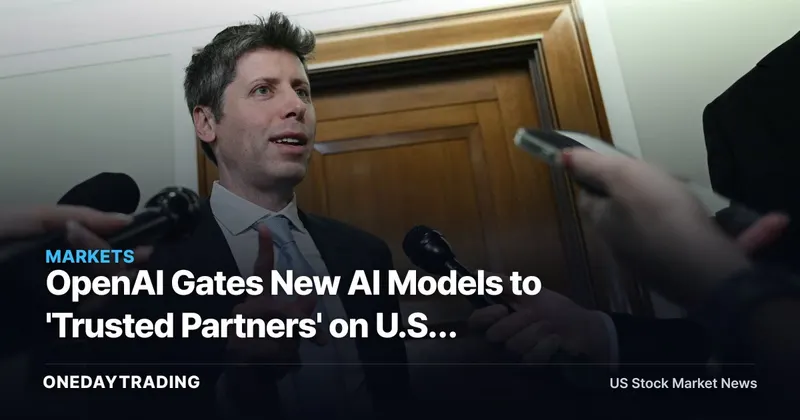
OpenAI confirmed it is limiting access to its newest AI models to a circle of trusted partners, acting at the request of the U.S. government and after previewing the models' capabilities with officials before launch. The move signals that frontier AI is crossing from open commercial release into a controlled, security-screened regime. For public-market investors, the read-through runs straight to OpenAI's closest listed proxy, Microsoft, and to the silicon layer underneath.
The Full Story
OpenAI is not a listed company, so the cleanest way to trade this is through the firms that monetize its models and supply its compute. The decision to gate new releases — rather than push them broadly to developers and enterprises — narrows the funnel through which capability reaches the market. That concentrates value with the few partners deemed trusted, and Microsoft, OpenAI's primary commercial and cloud partner, sits first in line.
The detail that OpenAI previewed the models with the government ahead of launch matters more than the restriction itself. It establishes a precedent: frontier models now ship only after a national-security screen. That raises the compliance bar for every lab and reframes model access as a policy-controlled asset rather than a pure product decision.
The dependency that does not change is compute. Whether a model is broadly released or restricted to vetted partners, it still must be trained and served on accelerators. That keeps Nvidia's GPUs and the broader AI infrastructure stack — networking, memory, data-center capacity — central to the thesis regardless of who is allowed to use the output.
Structural Background
Washington has steadily tightened its grip on advanced AI, treating frontier capability as dual-use technology adjacent to export controls already imposed on high-end chips. A government preview before launch extends that logic from hardware to the models themselves, formalizing the state as a gatekeeper at the top of the AI value chain.
Stock & Sector Ripple
- Microsoft (MSFT) — As OpenAI's anchor partner and exclusive cloud provider, restricted access concentrates distribution through Azure and Copilot, reinforcing its position even as it ties Microsoft tighter to OpenAI's regulatory exposure.
- Nvidia (NVDA) — Demand for training and inference compute is agnostic to who can use the model; gated access does not reduce the GPU intensity of building frontier systems.
- Alphabet (GOOGL) — A more controlled OpenAI rollout opens commercial room for rival frontier labs that pursue broader developer access.
- Broadcom (AVGO) — Custom AI silicon and networking demand tracks data-center buildout, insulated from model-access policy.
- Cybersecurity and compliance vendors — A national-security screening regime raises the value of governance, audit and secure-deployment tooling around AI.
Bull vs Bear Scenarios
Bull: gating elevates trusted partners into a privileged tier, deepening moats for Microsoft and keeping compute demand intact for Nvidia while raising barriers for less-connected challengers. Bear: policy-controlled releases slow the commercialization cadence that has driven AI revenue expectations, and a screening precedent could throttle the pace of model deployment that the current AI multiple is built on — a real risk if restrictions widen across the industry.
Investor Action Points
- Watch how broadly OpenAI defines trusted partners and whether the list extends beyond Microsoft — distribution breadth is the key variable.
- Track Microsoft's next quarterly commentary on Azure AI and Copilot adoption for evidence the partnership advantage is converting to revenue.
- Monitor Nvidia's data-center guidance for any sign that model-access curbs are denting accelerator demand — so far they should not.
- Follow whether U.S. regulators formalize pre-launch model review into policy, which would reset the timeline assumptions baked into AI valuations.
Market data check: MSFT
MSFT last traded near $372.97 (+5.71%). Our composite signal — blending price momentum and news flow — reads 🟡 neutral. Price momentum scores 95/100 (firm).
Data as of publication. Price via market feeds; for reference only, not investment advice.
📊 Analysis
Signal Neutral
Why Gated access concentrates advantage with trusted partners like Microsoft and leaves compute demand intact, but a government-screening precedent could slow industry-wide commercialization — cross-currents leave net direction unclear.
Tickers$MSFT$NVDA$GOOGL$AVGO
This article was independently written by OneDayTrading from public reporting. Read the original (CNBC)