Summary
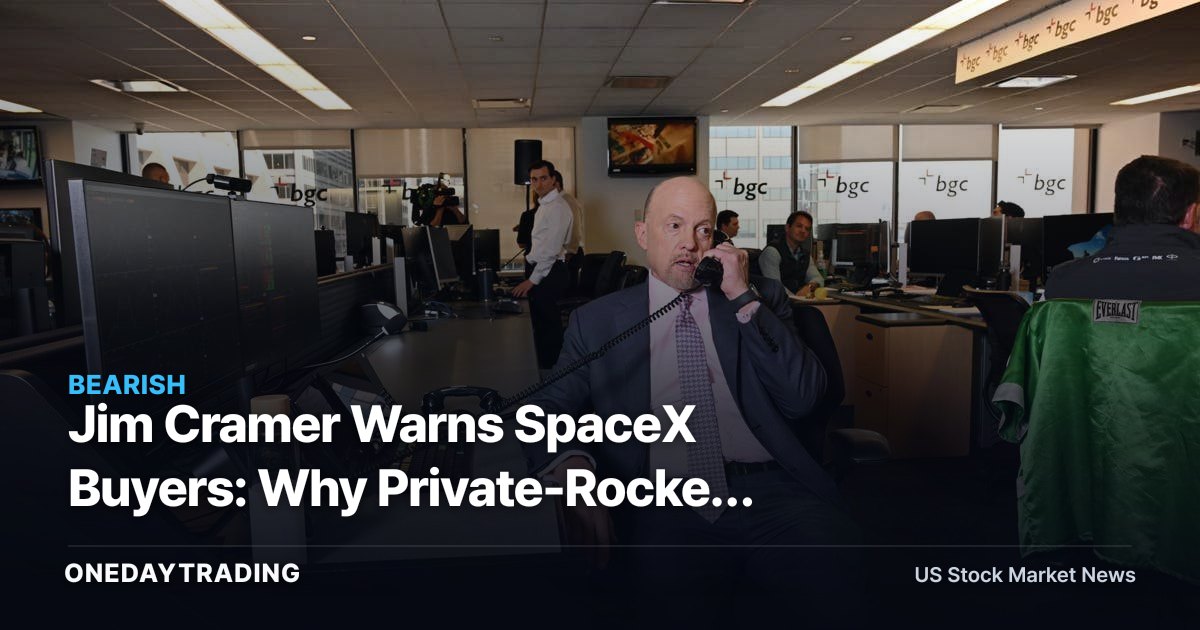
Jim Cramer issued a pointed warning to investors trying to buy into SpaceX, and the message matters because SpaceX is not a publicly traded company. The practical takeaway for retail traders is that the risk does not live in SpaceX itself but in the listed vehicles people use to fake exposure to it.
Those proxies can trade far above the value of what they actually hold, turning a bet on rockets into a bet on crowd psychology.
The Full Story
SpaceX is one of the most sought-after private companies in the world, yet ordinary investors cannot buy its shares on any U.S. exchange. That gap between demand and access is exactly what Cramer is flagging. When a name is this famous and this inaccessible, money tends to flow into whatever ticker is loosely associated with it, regardless of whether the underlying math supports the price.
The danger is structural. Closed-end and venture-style funds that hold small slices of SpaceX can detach from the value of their portfolios, with buyers paying a premium for the privilege of saying they own a piece of the story. A stern message from a high-profile commentator like Cramer typically targets this behavior: chasing access rather than valuation.
For an international retail audience, the lesson is that proximity to a hot private name is not the same as owning it. A fund may hold only a fractional position in SpaceX while its share price moves on headlines, not fundamentals.
Structural Background
Private companies stay private for a reason, and that means no quarterly filings, no audited earnings cadence, and no liquid market to anchor a fair price. Vehicles that offer indirect exposure fill the vacuum, but they introduce their own layer of risk: premium-to-net-asset-value swings, limited disclosure on holdings, and thin liquidity that can amplify both rallies and reversals.
Stock & Sector Ripple
- Destiny Tech100 (DXYZ): A listed fund known for holding private names including SpaceX. Its share price has a history of swinging well above the stated value of its assets, making it the clearest example of the premium risk Cramer is describing.
- ARK Venture and ARK ETFs (ARKK, ARKX): Cathie Wood's funds carry private allocations and space-themed baskets, so SpaceX sentiment can spill into flows even when direct exposure is small.
- Listed space and defense peers: Names like Rocket Lab (RKLB) often catch sympathy bids when SpaceX dominates headlines, despite very different revenue scale and end-markets.
- Satellite and launch supply chain: Demand narratives around Starlink and reusable launch can lift adjacent hardware and connectivity stories, but the linkage is thematic, not contractual.
Bull vs Bear Scenarios
The bull case is that SpaceX exposure, even indirect, gives retail investors a foothold in commercial space, satellite broadband, and launch dominance years before any potential public listing. If a SpaceX or Starlink IPO ever materializes, early proxy holders could be repriced higher.
The bear case is the one Cramer is pressing: paying a large premium for a sliver of a private company is a fragile trade. Premiums compress fast when sentiment cools, and there is no earnings report to catch a falling proxy. Liquidity and disclosure gaps make these vehicles unforgiving on the way down.
Investor Action Points
- Before buying any SpaceX proxy, check its premium or discount to net asset value rather than just the share price chart.
- Confirm how large the actual SpaceX position is inside the fund; a famous holding can still be a minor weight.
- Treat thinly traded, headline-driven tickers as position-size risks, not core holdings, and define an exit before entering.
- Watch for any official SpaceX or Starlink listing signals; until then, no vehicle offers clean, direct exposure.
Market data check: DXYZ
DXYZ last traded near $27.8 (-3.44%). Our composite signal — blending price momentum and news flow — reads 🟡 neutral. Price momentum scores 22/100 (soft).
Data as of publication. Price via market feeds; for reference only, not investment advice.
📊 Analysis
Signal Bearish
Why Cramer's warning targets retail investors overpaying for indirect SpaceX exposure through premium-priced proxy vehicles, a cautionary signal for those names.
Tickers$DXYZ$ARKK$RKLB$ARKX
This article was independently written by OneDayTrading from public reporting. Read the original (Yahoo Finance)