At a Glance
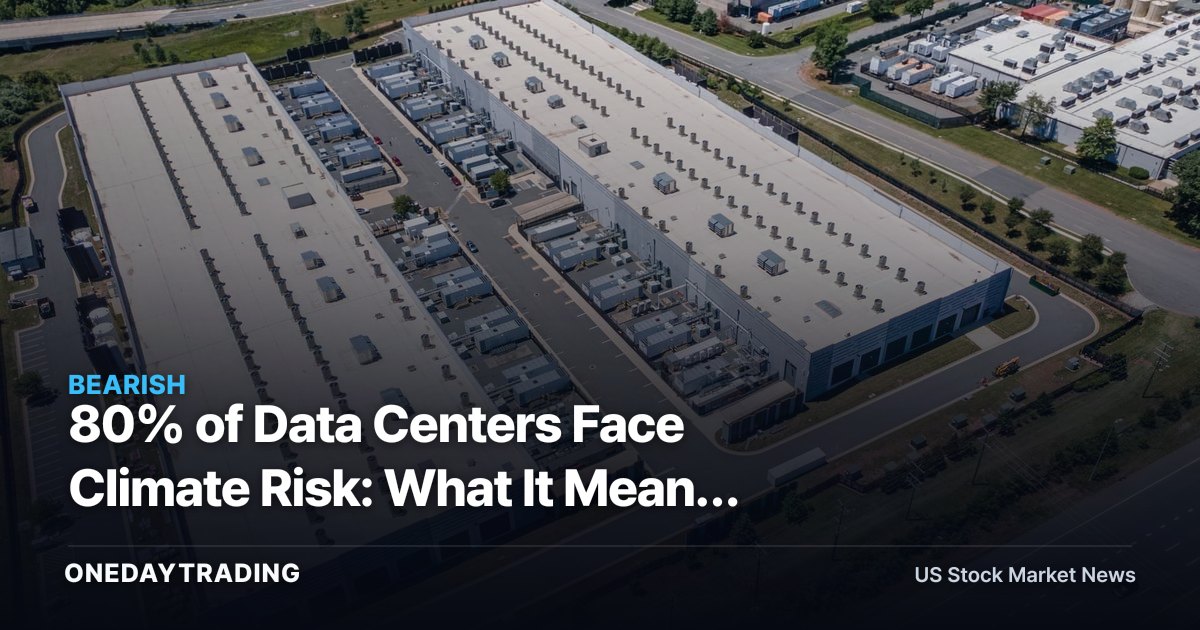
A new study finds that nearly 80% of global data center capacity sits in locations exposed to elevated climate risk, split between acute hazards such as flooding and fire and chronic stress from rising extreme heat. For investors, the takeaway is not a sudden shock but a slow repricing of operating cost, insurance and capital spending across the digital-infrastructure stack.
Why It Matters Now
Data centers are unusually sensitive to physical risk because their value depends on near-continuous uptime. A flood or fire that knocks a single facility offline can trigger service-level penalties, lost lease revenue and emergency capex, while chronic heat quietly raises the energy bill: hotter ambient air forces cooling systems to work harder, cutting the power that reaches servers and eroding the efficiency metrics landlords sell to tenants.
The timing matters because the industry is in the middle of an AI-driven build-out. New capacity is being added at a pace that pushes operators toward whatever land and power they can secure, sometimes in regions where water stress, heat or flood exposure is higher. That tension — build fast versus build resilient — lands directly on data center REITs that own the physical assets and on the hyperscalers that lease or operate them.
The channel to earnings runs through three lines: insurance premiums, which reprice with disclosed hazard exposure; cooling and power costs, which rise with heat and water scarcity; and capex, as redundancy, backup power and water-efficient cooling become table stakes rather than upgrades.
FAQ
- Is this an immediate threat to earnings? No. It is a structural cost and resilience story that shows up gradually in operating margins, insurance lines and capital budgets rather than in one quarter.
- Who is most exposed? Operators with concentrated capacity in high-hazard locations and thin redundancy, where a single outage event carries outsized financial consequences.
- Can it be mitigated? Yes — through site selection, liquid and water-efficient cooling, backup power and geographic diversification, all of which cost money up front.
- Does it change the AI demand story? Not the demand, but it raises the cost of meeting it, which pressures returns on newly built capacity.
Related Stocks and Sectors
- Equinix (EQIX) — a global colocation REIT whose contracts hinge on uptime; physical-risk disclosure and resilience capex feed directly into its cost base.
- Digital Realty (DLR) — large-footprint data center REIT exposed to both lease economics and rising cooling and insurance costs.
- Microsoft, Amazon, Alphabet (MSFT, AMZN, GOOGL) — hyperscalers whose cloud margins absorb higher energy and redundancy spending as they scale AI capacity.
- Vertiv (VRT) — a potential beneficiary, supplying the power and cooling hardware that resilience upgrades require.
What to Watch
- Operator commentary on insurance costs and physical-risk disclosure in upcoming earnings calls.
- Cooling efficiency and power-usage metrics in REIT operating updates.
- Guidance on capex tied to redundancy, backup power and water-efficient cooling.
- Order trends at cooling and power-equipment suppliers as a read on mitigation spending.
Overall Outlook
The bull case is that resilience spending is a manageable, demand-driven cost layered on top of a structurally growing AI and cloud market, and that equipment suppliers gain from it. The risk is that climate-linked insurance, energy and capex inflation compress returns on capacity built in the wrong places, with valuations on the most exposed REITs and hyperscalers leaving little room for a margin surprise. The deciding variable is execution on site selection and cooling efficiency, not headline demand.
Market data check: EQIX
EQIX last traded near $1,105.38 (+1.55%). Our composite signal — blending price momentum and news flow — reads 🟡 neutral. Price momentum scores 62/100 (firm).
Data as of publication. Price via market feeds; for reference only, not investment advice.
📊 Analysis
Signal Bearish
Why Elevated climate exposure across most data center capacity points to rising insurance, energy and capex costs that pressure margins for the most exposed operators.
Tickers$EQIX$DLR$VRT$MSFT$AMZN$GOOGL
This article was independently written by OneDayTrading from public reporting. Read the original (CNBC)