At a Glance
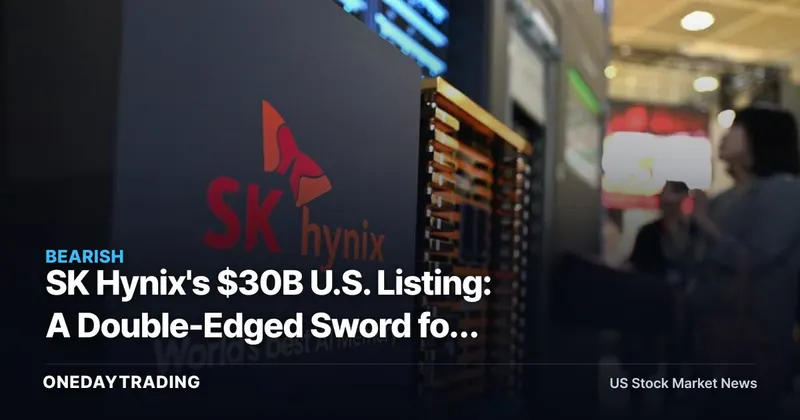
South Korean memory maker SK Hynix is reportedly weighing a U.S. listing valued near $30 billion, which would hand American investors a direct route to the world's leading high-bandwidth-memory supplier. For Micron, the only U.S.-listed pure-play memory name today, that arrival is a mixed blessing: it validates the AI-memory thesis but also creates a more visible head-to-head rival for capital.
Why It Matters Now
Micron's recent re-rating has leaned heavily on its position as the easiest way for U.S. funds to own the memory upcycle, particularly HBM tied to AI accelerators. A SK Hynix listing erodes that scarcity premium. SK Hynix is the clear HBM share leader and NVIDIA's primary qualified supplier, so investors who want the strongest exposure to AI memory demand could rotate part of their Micron allocation toward the new ticker rather than adding fresh money to the sector.
The flip side is that a high-profile $30 billion debut draws analyst and media attention to the entire memory complex, expanding the investor base and benchmark comparisons. More coverage can deepen liquidity and lift sentiment for Micron when the cycle is rising. The same spotlight cuts the other way during downturns, when side-by-side margin and HBM-share comparisons can expose Micron as the number-three player behind SK Hynix and Samsung.
This is fundamentally a competitive-dynamics and capital-flows story, not an earnings event, so the impact shows up in relative valuation and ownership rather than near-term fundamentals.
FAQ
- Is SK Hynix already U.S.-listed? No. The reported $30 billion listing is a prospective move; today Micron is the main U.S.-listed memory pure-play.
- Why would this hurt Micron? It removes Micron's scarcity value as the default U.S. memory proxy and offers a direct HBM-leader alternative.
- Why could it help Micron? A landmark listing raises sector awareness, liquidity, and the AI-memory narrative that lifts all memory names.
- Who leads HBM? SK Hynix holds the leading HBM share and supplies NVIDIA, with Micron and Samsung competing for the rest.
Related Stocks & Sectors
- Micron (MU) — loses scarcity premium as the sole U.S. memory pure-play but gains from broader sector attention.
- NVIDIA (NVDA) — benefits from a healthier, better-capitalized HBM supply chain feeding its AI accelerators.
- Semiconductors / Memory sector — a $30 billion listing reprices the DRAM and HBM peer group on relative metrics.
- Foundry and equipment names — capacity expansion signaled by a large capital raise supports memory-tool demand.
What to Watch
- Confirmation of the listing structure, timing, and final valuation versus the reported $30 billion figure.
- Micron's next earnings and HBM revenue guidance to gauge whether it is closing the share gap with SK Hynix.
- NVIDIA HBM qualification updates that show how supply is split across the three memory makers.
- Relative valuation multiples between Micron and SK Hynix once both trade on U.S. exchanges.
Overall Outlook
The bull case is that a marquee SK Hynix listing legitimizes AI memory as an investable theme, deepens liquidity, and pulls more U.S. capital toward the whole group, Micron included. The key risk is rotation: with a direct HBM-leader alternative available, Micron must defend its narrative on HBM share, margins, and execution rather than relying on being the only option. Memory remains a cyclical, capital-intensive business, so any listing-driven enthusiasm still hinges on the durability of AI-driven demand and pricing.
Market data check: MU
MU last traded near $1,048.51 (-0.31%). Our composite signal — blending price momentum and news flow — reads 🟡 neutral. Price momentum scores 48/100.
Data as of publication. Price via market feeds; for reference only, not investment advice.
📊 Analysis
Signal Bearish
Why A SK Hynix U.S. listing erodes Micron's scarcity premium as the sole U.S.-listed memory pure-play and adds a direct HBM-leader competitor for capital.
This article was independently written by OneDayTrading from public reporting. Read the original (MarketWatch)