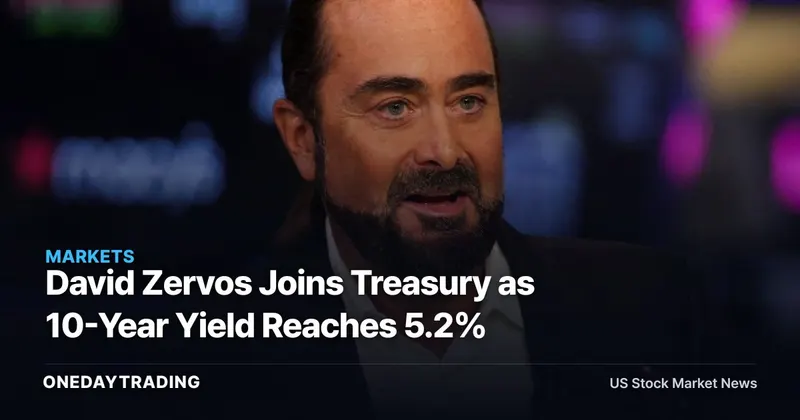
David Zervos Arrives as the 10-Year Treasury Reaches 5.2%
David Zervos is joining Scott Bessent’s Treasury Department as a counselor after the 10-year Treasury reached 5.2% Friday, giving investors a new policy voice to assess at a sensitive point for interest rates. Scott Bessent announced the appointment Monday in a statement obtained first by CNBC, which published its report on 2026-09-28. Zervos was expected to begin immediately and will advise across a broad range of issues.
The market relevance lies less in the title than in the alignment between Zervos’s publicly stated views and the questions confronting Treasury investors. He has supported increased buybacks of some long-term Treasury debt and has called for Federal Reserve interest rates to be lower. Those positions do not establish what the Treasury Department or the Federal Reserve will do, though they clarify the framework Zervos brings to the job.
What the Scott Bessent Appointment Changes
A Treasury counselor is an adviser, and this counselor position does not require Senate confirmation. Zervos will serve as a special government employee and expects his term to end in April 2027. The precise start date beyond the expectation that he would begin immediately was not provided, and the announcement did not disclose his compensation.
His appointment adds a veteran market economist to Bessent’s advisory circle. Zervos had been the longtime chief market strategist at Jefferies, where he had worked since 2010, and he was also a CNBC contributor. He described himself to CNBC as a “Wall Street geek” and called the appointment his third stint in government.
The personnel context matters because the department has experienced notable turnover. CNBC reported that Seven of 16 Treasury Department Senate-confirmed appointees had departed as of mid-August. The same reporting said Scott Bessent was working with his third chief of staff since becoming Treasury secretary in January 2025. Joseph Lavorgna, who previously held a similar counselor role, left in March.
Why David Zervos Matters to the Rates Debate
Zervos brings experience from both markets and monetary-policy institutions. He holds a doctorate in economics and has worked twice for the Federal Reserve: first in the early 1990s, conducting technical economics and interest-rate research, and again in 2009 as a visiting adviser. Kevin Warsh was at the Federal Reserve during the latter period, although whether the two worked together directly is unclear.
Donald Trump considered Zervos to lead the Federal Reserve before choosing Kevin Warsh in January. That history makes Zervos’s views relevant to investors, without giving a Treasury counselor authority over Federal Reserve decisions. The institutional distinction is essential: advice from inside Treasury can shape the policy discussion, while monetary-policy decisions remain a separate matter.
Last year, Zervos said interest rates should be “much lower.” The Federal Reserve raised interest rates earlier this month for the first time since 2023, placing his preference on the opposite side of the latest move. Bessent used more conditional language during a Sunday appearance on Fox News, saying the Federal Reserve “should have an open mind” about managing the economy.
From Treasury Buybacks to Equity Valuation
CNBC reported that the 10-year Treasury hit 5.2% Friday, a level last seen in 2007. That is the central market fact surrounding the appointment. A high long-term rate can increase the discount rate investors apply to future corporate cash flows, which may place more pressure on equities whose valuations depend heavily on earnings expected far ahead.
The transmission can also run through financing conditions. If long-term Treasury rates remain elevated, companies refinancing obligations or funding investment may face a less supportive rate backdrop. If long-term rates ease instead, the valuation and financing channels could become less restrictive. These are market mechanisms, not evidence that Zervos’s appointment by itself will produce either outcome.
Zervos endorsed Bessent’s decision to increase buybacks of some long-term Treasury debt during a CNBC appearance last month. Treasury debt buybacks involve the Treasury purchasing outstanding securities; investors will need to distinguish any effect on market functioning from a durable change in the direction of interest rates. His support signals policy alignment with Bessent on this tool, not proof of its future scale or results.
That distinction is especially important for equity investors. The tape can react to changes in long-term rates, while the appointment supplies no measured change in corporate revenue, costs or earnings. The investable signal will therefore come from what happens in the Treasury market and in subsequent policy decisions, rather than from the personnel announcement alone.
The Bull and Bear Cases for Rate-Sensitive Assets
Bull case: Zervos adds an experienced markets perspective to Treasury at a time when the 10-year Treasury stands at a stated 5.2% level. His support for buybacks of some long-term debt and his preference for lower Federal Reserve rates may strengthen internal consideration of approaches intended to address pressure in longer maturities. If observable long-term rates decline, rate-sensitive equity valuations could receive support through a lower discount rate.
Bear case: A counselor cannot determine Federal Reserve policy, and the appointment provides no evidence that long-term rates will reverse. The Federal Reserve raised rates earlier this month, while the stated 10-year Treasury level shows that investors are already confronting elevated long-term borrowing benchmarks. If that rate remains at 5.2% or moves higher, pressure through valuation and financing channels could persist regardless of Zervos’s preferences.
The neutral reading is therefore the disciplined one. Treasury has gained an adviser whose views are clear, although the market has not received a defined policy commitment, timetable or quantified program from the appointment. Directional conviction requires evidence from subsequent Treasury actions, Federal Reserve decisions and the 10-year Treasury itself.
Policy Authority and the Wider Personnel Picture
Bessent’s remit has extended beyond conventional Treasury matters. Donald Trump said Friday that Bessent would not also become the administration’s top artificial-intelligence adviser. That decision narrows one prospective role while leaving Zervos to enter Treasury in the broad advisory capacity described in the announcement.
The staff backdrop creates a separate test. Filling a counselor post brings another experienced economist into the department after the departures reported as of mid-August. It does not establish whether the broader personnel turnover has ended, so investors should avoid treating one hire as a complete answer to the department’s staffing picture.
Investor Checkpoints After the Zervos Hire
- Track the 10-year Treasury: Friday’s 5.2% level is the clearest market benchmark supplied with the announcement. Its direction will carry more information for equity valuation than the appointment alone.
- Separate advice from decisions: Watch for subsequent Treasury actions involving buybacks of some long-term debt, while recognizing that Zervos’s support does not guarantee a particular policy outcome.
- Follow Federal Reserve policy: The central bank raised interest rates earlier this month for the first time since 2023. Future decisions will show whether policy moves toward or away from Zervos’s preference for “much lower” rates.
- Monitor the defined service window: Zervos expects his special-government-employee term to end in April 2027, making that stated endpoint the boundary for evaluating his contribution in the role.
📊 Analysis
Signal Neutral
Why The appointment adds a markets-focused adviser who favors debt buybacks and lower rates, while his influence over policy and asset prices remains undefined.
This article was independently written by OneDayTrading from public reporting. Read the original (CNBC)