What Changes
The tape is pricing the obvious half of this ruling: FTC enforcement posture shifts toward the executive's deal-enabling preference, M&A risk premiums compress, and the antitrust tail risk on the big-platform names — META's Instagram fight, AMZN's marketplace case — gets discounted. That read is correct as far as it goes. What it misses is the mechanism behind the mechanism: a commission whose leadership now serves at presidential discretion does not just reprioritize enforcement; it fundamentally alters how counterparties calculate the durability of any regulatory settlement or consent order, because the executive that struck the deal could also unwind it.
The less-priced variable is the ruling's constitutional footprint. Humphrey's Executor protected not just FTC commissioners but the entire architecture of independent multi-member commissions. If lower courts extend the same logic to the SEC or the CFPB, the executive branch holds a degree of direct influence over securities regulation and consumer financial oversight with no modern precedent. That is not an equity tailwind — it is a volatility source that surfaces in how markets price regulatory certainty, particularly for financial sector names whose valuations rest on a stable rule-making environment.
By the Numbers
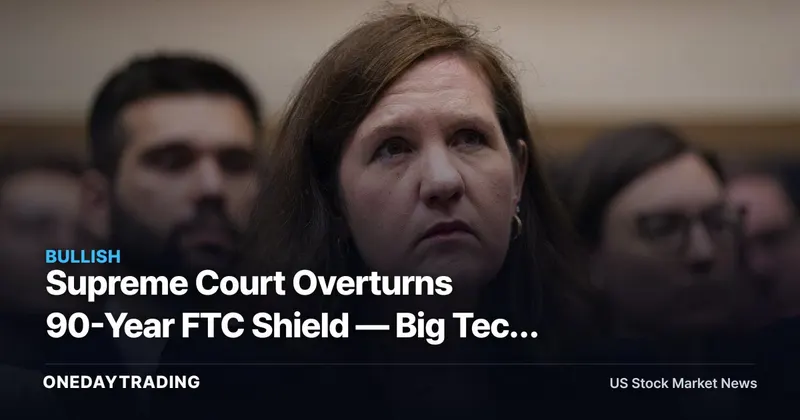
Humphrey's Executor dated to 1935 — a structural firewall between presidential politics and independent enforcement that stood for nine decades before this ruling dismantled it. The FTC operates as a five-member commission; Slaughter was one of two Democratic holdovers, meaning the practical enforcement shift was already underway before the Court formalized the executive's removal power. The precedent being erased protected not just the FTC but a cluster of independent multi-member commissions across financial, labor, and communications regulation — the universe of affected agencies makes this a macro ruling, not a sector ruling.
Winners & Losers
- META — The FTC's antitrust suit seeking to unwind Instagram and WhatsApp is the most direct live exposure. A commission operating closer to executive priorities could shift settlement posture or resource allocation on the case; the stock has carried a structural regulatory discount that now deserves re-examination.
- AMZN — The FTC's suit over marketplace and Prime practices now runs through a commission whose leadership profile will change. Reduced enforcement aggression on that case narrows a meaningful tail risk for Amazon's retail and third-party seller economics.
- GOOGL — DOJ leads the primary search-monopoly litigation, but FTC involvement in future AI platform and advertising market reviews operates under a structurally different posture. Narrowing the multi-front regulatory exposure matters for a company where antitrust has become a standing line item in risk disclosures.
- MSFT — The Activision acquisition showed how FTC opposition taxes deal timelines and imposes strategic costs. Future large-cap software M&A now faces a lower first-mover regulatory barrier, relevant for a company with the balance sheet to execute large combinations.
- Mid-cap deal targets in healthcare, fintech, and industrials — A wave of previously-chilled acquisitions could accelerate across sectors where FTC second-request risk had functionally deterred boards; M&A risk premiums should compress if the enforcement shift proves durable through the current term.
Risk Check
- State attorneys general retain independent antitrust authority and have grown more aggressive on platform competition; a weakened federal FTC does not clear the enforcement field — it redistributes it.
- The Federal Reserve's statutory structure differs from the FTC's and the ruling does not directly apply, but it feeds a market narrative that could pressure long-term Treasury yields if investors begin pricing an executive-influence premium into rate expectations.
- Lower-court application will determine the ruling's practical scope; a narrow reading limited to FTC-style single-mission commissions would contain the systemic read-through some investors are currently assuming.
- Deregulatory gains are only as durable as the current executive's term — a future administration reverses enforcement priorities with equal speed, capping the long-run multiple expansion the ruling might otherwise justify.
Bottom Line
The Court has removed a 90-year structural brake on executive influence over independent enforcement, and the near-term equity case — compressed M&A risk premiums, lower antitrust tail risk for big-platform names — is legitimate and likely to persist through the current administration. The counterweights matter in equal measure: state enforcement fills part of the federal vacuum, the ruling's scope remains untested in lower courts, and any sustained market narrative connecting this precedent to Fed independence would pressure the rate backdrop underwriting current multiples. The catalyst to watch is not the next FTC enforcement filing but the first significant legal challenge testing whether the ruling's logic reaches the SEC — that is the moment when structural stakes move from political narrative to market price.
📊 Analysis
Signal Bullish
Why Weakened FTC independence reduces structural drag on large-cap M&A and lowers antitrust tail risk for big-platform names carrying live enforcement exposure.
Tickers$GOOGL$META$AMZN$MSFT
This article was independently written by OneDayTrading from public reporting. Read the original (CNBC)