Key Takeaways
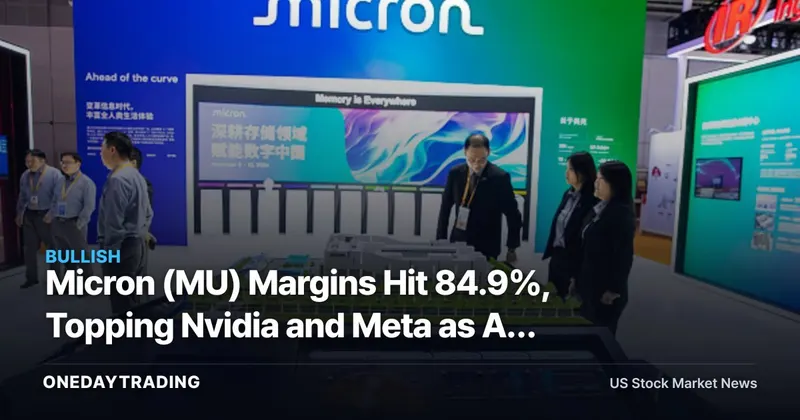
Micron just posted a gross margin of 84.9%, up from 39% a year earlier, a swing that briefly makes a memory maker more profitable per dollar of revenue than Nvidia or Meta. The signal is not a one-quarter fluke in pricing but evidence that AI demand has turned commodity memory into a constrained, premium input. For investors the read-through extends well beyond MU to the entire DRAM and high-bandwidth memory chain.
What Happened
In its latest earnings report Micron disclosed that gross margin climbed to 84.9% versus 39% in the comparable period a year ago. A 45-point margin expansion in a business historically known for brutal, loss-making down-cycles is the headline: memory is the classic boom-bust corner of semiconductors, and Micron has typically traded at low-teens to mid-30s gross margins outside of peak cycles.
The mechanism is operating leverage on top of pricing power. Memory is a high fixed-cost business; once fab capacity is full, incremental revenue from higher chip prices drops almost entirely to gross profit. When supply is tight and AI buyers compete for scarce capacity, average selling prices rise faster than costs, and margins inflate sharply. That is what lets a memory vendor momentarily out-earn, on a percentage basis, far higher-multiple platform companies like Meta and design-led Nvidia.
Background & Context
AI accelerators need enormous memory bandwidth, and high-bandwidth memory stacked alongside GPUs has become the binding constraint on AI server output. With only three suppliers of relevance globally, capacity earmarked for HBM pulls wafers away from conventional DRAM, tightening the broader market and lifting prices across the board. The result is a memory up-cycle driven by structural AI capex rather than the usual PC and smartphone replacement demand.
Market & Stock Impact
- Micron (MU): Direct beneficiary; an 84.9% gross margin signals pricing power and full utilization, the two ingredients that historically drive memory earnings and the stock during an up-cycle.
- Nvidia (NVDA): Mixed; HBM is a core input cost for its accelerators, so richer memory margins pressure Nvidia's bill of materials even as scarce memory validates AI demand.
- Korean memory peers (Samsung, SK Hynix): Read-through positive; the same tight DRAM/HBM dynamics that lifted Micron support their pricing, though they trade on foreign exchanges.
- Memory-equipment names (LRCX, AMAT, KLAC): Capex leverage; sustained shortage incentivizes new fab investment, the upstream demand driver for deposition, etch and inspection tools.
- Broad semis (SOX): The episode reinforces that the AI cycle is now lifting commodity silicon, not just logic and GPUs.
Investor Checkpoints
- Whether management guides next-quarter gross margin to hold near these levels or signals normalization, the single most important tell on cycle durability.
- HBM volume and pricing commentary, and how much capacity is committed to AI customers versus open-market DRAM.
- Capital spending plans; rising capex can extend the cycle but eventually adds the supply that ends it.
- Inventory and bit-shipment trends across PC and mobile, the legacy demand that can soften even as AI stays strong.
Outlook
The bull case is that AI memory demand is structurally scarce and that Micron's margin step-change reflects a multi-quarter pricing regime rather than a spike. The counter-case is equally grounded in memory's own history: margins this far above trend invite capacity additions, and every prior memory peak has eventually reversed when supply caught up or end-demand cooled. An 84.9% gross margin is more likely a cycle high to defend than a new baseline, so the variable that matters is how long the shortage and the AI capex behind it persist.
Market data check: MU
MU last traded near $1,048.51 (-0.31%). Our composite signal — blending price momentum and news flow — reads 🟡 neutral. Price momentum scores 48/100.
Data as of publication. Price via market feeds; for reference only, not investment advice.
📊 Analysis
Signal Bullish
Why A gross margin leap to 84.9% from 39% reflects AI-driven memory pricing power and full utilization, a strong earnings catalyst for Micron and the memory chain.
Tickers$MU$NVDA$LRCX$AMAT$KLAC
This article was independently written by OneDayTrading from public reporting. Read the original (CNBC)