Key Takeaways
Xiaomi and the broader low-end smartphone sector faced a sharp market reset on September 11, 2026, when CNBC reported that sub-$100 phones were becoming rarer as memory costs rose and shipments declined. For investors following Xiaomi, CNBC’s figures support a bearish reading on low-end volume but a more balanced interpretation of the company’s move toward higher-priced devices.
According to CNBC, global shipments of smartphones priced below $100 totaled about 173 million units last year, while shipments in that segment fell almost 60% in the second quarter of 2026 from a year earlier, based on IDC data. CNBC’s evidence indicates that the pressure is concentrated where component costs consume the largest portion of a phone’s selling price.
Sub-$100 Smartphones Lose Their Economic Foundation
A sub-$100 smartphone is a handset sold below $100, a segment whose economics depend on keeping component costs low enough to preserve a viable manufacturing margin. According to CNBC, memory represents almost 60% of the bill of materials—the direct component cost—of smartphones priced below $200, based on an estimate from Omdia’s Chow Sheng Win.
CNBC reported that chipmakers have prioritized higher-value products used in AI infrastructure, squeezing the supply of memory used in smartphones. In CNBC’s account, that supply allocation raises costs for handset manufacturers and makes the lowest-priced models harder to manufacture economically.
Bryan Ma of IDC told CNBC that low-end phones were becoming uneconomic to manufacture. CNBC’s figures support the interpretation that manufacturers have less room to absorb memory inflation in a device priced below $100 because memory already represents a large part of the component bill.
Xiaomi’s Product Mix Shows the Scale of the Retreat
According to CNBC, smartphones priced below $100 represented 27.7% of Xiaomi’s global shipments in the first half of 2025, but only 11.2% a year later. The source does not provide the precise dates covered by “a year later,” yet the reported comparison shows a substantial contraction in Xiaomi’s exposure to the cheapest tier.
The change extends beyond the sub-$100 category. According to CNBC, IDC data showed that Xiaomi’s share of shipments priced below $200 declined from 60% to 52.5% over the period described as beginning in 2023 and ending in the later comparison period.
Mainland China has moved further away from the low end. According to CNBC, Chow Sheng Win said that devices below $200 account for less than 20% of Xiaomi’s volume in mainland China. CNBC’s data therefore support an interpretation that Xiaomi’s home-market mix already depends predominantly on devices priced above that threshold.
Higher Prices Offer a Margin Route, Not a Guaranteed Outcome
According to CNBC, Neil Shah of Counterpoint Research estimated that Xiaomi’s average selling price rose about 30% since 2023 to $197. Oppo’s average selling price increased by a similar 30% since 2023 to $300, CNBC reported.
CNBC attributed this movement to Chinese manufacturers shifting up-market to lift margins as cheaper models become less economical. For Xiaomi investors, CNBC’s evidence suggests that a higher average selling price may counter some low-end cost pressure, but the fact sheet provides no production-cost figures or company profitability data with which to measure the net benefit.
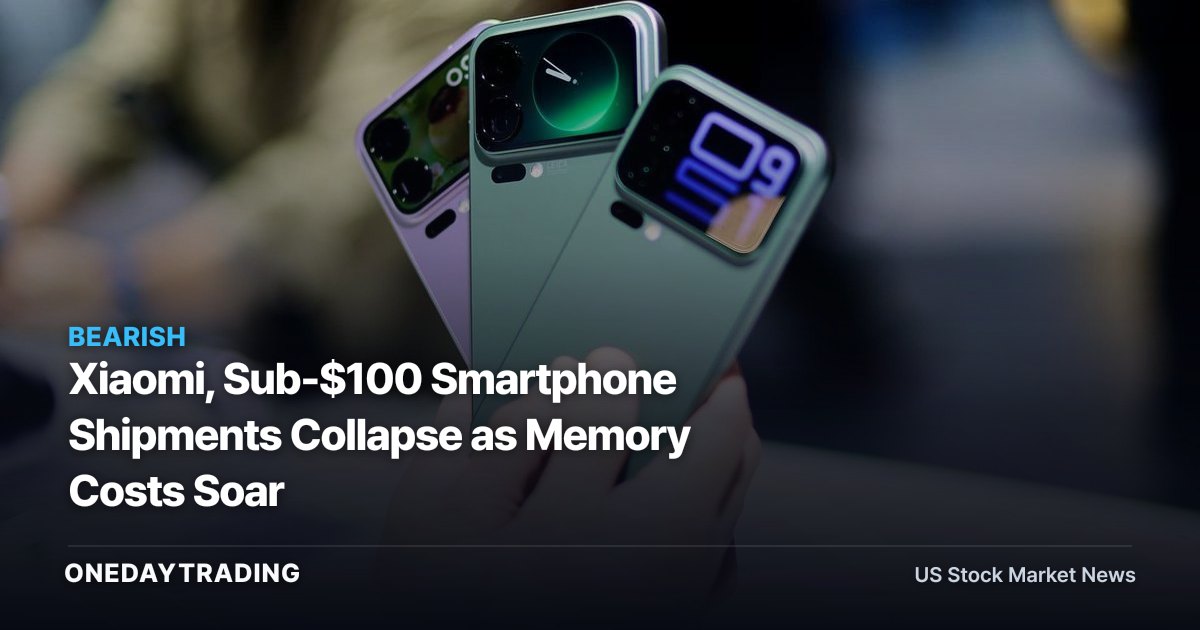
Xiaomi’s product strategy was visible in the 18 Fold, which CNBC reported was unveiled for the premium segment at a launch price of 10,999 yuan, or $1,640. Based on CNBC’s account, the device demonstrates Xiaomi’s expansion toward higher price points; it does not establish sales demand, shipment volume or financial success for the model.
Market and Stock Impact
- Xiaomi: According to CNBC, its sub-$100 share of global shipments dropped from 27.7% in the first half of 2025 to 11.2% a year later. CNBC’s figures support a negative interpretation for low-end unit exposure, while the approximately 30% increase in average selling price since 2023 to $197 offers a potential offset through a richer product mix.
- Oppo: According to CNBC, its average selling price rose by about 30% since 2023 to $300. CNBC’s reporting supports the interpretation that Oppo is participating in the same move away from the weakest low-price economics, although the fact sheet supplies no shipment-mix or profitability figures for the company.
- Low-end smartphone sector: According to CNBC, sub-$100 global shipments fell almost 60% in the second quarter of 2026 from a year earlier. Combined with memory reaching almost 60% of the bill of materials for phones below $200, CNBC’s evidence points to pressure on manufacturers whose economics rely heavily on the cheapest devices.
Internet Services Provide a Partial Cushion
CNBC reported that Chinese vendors generate internet-services and app revenue in their domestic market. Based on CNBC’s account, this revenue source may help counter some handset pricing pressure because the commercial value of a device is not confined to its initial sale.
That cushion cannot be quantified from the available evidence. The fact sheet gives no internet-services revenue, app revenue, margin contribution or user-economics figures, so CNBC’s reporting does not establish how much of the memory-cost pressure these businesses can absorb.
Investor Checkpoints
- Sub-$100 shipment trend: At the next IDC update, investors can compare the segment’s shipment direction with the almost 60% year-over-year decline reported by CNBC for the second quarter of 2026. The exact second-quarter shipment volume was not provided.
- Xiaomi’s price mix: At Xiaomi’s next shipment disclosure, the key comparison is whether sub-$100 devices remain near the 11.2% share reported by CNBC for the period described as a year after the first half of 2025.
- Memory burden: At the next Omdia assessment, investors can check whether memory remains close to the almost 60% share of the bill of materials reported by CNBC for smartphones below $200.
- Premium execution: At Xiaomi’s next product or shipment update, investors can look for disclosed demand or volume evidence for the 18 Fold following its reported launch at 10,999 yuan, or $1,640. CNBC’s report provides the launch price but no sales outcome.
Outlook: Mix Improvement Meets a Shrinking Entry Tier
The constructive case rests on Xiaomi reducing exposure to devices whose component economics have deteriorated. According to CNBC, the company’s average selling price has risen about 30% since 2023 to $197, its sub-$200 shipment share has fallen from 60% to 52.5%, and it has introduced the premium-positioned 18 Fold.
The opposing case is that a higher selling price does not by itself prove stronger earnings. CNBC provides no exact memory prices, production costs or profitability outcomes, while the almost 60% year-over-year decline in second-quarter 2026 sub-$100 shipments shows the severity of the volume contraction at the market’s entry tier.
CNBC reported Bryan Ma’s view that an easing memory crunch would moderate price increases rather than reverse them. For investors, the decisive evidence will be whether Xiaomi’s subsequent disclosures show that a richer product mix and domestic internet-services revenue can offset the loss of low-end volume without relying on an unsupported assumption that smartphone prices will return to earlier levels.
📊 Analysis
Signal Bearish
Why CNBC’s evidence points to severe low-end shipment contraction and heavier memory costs, partly offset by Xiaomi’s shift toward higher-priced devices.
This article was independently written by OneDayTrading from public reporting. Read the original (CNBC)