
Three-Line Briefing
- The average remaining debt of small business owners who closed last year stood at 85 million won at the time of closure — they shut their doors only after revenue had plunged more than 40%.
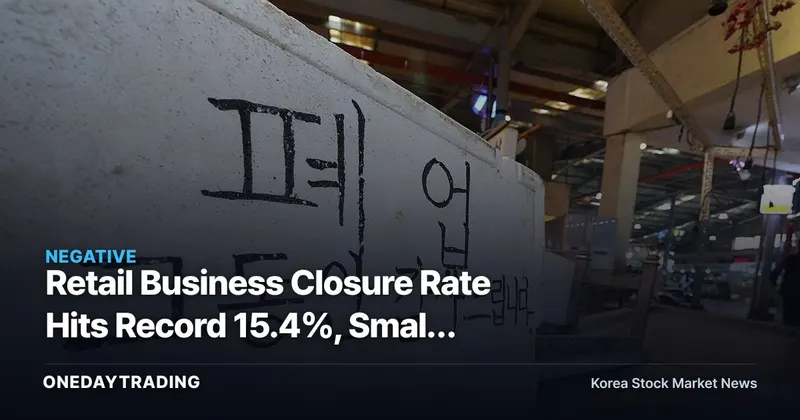
- The retail sector's 15.4% closure rate was the highest of all industry sectors, evidence that offline retail's structural disadvantage has moved beyond a simple economic cycle.
- The later the decision to close, the more debt piles up — this data confirms the paradox that government support actually delays closures and deepens losses.
What's Changing
The Ministry of SMEs and Startups' analysis speaks to the fact of closure, but what the numbers point to is a shift in consumption patterns. When small business owners close their doors only after enduring a revenue decline of more than 40%, it means they kept paying rent, interest, and labor costs throughout that process. The average remaining debt of 85 million won is the sum total of the cost of holding on, not the result of business failure itself. It is the bill for the time spent refusing to acknowledge failure.
Retail recording the highest closure rate among all industry sectors at 15.4% suggests that offline retail's structural disadvantage has gone beyond a simple economic cycle. As online commerce penetration and convenience store consolidation proceed simultaneously, this figure condenses the limits of price and logistics competitiveness that small retailers can sustain. The issue isn't the pace of closures, but where that consumption migrates to afterward.
Numbers in Context
The threshold of a revenue decline exceeding 40% before deciding to close paradoxically demonstrates the strong survival instinct of Korean small business owners. At the same time, that instinct economically worked to deepen losses. In a structure where franchise convenience stores and large discount marts absorb consumption, all it takes is the time for a single commercial district to be reshuffled for neighborhood retail revenue to fall by nearly 40%. The debt accumulated during that time is 85 million won. Put differently, the retail sector's 15.4% closure rate is the speed at which nearly one-seventh of retail commercial districts turn over in a single year — a scale difficult to offset with tenant-protection policies or short-term subsidies.
Stocks: Winners and Losers
- BGF Retail — A major convenience store franchise built on its CU franchisee network. An acceleration in small-merchant retail closures is expected to bring short-term spillover benefits, but if declining franchisee profitability reduces the incentive to open new stores, growth in the headquarters' franchise fee revenue will slow. Net new store openings are the key metric to watch in quarterly earnings.
- GS Retail — Operates the GS25 franchisee network. It shares the same industry-wide pressure as BGF Retail, and the sustainability of franchise fee revenue from its convenience store division is the key variable for its valuation.
- E-Mart — There is room for some consumption to flow into large discount marts as small-merchant retailers close. However, with the pace of online commerce substitution overwhelming offline earnings, the scale of any spillover benefit is limited.
- Coupang (CPNG) — The platform most directly absorbing the benefit of retail consumption shifting online. During phases of accelerating small-merchant closures, both expanding consumer touchpoints and rising average order value are at work simultaneously.
- Lotte Shopping — A diversified retail structure spanning department stores, discount marts, and e-commerce. If consumer sentiment continues to contract, no single channel serves as a complete line of defense, leaving it broadly exposed to industry downside.
Risk Check
- Accelerating closures → declining self-employed income → contracting consumption, a vicious cycle: if retail closures function as a leading indicator for domestic consumption, additional downward pressure will spread across the retail sector as a whole.
- The paradox of government support: this data confirms that support measures such as loss compensation and low-interest loans delay economically unviable business closures and inflate debt. The larger the scale of such policies, the greater the likelihood that average debt in future statistics will rise as well.
- Commercial district vacancy risk: falling rents and rising vacancies in commercial districts where retail closures are concentrated represent a channel through which risk could transmit to real estate trusts and REITs holding retail assets.
- Overinterpreting convenience store spillover benefits: the short-term beneficiary narrative for BGF Retail and GS Retail could quickly unwind if slowing net store growth and franchisee profitability pressure materialize.
Bottom Line
The retail sector's 15.4% closure rate is a progress report on the restructuring of domestic consumption — the spillover-benefit scenario for convenience stores and large discount marts holds only to a limited extent against the pace of online penetration, and the next checkpoints are BGF Retail and GS Retail's third-quarter net new store counts and the debt trends in small-merchant surveys.
LG Uplus: A Real-Time Data Snapshot
LG Uplus's most recent closing price was 14,000 won (0.00% versus the previous day), and the signal combining foreign and institutional investor supply-demand (order flow) with news and momentum is 🟡 neutral / wait-and-see. With positive and negative signals mixed, this is a range to watch.
- ▼ Trend Alignment — Short- and medium-term downward alignment (Today +0.0% · 1 Week -1.4% · 1 Month -13.2%)
- ▼ 52-Week Position — Near the 52-week low, 8th percentile
※ Price and foreign/institutional investor supply-demand (order flow) data are provided by Korea Investment & Securities (KIS) and reflect figures as of publication time.
This article is automatically summarized and analyzed content based on the original news report. View original (Maeil Business Newspaper, Economy)