
At a Glance
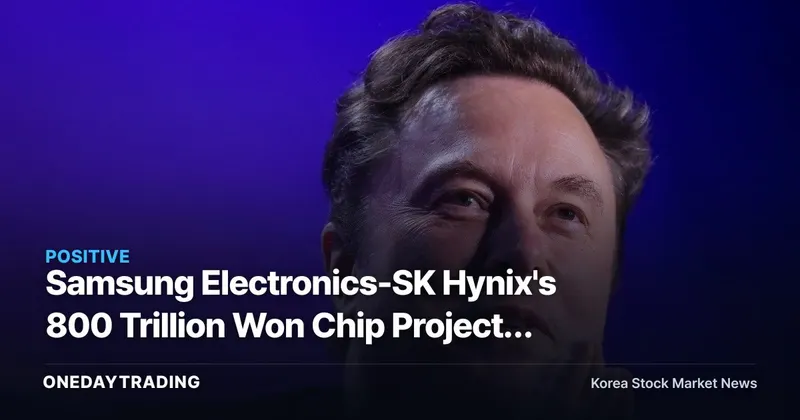
The 800 trillion won semiconductor mega-project jointly undertaken by Samsung Electronics and SK Hynix is once again driving up share prices of Korea's power-related stocks. The market's focus has shifted from the foundry and memory line expansions themselves to the question of who will supply the power needed to run those lines. This should be read not as a simple theme rotation, but as a signal that the bottleneck in the semiconductor capex cycle has moved from wafer equipment to power infrastructure.
Why It Matters Now
Semiconductor fabs are facilities that require uninterrupted, large-scale power supply around the clock. If the 800 trillion won in new investment is carried out as planned, demand for ultra-high-voltage substations, transmission lines, and large-capacity transformers will rise proportionally. This is exactly where the market's attention is focused: while chip equipment stocks already have much of that expectation priced into their valuations, power equipment and grid-related stocks are seen as not yet fully pricing in the incremental power demand this mega-project will generate.
This mirrors precedents such as Elon Musk repeatedly identifying power procurement as the top risk for his AI and data center businesses, and Samsung Electronics Chairman Lee Jae-yong flagging securing power supply as a key variable in expanding chip investment. AI data centers and advanced semiconductor fabs around the world share the same bottleneck — power supply capacity — and Korea finds itself needing to solve this bottleneck through national-level industrial policy. That is also why the government is treating power supply for semiconductor clusters as a national policy priority.
FAQ
- Q. Why do power stocks rise on semiconductor investment news? A. Because operating a fab requires massive amounts of power, and orders for substations, transmission lines, and transformers are placed in sequence once semiconductor investments are confirmed.
- Q. Is this the first such rally? A. No. The power-demand logic driven by semiconductors and data centers has already moved the market on multiple occasions, and this time the sheer scale of the 800 trillion won project served as a fresh confirmation trigger.
- Q. What is the government's role? A. The key tasks are establishing transmission and substation plans and supporting the permitting process to ensure a stable power supply for semiconductor clusters; if this timeline slips, momentum in related stocks could be delayed as well.
- Q. How long before this shows up in earnings? A. Substations and transformers typically have a one- to two-year lag between order wins and revenue recognition, so a gap can easily emerge between share prices pricing in expectations early and the eventual earnings confirmation.
Related Stocks and Sector Impact
- HD Hyundai Electric — A direct beneficiary of the expanding order backlog for ultra-high-voltage transformers, tied to grid-expansion orders for semiconductor clusters.
- LS ELECTRIC — With a portfolio of power equipment and transmission/distribution facilities, it is cited as a bellwether for growing power-infrastructure demand from semiconductors and data centers.
- Hyosung Heavy Industries — Its heavy electrical equipment segment, including transformers and circuit breakers, could gain order momentum alongside expanding grid investment at home and abroad.
- Doosan Enerbility — Its nuclear and power-generation equipment portfolio is linked to discussions on securing stable power sources for semiconductor clusters, positioning it on a policy-driven beneficiary path.
- KEPCO (Korea Electric Power Corporation) — As the entity responsible for executing transmission and substation plans, it faces the double-edged variables of investment cost burden and electricity rate policy.
Investment Considerations
- Many power equipment stocks have already rallied sharply in recent months, so valuation pressure could surface before new orders are actually confirmed.
- The 800 trillion won figure is a multi-year planning number, and the actual scale and timing of execution in any given year remain subject to adjustment.
- Power equipment orders have a substantial gap between the disclosure date and the point of revenue recognition, so investors should factor in the possibility of a disconnect between share-price momentum and earnings announcements.
- Changes in the government's transmission/substation plans and electricity rate policy could affect the profitability structure across the entire related value chain, including KEPCO.
Overall Outlook
The optimistic scenario is one in which the 800 trillion won project is executed as planned and power infrastructure orders materialize in sequence. In that case, order backlogs at transformer and heavy electrical equipment stocks could trend upward over several quarters. The pessimistic scenario involves delays in the investment timeline or slower government funding and permitting procedures, in which case the power-stock rally risks ending as mere sentiment without earnings confirmation. The key things to watch next are the schedule of government announcements related to semiconductor clusters, individual companies' new order disclosures, and whether power equipment segment revenue growth actually shows up in quarterly earnings.
HD Hyundai Electric: Real-Time Data Snapshot
HD Hyundai Electric's most recent closing price was 1,012,000 won (0.00% versus the previous day), and the composite signal combining foreign/institutional order flow with news and momentum reads 🟡 Neutral / Wait-and-see. Positive and negative signals are mixed, making this a period to watch closely.
- ▼ Order Flow Continuity — Foreign investors net sellers for 4 straight days (−19.4 billion won)
※ Price and foreign/institutional investor flow data are provided by Korea Investment & Securities (KIS) and are current as of publication time.
This article is AI-generated summary and analysis content based on the original news report. View Original (Maeil Business Newspaper, Corporate)