
At a Glance
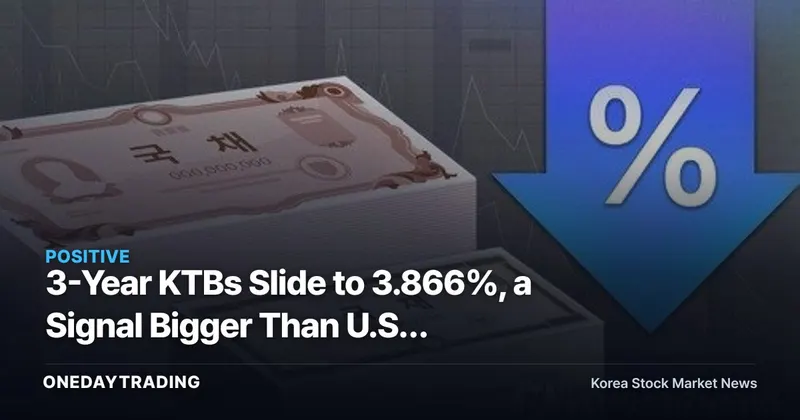
Korean Treasury bond (KTB) yields fell across the board on the 15th. The 3-year yield slid to 3.866%. The trigger was a single data point: U.S. Consumer Price Index (CPI) coming in below market expectations. On the surface, this looks like a relief rally, but the fact that the 3-year yield moved signals that the market has already begun recalculating the Fed's entire rate-cut path.
Why It Matters Now
The 3-year segment is the most sensitive gauge of the Bank of Korea's average benchmark interest rate path over the next three years. The fact that this segment was shaken by a single U.S. inflation print shows that Korea's bond market still moves in lockstep with the timing and scale of Fed rate cuts rather than domestic drivers. The fact that yields fell across every maturity should be read not as simple bargain-hunting but as a signal that the outlook for policy rates itself has shifted lower.
A drop in interest rates is a drop in the discount rate. In theory, assets whose value depends more heavily on distant future profits should rally more. That's why stocks (tickers) in the middle of large semiconductor capex cycles, biotech names valued on clinical trial and licensing-deal expectations, and platform growth stocks are cited as the primary beneficiaries. Banks and insurers face the opposite pull: net interest margin (NIM) pressure. When rates fall, the loan-deposit spread narrows and reinvestment yields on bond holdings decline.
Still, investors need to separate what the market has already priced in from what it hasn't. A reversal built on a single U.S. CPI surprise could just as easily flip back with next month's data. What remains unpriced are the Bank of Korea Monetary Policy Board's actual decision in August, and how much support the KRW/USD exchange rate lends to sustaining this reversal.
FAQ
- Why does the 3-year KTB yield matter? - It embodies the market's 3-year average forecast for the Bank of Korea's benchmark interest rate, making it the segment where monetary policy expectations are first reflected.
- Why does U.S. CPI move Korean bond yields? - As expectations for Fed rate cuts grow, global capital rotates into risk assets and emerging-market bonds, and domestic yields come under downward pressure as they track this flow.
- How does falling interest rates affect the KOSPI? - A lower discount rate is favorable for growth-stock valuations, but it squeezes margins at rate-sensitive sectors such as banks, so the impact cuts both ways.
- What indicators should be watched next? - The August Monetary Policy Board decision, whether the KRW/USD exchange rate falls further, and next month's U.S. CPI release.
Related Stocks (Tickers) and Sector Impact
- Mirae Asset Securities, NH Investment & Securities - A window in which bond holdings gain in valuation. The steeper the rate decline, the greater the contribution to trading-division earnings.
- Samsung Electronics (005930), SK Hynix (000660) - A lower discount rate opens room for a valuation re-rating of semiconductor growth stocks (tickers), but without an actual recovery in industry conditions, this could amount to no more than multiple expansion.
- KB Financial Group, Shinhan Financial Group - Falling rates compress the loan-deposit spread, weighing on NIM. However, if the decline is gradual, the impact should be limited.
- Construction and real estate-related stocks (tickers) - Falling rates ease the burden of loan rates, which is positive for genuine end-user demand sentiment, but an actual recovery in trading volume will likely lag.
Investment Considerations
- This decline in yields was triggered by a single U.S. CPI print. If inflation rebounds in the next reading, the reversal could unwind quickly.
- Watch the KRW/USD exchange rate level alongside this. If the exchange rate rises again, foreign investors' capital could exit domestic bonds and equities, weakening the durability of this reversal.
- Bank stocks (tickers) are not beneficiaries of falling rates. A growth-stock approach and a financial-stock approach should not be judged by the same yardstick.
- Until the August Monetary Policy Board meeting, KTB yields are likely to remain highly sensitive to each individual data release.
Overall Outlook
The optimistic scenario is one in which U.S. inflation moderation is confirmed again in the next data release, cementing expectations for Fed rate cuts. In that case, KTB yields have room for further declines, and the re-rating of growth-stock valuations would gain further momentum. The risk is that this CPI reading proves to be a temporary dip and inflation rises again in next month's data. In that case, KTB yields would reverse, and the valuations of growth stocks (tickers) that rode this rally could reverse as well. What matters is not a single data point, but whether the trend continues.
This article was automatically summarized and analyzed based on the original news report. View Original (Yonhap News Agency, Securities)