
At a Glance
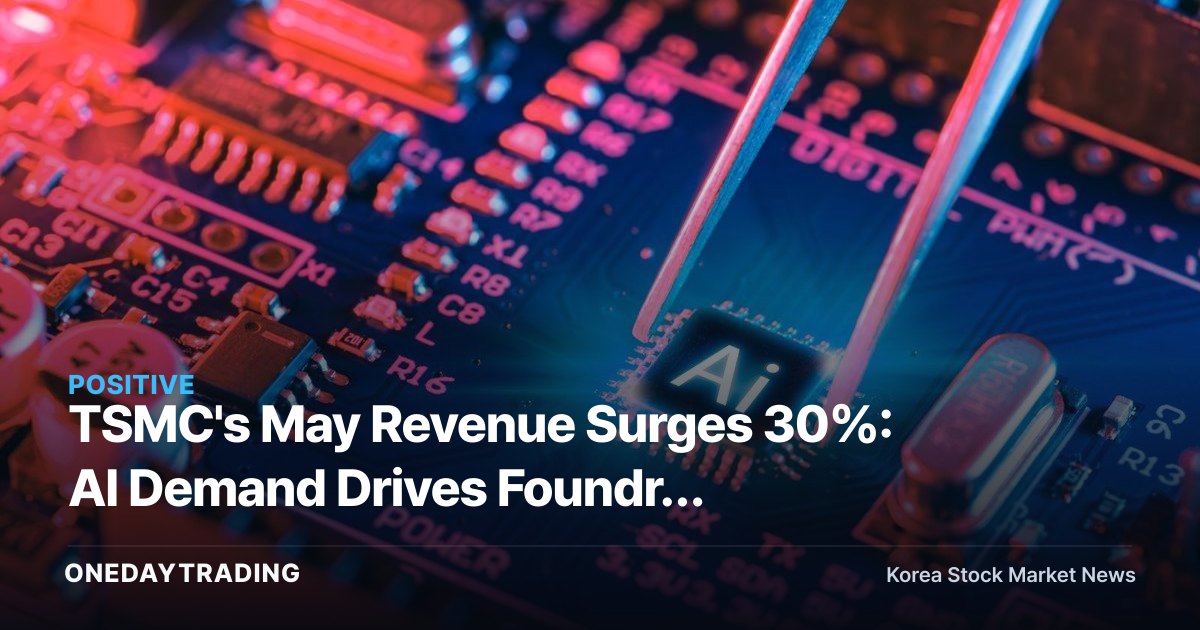
TSMC, the world's largest foundry, reported that its May revenue rose roughly 30% year over year. Analysts say demand for artificial intelligence (AI) accelerators and high-performance computing chips shows no sign of slowing, keeping utilization of its advanced process nodes at a high level. Some in the market argue that, even with such strong earnings, the current share price still sits in undervalued territory.
Why It Matters Now
TSMC manufactures the core chips for global big-tech players such as Nvidia, AMD, and Apple, and its monthly revenue serves as a leading indicator of the temperature of the AI semiconductor cycle. The fact that May revenue climbed past the mid-teens to around 30% suggests that AI data center investment may have moved beyond a short-term spike into a phase of structural growth.
In particular, as the share of advanced nodes such as 3nm and 5nm grows, average selling prices and profitability are improving in tandem. If exchange rate effects combine with a richer mix of high-value products, this could lead to upward revisions in quarterly earnings estimates — directly influencing investor sentiment across the entire global semiconductor value chain.
At the heart of the undervaluation debate is the price-to-earnings ratio (PER) relative to growth. One view holds that, if AI demand persists, future earnings growth will more than justify the current valuation; a more cautious camp counters that much of those expectations is already priced into the stock.
Frequently Asked Questions
- What is the main driver behind the 30% revenue growth? — Rising orders for advanced nodes used in AI accelerators and high-performance computing are cited as the biggest factor.
- Is the strong earnings result also a positive catalyst for Korean semiconductors? — A spillover in demand is expected for Korean firms that supply HBM and advanced packaging, though the competitive landscape must be considered as well.
- Is the stock really undervalued right now? — Opinions diverge depending on assumptions about future earnings growth, and if estimates waver, so does the valuation appeal.
- What are the risks? — A slowdown in the pace of AI investment, US-China regulation, and exchange rate volatility are all variables.
Related Stocks (Tickers) and Sector Impact
- Samsung Electronics — Competes with TSMC in both foundry and memory, while also benefiting from the expansion of AI memory demand.
- SK hynix — Demand for high-bandwidth AI memory such as HBM tends to rise alongside TSMC's utilization rates.
- Hanmi Semiconductor — Expected to be a direct beneficiary of rising demand for back-end equipment such as HBM bonding machines.
- Leeno Industrial, semiconductor materials and components stocks — Rising utilization of advanced nodes is positive for inspection and materials companies' earnings.
- Korean semiconductor equipment and materials/parts sector — If the AI investment cycle continues, order momentum could be sustained.
What to Watch When Investing
- Monthly revenue is highly volatile, so quarterly trends and guidance should be checked alongside any single month's figure.
- If the pace of AI data center investment slows, advanced-node orders could cool quickly as well.
- US-China semiconductor regulation and geopolitical risk could affect both supply chains and demand.
- With elevated expectations already priced into the stock, watch for increased volatility around earnings releases.
Overall Outlook
In the optimistic scenario, demand for AI accelerators persists structurally, lifting both TSMC's advanced-node revenue and profitability, and that warmth spreads across the broader Korean semiconductor ecosystem that supplies HBM and materials/parts. That said, concerns over an AI investment bubble, regulatory variables, and shifts in exchange rates and pricing power are risks that could shake estimates at any time. Rather than focusing on short-term price action, a balanced approach centered on the durability of AI demand and quarterly earnings guidance remains the more effective strategy.
This article is content automatically summarized and analyzed based on the original news report. View original (Yahoo Finance)