
3-Line Briefing
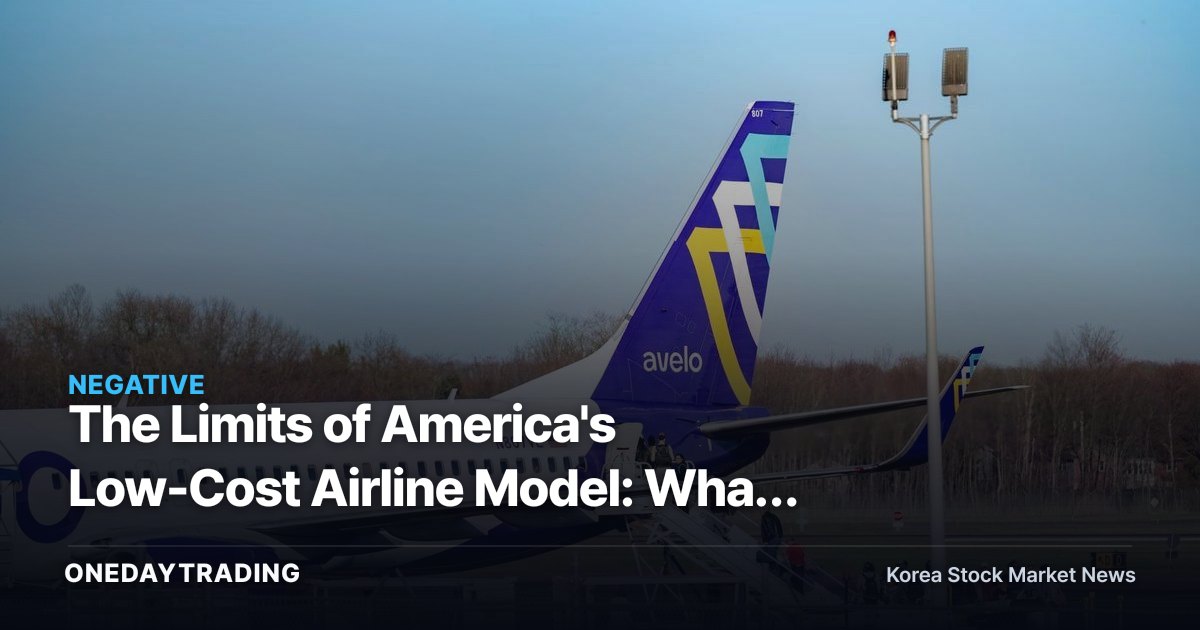
- In the U.S., Spirit Airlines — which built its business around ultra-low fares — has entered bankruptcy proceedings, while Delta and United, which expanded premium seating and mileage businesses, continue to post solid earnings.
- The key point of this case is not a temporary cost shock such as a sharp gain (surge) in oil prices, but rather that the profitability limits of a low-fare-only strategy have been exposed.
- This could become a dividing line separating the business structures of Korea's LCCs (Jeju Air, Jin Air, T'way) from those of full-service carriers (Korean Air).
What Is Changing
For some time, the investment logic for the airline industry was simple: the assumption that lowering fares to boost load factors would generate profits through economies of scale. Spirit's bankruptcy shows that this assumption no longer holds automatically. Pushing seat prices to extreme lows thins the margin per seat and makes it harder to absorb fixed costs such as labor, maintenance, and airport usage fees. A structural weakness is that the moment a competitor deploys low-fare seats on the same route, the price defense line collapses.
Conversely, what allowed Delta and United to hold up was their revenue sources beyond fares. High unit revenue from premium and business-class seats, partnership revenue from selling airline mileage to credit card companies, and ancillary-service revenue such as baggage and seat selection all cushion economic swings. In other words, even within the same airline industry, what divided survival was whether revenue was concentrated in fares alone or spread across multiple streams.
This trend is not unrelated to the Korean market. After COVID, Korea's LCCs recovered quickly by concentrating their firepower on short-haul Japan and Southeast Asia routes, but as routes overlap and new aircraft are added, there is room for fare competition to reignite. The U.S. case is a reminder that when low-fare competition overheats, the operators with the weakest financial stamina are the first to fall.
Reading the Numbers and Context
The original article points to a structural problem rather than specific cost items. The key is that Spirit's failure was not caused by a sharp gain (surge) in jet fuel prices. Fuel cost is a variable that every airline bears equally, so if some survive and others collapse in the same oil-price environment, the difference lies not in costs but in revenue structure. For Korea's LCCs too, the exchange rate and oil prices are major cost axes, but the real differentiator comes from ancillary revenue and route portfolios.
Beneficiary and Affected Stocks
- Korean Air: As a full-service model that holds premium seating, cargo, and mileage businesses together, its relative defensive strength could come to the fore if low-fare competition intensifies. That said, post-merger route and fleet realignment costs remain a variable.
- Delta Air Lines / United Airlines: Direct cases proving the validity of a model centered on premium and card-partnership revenue, prompting a shift in the yardstick for global airline stocks from fares to revenue diversification.
- Jeju Air / Jin Air / T'way Air: With high dependence on short-haul low fares, they are sensitive to intensifying competition. Their fortunes could diverge depending on how far they expand ancillary-service revenue, diversify into medium- and long-haul routes, and secure cost efficiency.
Risk Check
- It is difficult to map the U.S. case directly onto Korea. Korea's LCCs have a high share of short-haul routes and a different market structure, so the same conclusion cannot be assumed.
- If oil prices and the won-dollar exchange rate rise simultaneously, margins across the entire industry sector come under pressure regardless of revenue structure.
- If travel demand slows or an oversupply of capacity on Japan and Southeast Asia routes coincides, fares could swing weak quickly.
- Full-service carriers also carry separate risks of their own, such as merger and restructuring costs and cargo-fare volatility.
One-Line Conclusion
Now that the vulnerability of an airline model surviving on low fares alone has been confirmed, weight may shift toward operators with ancillary revenue and route-diversification capabilities — but it must also be kept in mind that external variables such as the exchange rate, oil prices, and demand act on all airline stocks at once.
This article is content automatically summarized and analyzed based on the original news. View Original (CNBC)