
Summary
The real question behind Delicious's IPO isn't whether a fashion platform is going public — it's whether Dongdaemun wholesale transaction data can be converted into advertising, subscription, logistics, and SaaS revenue. Last year's revenue of KRW 30.7 billion and operating profit of KRW 1.6 billion, marking a swing to profitability, are just the starting point. For the IPO price range of KRW 5,000-7,000 to be justified, both the number of advertisers and the membership conversion rate need to keep rising after listing.
As Park Se-ra sees it, what the market is really buying isn't the phrase "swing to profitability." It's whether Sinsang Market's transaction frequency has become essential infrastructure — essential enough that both wholesalers and retailers are willing to pay for it.
What Happened
Delicious, which operates the fashion wholesale platform Sinsang Market, is pursuing a listing on KOSDAQ and plans to offer 2.2 million shares. The indicative IPO price range is KRW 5,000-7,000, implying total proceeds of KRW 11-15.4 billion. Based on this price band, the expected market capitalization has been set at KRW 109.3-153 billion.
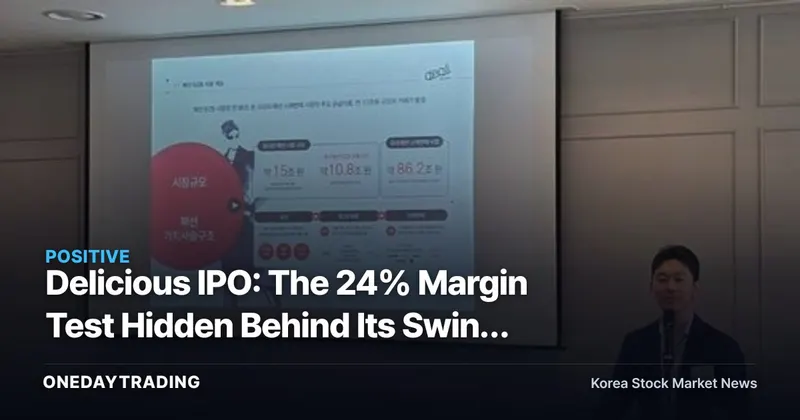
CEO Jung Chang-han said on the 29th that the company would use last year's swing to operating profit as a springboard to become a global fashion B2B platform. Delicious plans to use the IPO proceeds to expand its global SaaS business and push into the Japanese market, among other initiatives. The institutional demand forecast (book-building) runs from July 23-29, and the general subscription period is scheduled for August 3-4.
The numbers show that Sinsang Market has already grown well beyond a simple app. Cumulative transaction volume has surpassed KRW 5 trillion, with 9.26 million cumulative wholesale order receipts and 50.12 million cumulative units ordered, according to the company. The catch is that transaction volume itself doesn't flow directly into company revenue. Delicious's profitability is instead determined by the take rates it charges on top of transactions — through advertising, membership, logistics, and SaaS.
Structural Context
The press release talks about a swing to profitability. What the data actually shows is the first real test of platform monetization. Last year, revenue of KRW 30.7 billion rose 23.7% year-on-year, and operating profit turned positive at KRW 1.6 billion. A loss-making platform crossing into profitability is undeniably meaningful. That said, the fashion wholesale market is sensitive to the business cycle and inventory cycles. When retailers' order turnover slows, wholesalers' ad spending is typically the first thing to get cut.
Sinsang Market's edge lies in the transaction data that links Dongdaemun wholesalers with retailers nationwide on a single screen. Wholesalers want exposure, while retailers want fast discovery and delivery convenience. Delicious monetizes this gap through Sinsang Ad, Sinsang Membership, Plus Membership, and Sinsang Delivery. As the platform gets stronger, gross margin could improve, but expansion into Japan and SaaS could once again push up upfront headcount and marketing costs.
Stock (Ticker) and Sector Impact
- Delicious IPO: This is a case of a fashion B2B platform going public after turning profitable. The institutional book-building demand ratio and where the final IPO price lands within the band will be the first indicators of investor sentiment toward platform IPOs.
- NAVER: Since NAVER is cited mainly as a financial investor, the direct earnings impact is limited. Still, there is room for the market to reassess the value of B2B transaction data within commerce and advertising platform valuations.
- Fashion platforms: This is a different axis from Musinsa-style B2C brand commerce. For Delicious, wholesaler advertising spend and retailer subscription fees are the core drivers, so repeat usage by business users matters more than consumer traffic.
- IPO market: Whether the price settles near the top of the band and how well the market absorbs freely tradable shares after listing could affect the pricing power of other small and mid-cap platform IPO candidates.
Bull vs. Bear Scenarios
The bullish scenario is straightforward. On a platform with KRW 5 trillion in cumulative transaction volume, growth in ad products and membership sign-ups could flow through to profit without a large increase in fixed costs. If the Japan expansion is structured around selling Dongdaemun's fast product supply chain to overseas retailers, it could add SaaS and logistics revenue at the same time.
The bearish scenario is more realistic. Last year's operating profit of KRW 1.6 billion still isn't enough on its own to justify a valuation in the KRW 100 billion-plus range. The closer the IPO price lands to the top of the range, the more investors are effectively paying upfront for future growth. If the fashion market cools or ad spending slows, the swing to profitability may hold, but the pace of margin improvement could slow. The volume of freely tradable shares right after listing and the lock-up release schedule are also overhangs for the stock.
Investor Action Points
- Check whether the institutional book-building results, wrapping up on July 29, show the IPO price settling near the top of the range and whether the share of shares under lock-up commitments is sufficient.
- Before the general subscription on August 3-4, be sure to compare the proportion of freely tradable shares right after listing with the lock-up release schedule for existing investors.
- In the first earnings report after listing, focus less on the revenue growth rate and more on the share of advertising/membership revenue, Japan-related costs, and the operating margin.
- If a slowdown in fashion consumption becomes evident, wholesaler ad spending is likely to decline before transaction volume does. Monthly order counts and growth in paying advertisers are the leading indicators to watch.
NAVER in Real-Time Data
NAVER's most recent closing price was KRW 200,000 (-4.76% from the previous day), and the composite signal combining foreign/institutional supply-demand (order flow) with news and momentum reads 🟡 Neutral / Wait-and-see. With positive and negative signals mixed, this is a stock to watch rather than act on.
- ▼ Supply-Demand (Order Flow) Continuity — Foreign investors have been net sellers for 4 straight days (-KRW 29.6 billion)
- ▲ News Flow — 2 positive catalysts vs. 1 negative catalyst — positive catalysts lead
Recent related news skews favorable, with 2 positive catalysts versus 1 negative catalyst.
※ Price and foreign/institutional supply-demand (order flow) data are provided by Korea Investment & Securities (KIS), as of the time of publication.
This article is auto-summarized and analyzed content based on the original news report. View original (Yonhap News Agency, Securities)