
At a glance
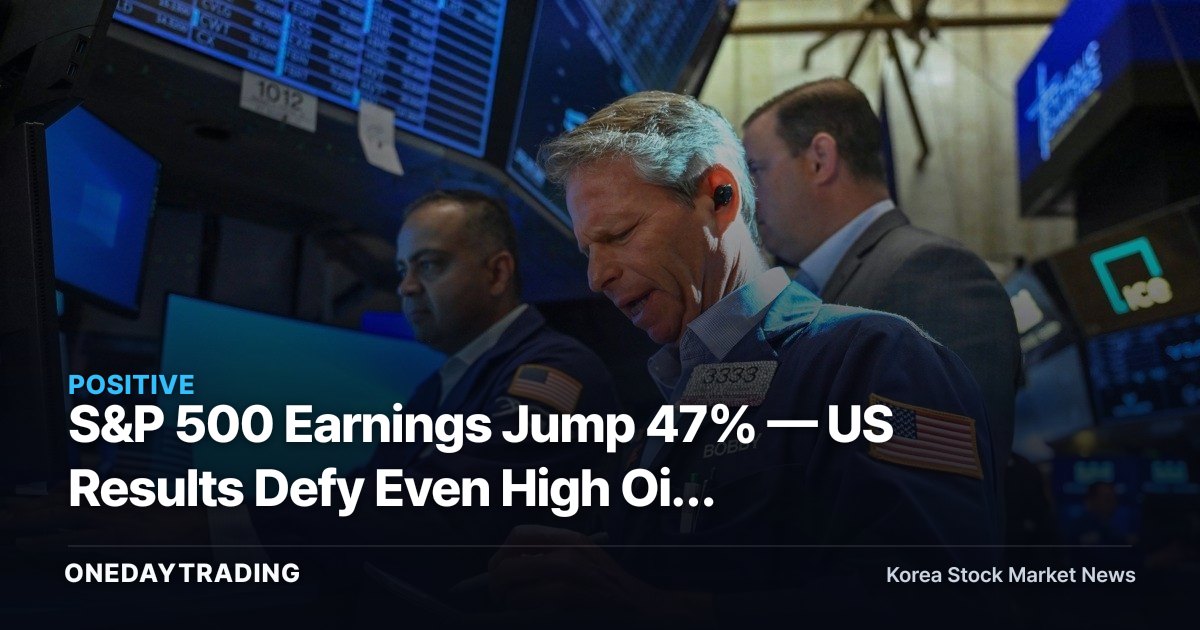
S&P 500 corporate earnings rose 47.4% year over year. What this really signals isn't that US equities are ignoring oil prices and high interest rates — it's that earnings growth has, for now, absorbed the valuation burden.
For Korean investors, the key question isn't whether to raise US equity exposure. It's whether the transmission path — from interest rates to multiples to sector leadership — is shifting.
Why it matters now
This US earnings season looks strong on the numbers. S&P 500 second-quarter earnings growth of 47.4% is the highest level in five years, and nearly 90% of companies that have reported beat market expectations. Eight of eleven sectors posted double-digit earnings growth. What sets this apart from previous rallies is that earnings breadth has widened — this isn't a market propped up by Big Tech alone.
But what the market is really pricing in isn't earnings themselves — it's earnings sustainability. High oil prices are a tailwind for energy company earnings, but a cost burden for consumer and transportation sectors. ExxonMobil and Chevron posting a combined $26.5 billion in profit shows the resilience of the energy sector. At the same time, rising gasoline prices and living costs are squeezing lower-income consumers' wallets — a seed for future revenue slowdown.
Where interest rates stand also matters. With the Fed's benchmark interest rate holding at 3.5–3.75%, earnings growth above 40% can support stock prices. But if CPI heats up again and the 10-year yield rises, the market will assign a lower multiple to the same earnings. The current S&P 500 strength leans more on earnings surprises than on economic expansion. Missing this distinction means mispricing stocks in the later stage of the rally.
FAQ
- Is the US market already expensive? Earnings growth has eased some of the multiple pressure. But if rates rise again, the ceiling on price-to-earnings ratios stays capped.
- Has the Big Tech concentration eased? Double-digit earnings growth across eight sectors reflects broader participation. Still, index-level contribution remains sensitive to large-cap tech and energy majors.
- What does this mean for the Korean market? If US consumption and AI investment hold up, there's a read-through to semiconductors, power equipment, defense, and the energy value chain. Conversely, rising rates increase the discount rate applied to growth stocks.
- Why does the exchange rate matter here? A weaker won against the dollar protects returns on US stock holdings. But it can also raise currency-hedging costs and work against foreign investor order flow (supply-demand) in the domestic market.
Related stocks/sector impact
- US large-cap ETFs. As S&P 500 earnings growth broadens, the defensive case for index products strengthens. That said, they'd face multiple compression together if rates rise.
- Semiconductors and AI infrastructure. If cloud and AI investment keeps driving earnings, it's an opportunity to confirm order continuity at Korean memory and power-infrastructure companies.
- Energy. High oil prices boost cash flow at upstream-heavy companies like ExxonMobil and Chevron. Domestic refiners need both refining margins and oil price direction to align.
- Defense. Geopolitical tension and expanding defense budgets improve earnings visibility for US defense stocks (tickers) like Lockheed Martin and RTX. Korean defense stocks need export order disclosures to follow before gains can hold.
- Consumer goods and transportation. Rising fuel costs and living expenses squeeze margins. Watch spending per customer and cost pass-through rates before revenue figures.
Investment considerations
- Watch the next US CPI and PCE reports for signs of second-round inflation driven by oil. If the figures come in high, the rise in the discount rate will be priced in before the earnings strength.
- Guidance matters more than the second-quarter results themselves. Third-quarter revenue outlooks and margin commentary will move stock prices more than earnings already reported.
- Energy-sector earnings are strong while oil prices hold up. If oil prices roll over, today's earnings growth rate could fade quickly on base-effect math.
- Korean investors shouldn't mistake the exchange rate for a separate source of return. A weaker won against the dollar reduces unrealized gains on US stock holdings and shifts foreign investor order flow (supply-demand) in the domestic market.
Overall outlook
The bullish scenario is clear. If earnings growth spreads from Big Tech into energy, financials, and industrials, and rates stabilize, the S&P 500 has a better chance of defending its elevated index levels. In that case, AI supply chains, power equipment, defense, and parts of the refining value chain would be relatively favored in the Korean market.
The trigger for the opposite scenario is inflation. If high oil prices lead to slower consumption and renewed rate hikes, the market will price in next quarter's deceleration ahead of the 47.4% earnings growth already reported. What to watch now isn't the number of earnings reports — it's August inflation data, the Fed's September signal, and the won-dollar level at which foreign investor order flow (supply-demand) in Korea reverses.
This article was automatically summarized and analyzed based on the original news report. View original (Yonhap News Securities)