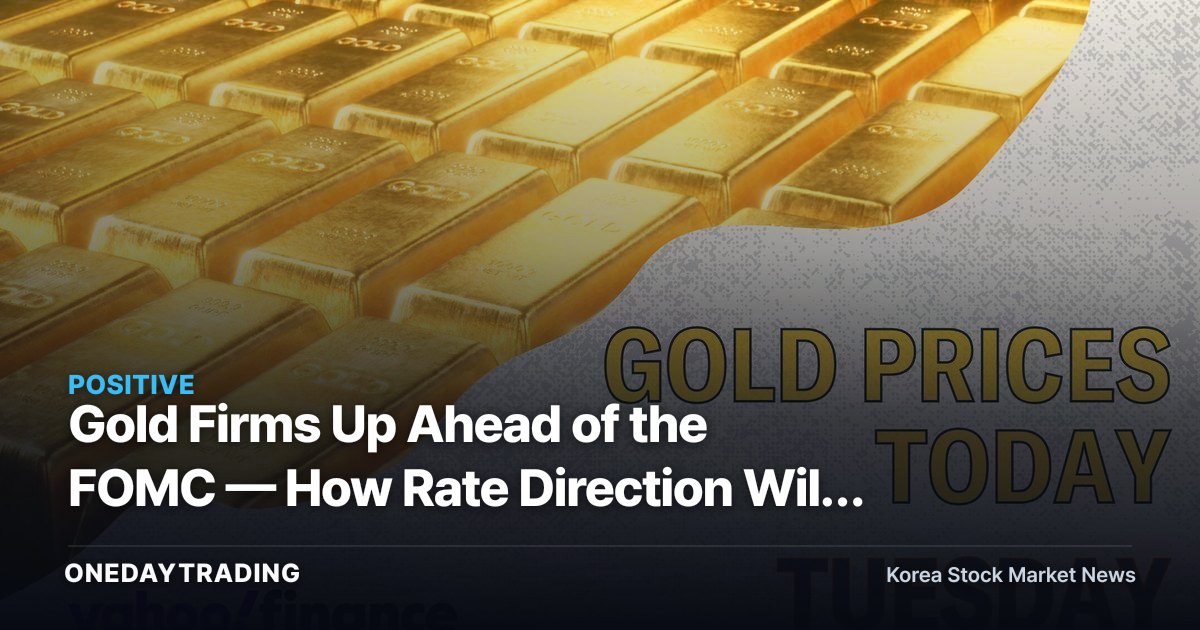

Gold's strength is a signal of more than just a simple flight to safe havens. It means the market has begun to price in the Fed's rate-cut path once again, and this ripples through the value of the dollar, real interest rates, and even the margin structures of domestic non-ferrous and precious-metals companies that produce gold as a byproduct or whose earnings are tied to gold prices. For Korean investors, this trend is less a short-term trading catalyst and more a gauge for assessing where the center of gravity in asset allocation is tilting, depending on the outcome of the Fed meeting.
Three-Line Briefing
- International gold prices are consolidating their strength as buying interest flows in ahead of the Federal Open Market Committee (FOMC) meeting.
- The key variable is not the rate decision itself, but the dot plot and Chair Powell's remarks, which will offer clues about the pace of future cuts.
- Depending on the direction of rates and the dollar, domestic companies that produce and handle precious metals, along with safe-haven demand, could swing together.
What's Changing
Gold is an asset that bears no interest, so the lower rates go, the more attractive it becomes on a relative basis. Gold firming up ahead of the meeting can be read as the market leaning toward a hold or a cut rather than further hikes. In other words, the essence of this price strength lies in shifting monetary-policy expectations rather than in gold's own supply-demand (order flow).
The crux is the tone of the message that comes out of this meeting. Even if a hold materializes as expected, if the dot plot showing members' future rate projections points toward an earlier timing for cuts, gold could face additional upward pressure; conversely, if it signals higher-for-longer rates, profit-taking could emerge. Ultimately, the price volatility immediately after the meeting is likely to be determined more by the accompanying materials and the press conference than by the statement itself.
By the Numbers and Context
Gold typically shows an inverse relationship with the dollar. If the meeting's outcome leads to dollar weakness, that is favorable for dollar-denominated gold prices, while for domestic investors converting into won, the exchange rate adds another layer of variability. It's worth keeping in mind that when the won-dollar exchange rate is high, even if international gold prices move sideways, gold prices in won terms and the won-converted revenue of related companies are relatively supported.
Beneficiary and Affected Stocks
- Korea Zinc: It recovers and sells gold and silver as byproducts of its zinc and lead smelting process. Since rising precious-metals prices improve margins without any additional cost increase, it is a prime direct beneficiary of gold's strength.
- Precious-metals trading and distribution sector: In a rising-price phase, trading turnover and valuation gains increase, but inventory risk also grows when volatility expands.
- Banks and brokerages: If demand for gold-linked products (gold banking, gold ETFs) rises, the fee base could expand.
- Exporters with large dollar-asset exposure: If dollar weakness accompanies, it is a positive catalyst for gold but a burden on export profitability, so the direction could diverge.
Risk Check
- If the Fed reaffirms higher-for-longer rates, the logic behind gold's strength could quickly waver.
- If gold prices are already in a high range, the burden of profit-taking is heavy relative to the room for further gains.
- Domestic related stocks may be driven more by individual factors such as the exchange rate, smelting fees, and raw-material input costs than by gold prices, creating a risk that gold prices and share prices move separately.
- If the flight to safe havens is coupled with a retreat from risk assets, it could weigh on the broader stock market in the same phase.
One-Line Conclusion
As long as rate-cut expectations underpin gold prices, the environment is favorable for precious metals and related stocks; however, if this meeting's dot plot and Powell's remarks roll back those expectations, the strength logic could weaken at once — making this a phase to respond while checking both the meeting outcome and the exchange-rate level.
Korea Zinc Through Real-Time Data
Korea Zinc's latest closing price is 1,261,000 won (-2.47% from the previous day), and the signal light combining foreign-investor and institutional-investor order flow with news and momentum is 🔴 Caution. Foreign investors, institutional investors, and momentum are negative, so caution is warranted right now.
- ▼ Dual selling — foreign investors −1.2 billion won · institutional investors −3.6 billion won selling together
Recent related news is favorable, with 1 positive catalyst · 0 negative catalysts.
※ Price and foreign-investor/institutional-investor order-flow data are provided by Korea Investment & Securities (KIS), as of the time of publication.
This article is auto-summarized and analyzed content based on the original news. View original (Yahoo Finance)