
Key Takeaways
200 million won allegedly moved a permit decision. A senior official at the Anseong City government has been indicted on charges of colluding with a private developer, granting favorable treatment on a real estate development permit in exchange for money. The case could end up being contained as an isolated lapse. But if it escalates into evidence of structural corruption within local permit administration, a reassessment of PF project viability across southern Gyeonggi Province's development projects becomes unavoidable.
What Happened
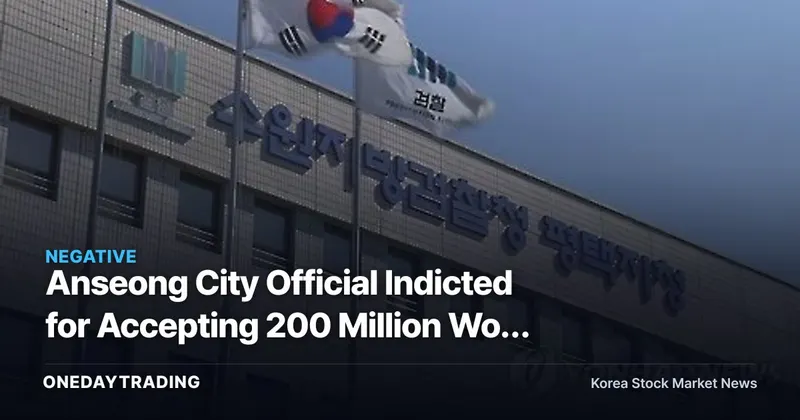
Prosecutors have indicted a senior Anseong City Hall official and a private developer on charges of bribery and bribe-giving. At the core of the case is an allegation that roughly 200 million won changed hands in return for favorable treatment during the permit-approval process for a real estate development project. This goes beyond a simple solicitation — what makes it more serious is that a decision-maker within the permit administration itself was directly implicated.
Permit-related corruption is difficult to expose. Approval authority is monopolized by local governments, and private developers have weak bargaining power in a structure where their project timelines are effectively held hostage. The indictment is the result of investigators tracing the fund flow backward, and it is notable that the charges specify concrete amounts and the exact nature of the favors granted.
Background and Context
Southern Gyeonggi Province is a region where demand for logistics centers, residential complexes, and industrial facility development has concentrated amid the expansion of the Seoul metropolitan area. The Anseong-Pyeongtaek area has seen development pressure rise rapidly since the early 2020s, coinciding with the easing of metropolitan-area regulations. In a structure where a single permit decision can determine a project's profitability, the incentive for collusion between public officials and private developers was structurally built in. This case is an instance where that incentive translated into actual conduct. The concern is that it may be only the tip of the iceberg.
Market and Stock (Ticker) Impact
- Small and mid-sized real estate developers and project promoters: This is a direct risk for smaller developers heavily reliant on local government permits. If the investigation expands, permit reviews could be revisited or delayed, adding pressure to PF maturity structures tied to construction completion timelines. Listed construction companies with PF exposure linked to these developers face this as an indirect risk.
- Financial institutions holding local PF exposure: Savings banks, securities firms, and capital firms holding PF exposure to development projects in southern Gyeonggi Province should review permit-delay risk. Amid ongoing regulatory pressure to normalize PF loans, permit-related uncertainty could trigger a broader reassessment of project viability.
- Large construction companies: Direct involvement is unlikely, but industry-wide compliance costs are set to rise. If investigators expand their review of public development projects, permit re-examinations at some sites could feed into project costs.
- Local land and pre-sale markets: Rising uncertainty around development permits could dampen near-term land-purchase demand in southern Gyeonggi Province. REITs and public offering funds with heavy exposure to real estate assets in this region warrant monitoring.
Investor Checkpoints
- Scope of the investigation: Whether this indictment is contained to Anseong City alone, or whether the investigation spreads to other local governments in southern Gyeonggi Province, will be the dividing line for sector risk.
- PF maturity and normalization schedule: Check half-year disclosures from financial institutions holding PF exposure to development projects in southern Gyeonggi Province for regional exposure levels and provisioning status.
- Changes to permit administration policy: Watch for whether the Ministry of Land, Infrastructure and Transport or the Ministry of the Interior and Safety announces measures to strengthen oversight of local permit administration. Tighter standards would lengthen permit processing times and push back overall development project timelines.
- Timing of the first-instance court ruling: If the charges are confirmed, questions could be legally raised about the validity of the related development permit, making it worth checking whether cross-default clauses in linked PF loans could be triggered.
Outlook
If the indictment is resolved as an isolated lapse by specific individuals and the investigation does not expand, the market impact will be localized. There is even a scenario in which permit procedures in the Anseong area become more transparent as a result of the normalization process.
The risk scenario is different. If prosecutors or the Board of Audit and Inspection begin reviewing similar cases across local governments throughout the Seoul metropolitan area, a simultaneous reassessment of project viability could sweep through the local PF market. With PF restructuring pressure already mounting from prolonged high interest rates, the added variable of permit delays would quickly drive up project-level funding costs. Two things to watch next: whether prosecutors file additional indictments, and when the Ministry of Land, Infrastructure and Transport issues guidance to strengthen oversight of local permit administration.
This article was automatically summarized and analyzed based on the original news source. View Original (Yonhap News)