
Summary
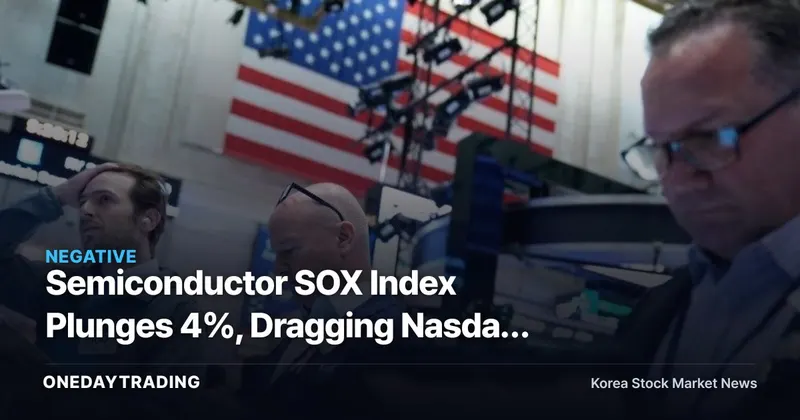
On the 16th (local time), the Philadelphia Semiconductor Index (SOX) slid roughly 4%, dragging the Nasdaq down 1.47%. The S&P 500, meanwhile, fell just 0.51% the same day, cutting its decline by more than half. This gap within the same New York trading session shouldn't be read as ordinary volatility — it signals that the market has begun recalculating the premium it has been assigning to semiconductor valuations.
What Happened
Across the materials-equipment-foundry-set semiconductor supply chain, when an index wobbles, the segment carrying the heaviest valuation burden gets shaken out first. The SOX is a highly sector-pure index made up of chip design, equipment, and foundry companies. The Nasdaq has a substantial weighting in these same SOX constituents by market capitalization, so when the SOX shakes, the whole index shakes with it. The S&P 500, on the other hand, is diversified across financials, healthcare, consumer staples, and other sectors, so a shock from a single semiconductor sector spreads to the broader index more slowly. The relatively shallow 0.51% drop that day is a direct reflection of that diversification effect.
The issue is that this sharp drop (plunge) originated not from an earnings shock but from a valuation pullback. This year, semiconductor stocks have moved in a pattern where multiples rose first on AI data-center demand expectations, with earnings following afterward. In such a phase, even minor news — on the rate path or oversupply concerns — can trigger outsized swings in the index. Whatever triggered the pullback, the sheer size of the reaction reflects just how much valuation pressure had built up.
Structural Background
Semiconductor industry conditions pass through with a lag — from materials and equipment orders, to foundry utilization rates, to finished-product shipments. What's currently priced in is AI server and HBM demand over the next several quarters, not earnings that have already been confirmed. In other words, how far the index has pulled forward future expectations determines the magnitude of the sharp drop (plunge). The joint weakness in the SOX and Nasdaq, alongside the S&P 500's relative resilience, should ultimately be read as a gauge of just how much of a semiconductor premium had been built in.
Impact on Stocks (Tickers) and Industry Sectors
- Samsung Electronics · SK Hynix - Nasdaq and SOX corrections directly affect the supply-demand (order flow) for large-cap KOSPI semiconductor stocks (tickers) on the next trading day, following the close of the New York market. Short-term selling can emerge purely from index co-movement, regardless of the memory price outlook.
- Equipment makers such as Wonik IPS, PSK, and TES - Valuation adjustments among U.S. semiconductor equipment and design companies also pressure the multiples of Korean materials/parts/equipment (component) stocks whose earnings cycles are closely linked.
- HBM back-end process names such as Hanmi Semiconductor - If AI server demand expectations get walked back, these are the first candidates for valuation reassessment.
- Semiconductor-themed ETFs and SOX-tracking products - A sharp drop (plunge) in the SOX feeds directly into the net asset value of related ETFs, with leveraged products seeing amplified volatility.
Bullish vs. Bearish Scenarios
The bearish case gives weight to the possibility that this correction signals the AI data-center capex cycle has passed its peak. In a phase where valuations ran ahead of earnings, even minor concerns get amplified into large drops, and there's no guarantee the correction ends in a single day. The bullish case, however, points to the S&P 500's limited 0.51% decline as evidence that this sharp drop (plunge) is merely an internal valuation pullback within the semiconductor sector, not a signal of broader economic demand slowing. The fact that no confirmation of an actual slowdown in AI server and data-center investment has emerged yet also supports this scenario. The key question is whether this correction is a one-day pullback or the start of a trend reversal that's pre-pricing a capex slowdown.
Investor Action Points
- Check SOX and Nasdaq futures trends on the next trading day and whether the decline is being retraced.
- Review AI server/data-center order intake and capex guidance from major semiconductor earnings releases scheduled this month.
- Watch foreign investors' supply-demand (order flow) and program trading trends for Korean large-cap semiconductor and materials/parts/equipment stocks on the next trading day.
- Gauge fund flows into semiconductor-themed ETFs to assess whether this correction is a short-term retracement or a trend reversal.
This article was automatically summarized and analyzed based on the original news source. View original (Maeil Business Newspaper, Securities)