
Three-Line Briefing
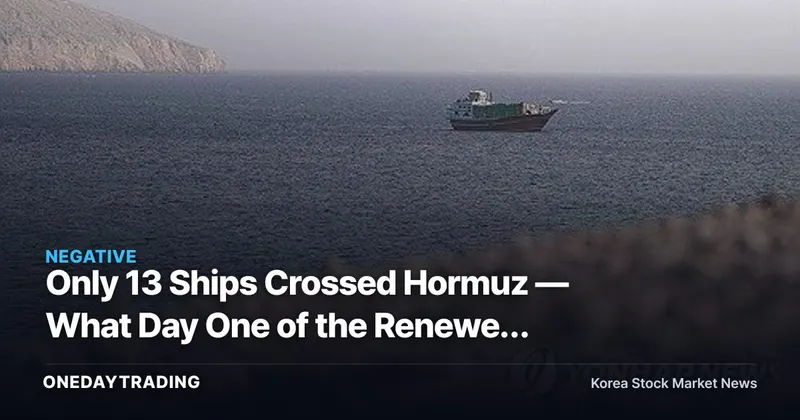
- Amid continuing armed clashes, the U.S. Navy resumed its blockade of Iranian ports, and on its first day only 13 ships transited the Strait of Hormuz.
- Since transit volume itself is a leading indicator of the physical bottleneck in seaborne crude transport, this figure signals that geopolitical risk has moved from narrative to actual volume.
- With ripple effects likely to fan out across oil prices, refining margins, tanker freight rates, and jet fuel costs, investors need to distinguish winners from losers sector by sector.
What's Changing
What matters isn't the number 13 itself, but the fact that day one confirmed the blockade can actually reduce transit volume. The market had already priced Hormuz risk into oil as a "geopolitical premium." But that premium was, after all, a value assigned to probability. The sharp drop in actual ship transits signals that probability has turned into an event, opening room for prices to be repriced.
Still, a single day's data cannot confirm a trend. Hormuz is a narrow bottleneck in global seaborne crude transport that is difficult to replace, and the key question is whether ship transits keep falling over consecutive days. A one-day snapshot and a sustained bottleneck get reflected in the oil price curve in entirely different ways. The former simply reconfirms a premium already priced in; the latter represents a real supply reduction not yet reflected.
For refiners, two variables move simultaneously: rising crude procurement costs and the defense of refining margins. If pass-through to product prices such as gasoline and diesel fails to keep pace with the rise in crude import costs, margins get squeezed instead of expanding. Conversely, if a prolonged blockade delays crude shipping schedules bound for Asia, refiners will be forced to adjust utilization rates, adding to the quarterly earnings volatility of domestic refiners.
Reading the Numbers in Context
The transit count of 13 ships, recorded just as the blockade resumed, is the first data point that will serve as a benchmark for how far volume has fallen versus normal times. Whether this figure recovers over the following days or falls further into single digits is the real gauge of oil price direction. Adding to this, the fact that armed clashes between the U.S. and Iran are continuing sporadically lends weight to the interpretation that the blockade is a byproduct of genuine military tension rather than a negotiating chip.
Stocks to Watch: Winners and Losers
- S-Oil, SK Innovation (SK이노베이션): Both rising crude procurement costs and the possibility of wider refining margins are in play at once, making the speed of product-price pass-through the key swing factor for earnings.
- HMM, Pan Ocean (팬오션): Adopting detour routes lengthens voyage distances and days, which is positive for revenue, but also raises fuel and charter cost burdens.
- Korean Air, Asiana Airlines: Given the high share of jet fuel in operating costs, an inability to immediately pass rising oil prices through to fares makes near-term margin pressure unavoidable.
- Hanwha Aerospace, LIG Nex1: The longer Middle East geopolitical tensions persist, the more order momentum for related defense stocks (tickers) could come into focus.
- Chemical stocks (industry sector) such as Lotte Chemical: A heavier naphtha feedstock cost burden could translate into pressure on spreads.
Risk Check
- The 13-ship count may prove to be a one-off snapshot — confirmation requires several more days of transit data.
- If the blockade drags on, whether alternative transport routes (such as overland pipelines) can be activated will determine the actual scale of the supply shock.
- If a sharp gain (surge) in oil prices stokes inflation concerns, expectations for rate cuts could retreat, weighing on valuations broadly.
- Refining and chemical stocks could face the paradoxical situation of margin erosion if cost pass-through lags behind sales-price pass-through.
Bottom Line
The geopolitical premium is still alive, but until it's confirmed whether the decline in ship transits continues for several more days, it's too early to call a firm direction for oil, refining, or shipping stocks (tickers).
This article is automatically summarized and analyzed content based on the original news report. View Original (Yonhap News Agency, Markets)