
Three-Line Briefing
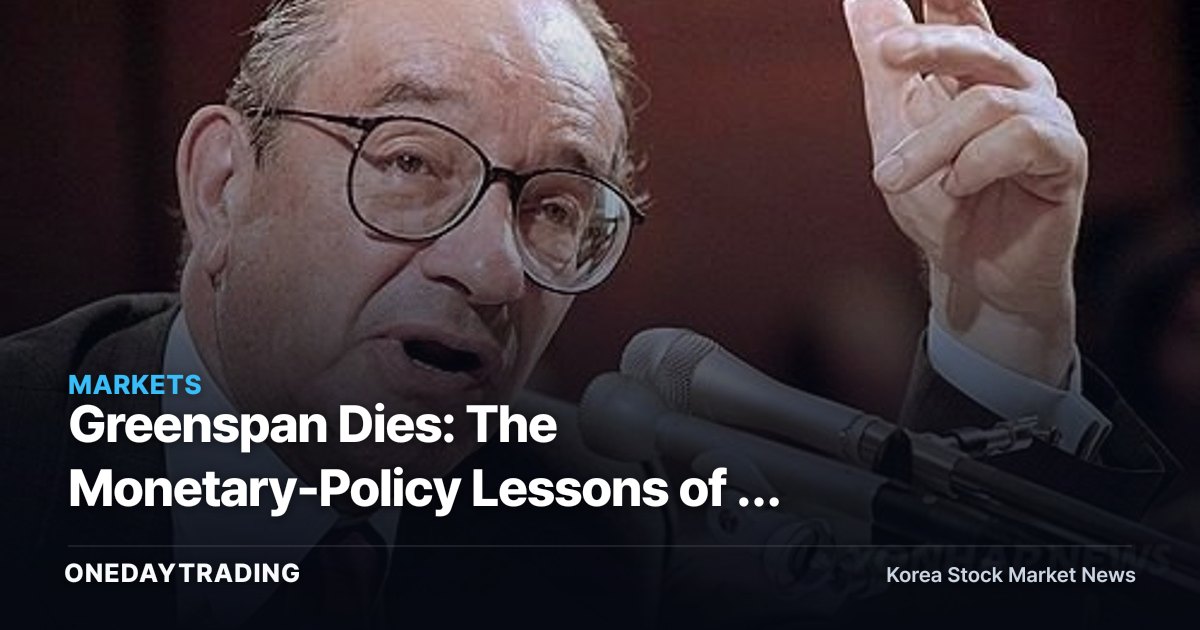
- Alan Greenspan, the former Fed Chair who led the central bank for roughly 18 years from 1987 to 2006, has died. He is a two-sided figure — a symbol of a Goldilocks economy of long-running growth amid low inflation, yet also a target of criticism for allowing asset bubbles to go unchecked.
- His asymmetric easing bias — cutting rates swiftly in a crisis but never moving preemptively against bubbles, the so-called "Greenspan put" — became the origin of a market structure in which investors price in a central-bank bailout.
- From an investor's standpoint, the key point is not the eulogy but the fact that a central bank's rhetoric, policy consistency, and approach to bubbles still operate as variables that drive today's rate bets and growth-stock valuations.
What Changes
Greenspan's death is not, in itself, a market-moving event. Its significance lies in prompting a reassessment of the monetary-policy framework he designed. What defined his era was a principle: when signs of recession or a market sharp drop (plunge) appeared, cut rates quickly to absorb the shock, but when equities or real estate overheated, do not judge in advance whether a bubble exists and tighten against it. Markets took this as a put option backstopping the downside, and risk-asset appetite was structurally reinforced.
This framework is the starting point of today's market, with its heavy dependence on asset prices. Investors buying tech stocks and long-dated bonds simultaneously on a single signal of a Fed pivot toward easing, and the pattern in which valuations jump first on rate-cut expectations alone, are responses learned during the Greenspan years.
At the same time, he is criticized for acknowledging bubbles only after the fact. His view that an asset price is confirmed as a bubble only once it bursts led to controversy over the absence of preemptive action against the dot-com bubble and the mid-2000s housing-market overheating. This is also the starting point of the counter-reaction that now leads the Fed to weigh financial stability and price stability together.
By the Numbers and Context
Shortly after taking office in 1987, Greenspan faced Black Monday that October, when the Dow Jones plunged more than 20% in a single day; he earned his reputation by swiftly supplying liquidity to the market and calming the crisis. He then served for more than 18 years, through the long expansion of the 1990s and the bursting of the dot-com bubble in 2000. That long tenure itself was the backdrop that produced policy continuity and a learning effect in the market.
The crux of the context is the difference in eras. In his time, globalization and low inflation underpinned an easing bias, but in the recent environment, where inflation has resurfaced, the same kind of unlimited easing no longer works. Mapping the old framework directly onto the present can lead to a misreading of the rate path.
Winning and Losing Sectors
- Growth stocks and the tech sector: most sensitive in valuation to an easing bias and low-rate expectations. The stronger the perception that the central bank responds to bubbles after the fact rather than heading them off, the more risk appetite for high-PER stocks (tickers) revives.
- Financial sector: directly tied to the rate cycle and the loan-deposit spread, it sits squarely in the path of any shift in the monetary-policy framework. Prolonged easing pressures margins, while a turn to tightening improves them — two opposing paths.
- Real estate and REITs: the asset class most sensitive to long-term rates and borrowing costs, and the one at the center of the debate over how to handle bubbles.
- Long-dated and other bonds: policy consistency and rate-cut expectations are priced in directly, and a weakening easing bias raises duration risk.
Risk Check
- Overreading a memorial news item as a market signal is itself a risk. This matter is not a direct share-price catalyst.
- Today's Fed operates under a different inflation phase and a different set of personnel and policy stance, so simply projecting Greenspan's easing bias onto the present can throw off the rate outlook.
- Risk appetite that leans on the Greenspan put carries the cost of accumulating bubbles. Easing-dependent bets are exposed to a sharp reversal at the moment policy turns.
- Historical analogy has a small sample, so its limits in generalization are large. Positioning that assumes the same pattern will repeat makes the variables hard to control.
One-Line Conclusion
Greenspan's legacy became fuel for risk appetite by institutionalizing the expectation that the central bank will backstop the market, but it also left behind a bill in the form of unchecked bubbles. It is reasonable for investors to gauge how far this easing bias can hold up in an inflation phase — through the next Fed meeting's rate decision, the dot plot, and shifts in the tone of the chair's remarks — and to adjust their exposure to growth stocks and bond duration accordingly.
This article is content automatically summarized and analyzed from an original news report. View original (Yonhap News, Securities)