
Key Takeaways
Kioxia's rise to the top of Japan's market capitalization rankings is not simply the success story of a single Japanese company. It reads as a market signal that the NAND flash cycle—long overshadowed by DRAM—has decisively turned. The enormous profit reaped by Bain Capital is also a case study in just how extreme the swings between troughs and peaks in the memory industry can be.
For Korean investors, the direct points to watch are SK Hynix—which holds a stake in Kioxia while also competing in the NAND market—and whether Samsung Electronics, the memory market leader, can restore its profitability.
What Happened
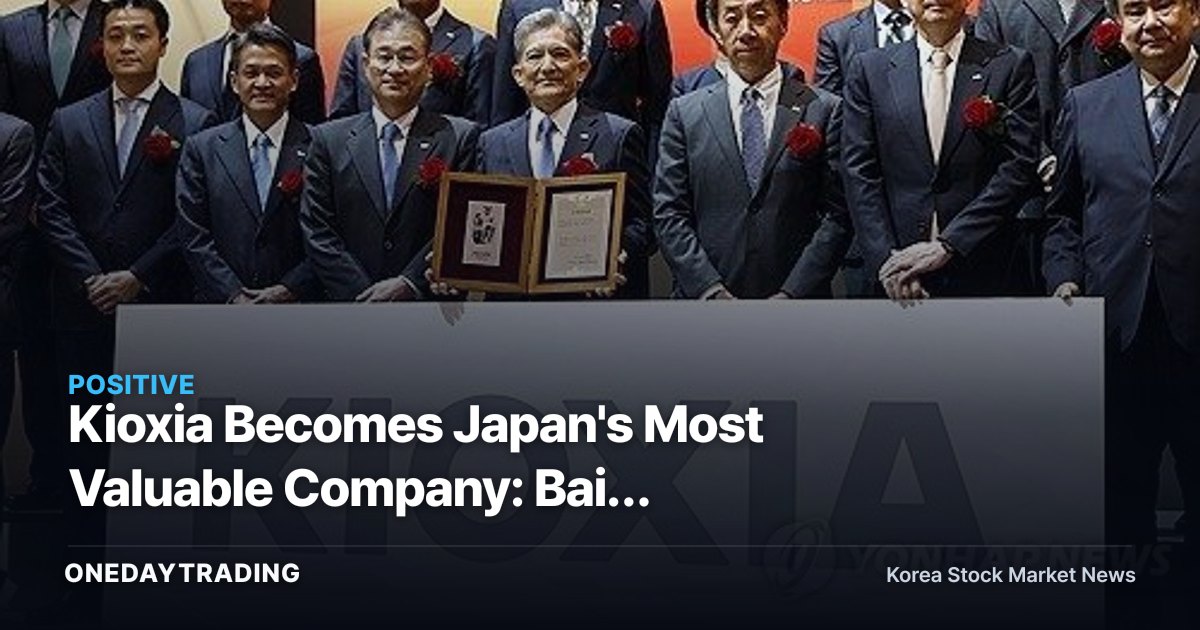
Shares of Kioxia, the Japanese specialist in NAND flash memory, surged to become the most valuable stock on the Japanese market by market capitalization. Kioxia was spun off from the former Toshiba memory division, and in 2018 a consortium led by U.S. private equity firm Bain Capital acquired it for roughly 2 trillion yen.
At the time, Toshiba was facing a liquidity crisis stemming from accounting fraud and the collapse of its U.S. nuclear power subsidiary, and many viewed the sale as effectively handing over a prized memory business at a bargain price. With this sharp gain (surge) in the share price, Bain Capital's paper profit on its holdings is reported to have reached around 23 trillion won.
The driver behind the share-price rally is the expansion of investment in artificial intelligence (AI) data centers. As demand grows for the high-capacity storage required for AI training and inference, prices for enterprise solid-state drives (eSSDs) and high-capacity NAND have rebounded, rapidly improving the earnings outlook for a Kioxia that had been mired in losses.
Background and Context
The NAND market saw most major players post losses in 2022–2023 amid severe oversupply and falling prices. Since then, prices have entered a recovery phase as manufacturers cut production and demand for high-value-added products for AI servers revived.
Kioxia maintains a joint production arrangement with U.S.-based Western Digital, and SK Hynix participated in the acquisition consortium as a financial investor, securing certain equity rights. In other words, Kioxia's revival is directly tied to Korean memory companies that are simultaneously competitors and stakeholders.
Impact on the Market and Individual Stocks
- SK Hynix: Through its participation in the consortium, it shares in some of the paper gains from Kioxia's rising value, while the rebound in NAND prices feeds directly into the profitability of its core business. That said, NAND contributes less to earnings than DRAM, so the strength of the price recovery is the key variable.
- Samsung Electronics: As the No. 1 player by NAND market share, it has the greatest profit leverage in its memory division when prices rebound. Expanding the share of high-capacity eSSDs for AI is the crucial factor in margin improvement.
- Semiconductor materials and equipment makers: Higher NAND utilization rates and expectations of resumed capacity expansion could translate into orders for domestic suppliers tied to etching and deposition processes.
- Competitive-landscape variable: Kioxia's restored financial strength means greater capacity for future expansion and technology investment, which over the medium to long term could become a source of supply pressure for Korean companies.
Investor Checkpoints
- Watch whether the monthly trend in NAND contract prices (eSSDs and commodity products) continues to rebound.
- In the quarterly earnings of SK Hynix and Samsung Electronics, examine the extent of the NAND division's swing to profit and changes in the eSSD revenue share.
- Shifts in AI data-center investment guidance (capex plans of major big-tech firms) will determine the outlook for storage demand.
- Gauge supply-side pressure based on whether Kioxia and Western Digital announce capacity-expansion plans.
Outlook
If AI demand holds firm and manufacturers maintain supply discipline, the NAND price upcycle could lengthen, with room for Korean memory stocks to build stronger earnings momentum. Conversely, if revived companies like Kioxia all move to expand capacity at once, there is a risk that oversupply reappears as it did in the past and prices cool quickly—and the fact that much of the recovery expectation is already priced into the stocks could weigh on valuations. The coming quarterly earnings will need to verify whether the short-term share-price surge has outpaced the speed of fundamental improvement.
SK Hynix Through Real-Time Data
SK Hynix's latest closing price is 2,382,000 won (+4.11% from the previous day), and the signal light combining foreign and institutional investor supply-demand (order flow) with news and momentum is 🟢 Buy-Leaning. With foreign investors, institutional investors, news, and momentum all positive, it merits attention.
- ▲ Order-flow continuity — Foreign investors net buyers for 4 consecutive days (+839.9 billion won)
- ▲ Dual buying — Foreign investors +839.9 billion won and institutional investors +560.4 billion won buying in tandem
- ▲ Trend alignment — Short- and medium-term aligned to the upside (intraday +4.1% · 1 week +7.5% · 1 month +20.9%)
- ▲ 52-week position — In the top 99% of the 52-week range — new-high territory
- ▲ News flow — 25 positive catalysts vs. 6 negative catalysts — positive-leaning
Recent related news is favorable, with 25 positive catalysts and 6 negative catalysts.
※ Price and foreign/institutional investor supply-demand (order flow) data are provided by Korea Investment & Securities (KIS), as of the time of publication.
This article is content automatically summarized and analyzed based on an original news report. View original (Yonhap News Securities)