
At a Glance
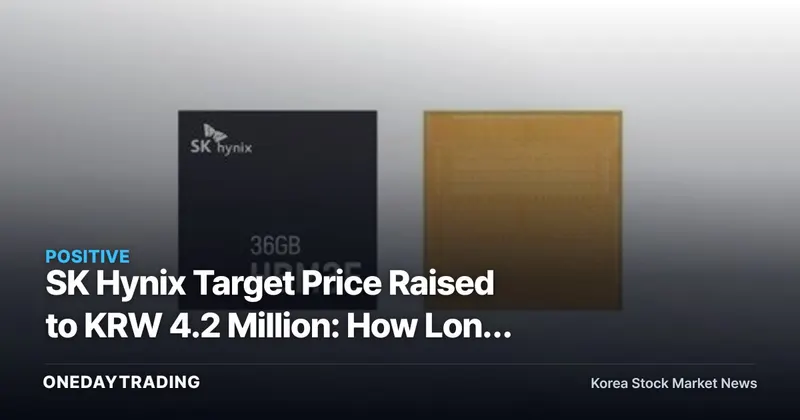
KB Securities raised its target price for SK Hynix by KRW 400,000, from KRW 3.8 million to KRW 4.2 million. The brokerage also raised its operating profit estimates, judging that the memory supply shortage will last longer than expected. What matters more than the size of the target price hike is that the rationale rests not on a short-term price rebound but on how long the supply shortage will persist.
Why It Matters Now
To see where the memory chip cycle truly stands, the supply chain needs to be broken down into wafer input, process conversion, packaging, and customer orders. SK Hynix is prioritizing wafer capacity and back-end packaging lines for HBM used in AI accelerators. Because HBM is built by stacking multiple DRAM dies using through-silicon vias, the same production capacity yields less volume available for commodity DRAM. KB Securities' view that the supply shortage will persist longer suggests this prioritization is unlikely to ease anytime soon.
The key distinction is between what the market has already priced in and what it hasn't. Robust HBM demand is already well-known information. On the other hand, if commodity DRAM and NAND prices are also strengthening as inventories normalize, that becomes a fresh trigger for upward earnings revisions. The fact that KB Securities' target price hike stems from raising the operating profit estimate itself — rather than simply the DRAM price outlook — suggests this call should be read as a signal that underlying earnings power is structurally changing, not just a valuation re-rating.
Frequently Asked Questions
- What is the basis for the KRW 4.2 million target price? — KB Securities raised its operating profit estimate for SK Hynix on the view that the memory supply shortage will be prolonged, and recalculated the target price to reflect that.
- Is the increase from KRW 3.8 million to KRW 4.2 million large? — The KRW 400,000 hike, roughly 10%, is in line with the recent trend of research houses successively raising their expectations.
- How long could the supply shortage last? — Rather than pinning down a specific end date, the report emphasizes the direction that the shortage phase will run longer than expected.
- Hasn't the stock price already priced in these expectations? — What matters is the gap between the target price and the current share price, and whether the profit estimate actually holds up in the next earnings report.
Related Stocks & Sector Impact
- SK Hynix — The direct subject of the target price hike. HBM supply prioritization together with strength in commodity DRAM prices is the key channel behind the upward earnings revision.
- Samsung Electronics (005930) — Shares the same beneficiary path from the memory supply shortage. DRAM and NAND price trends jointly affect earnings expectations for its semiconductor division.
- Memory equipment and materials stocks — A prolonged shortage increases the incentive for continued capacity expansion and process-conversion investment, which spills over into order flow for domestic semiconductor equipment and materials makers.
- HBM customers — AI accelerator makers such as Nvidia depend on stable HBM procurement, so they are also affected by this reshuffling of supply priorities.
Investment Considerations
- A target price is a brokerage estimate, not confirmed earnings. It needs to be verified whether operating profit matches the estimate when the next quarterly results are released.
- Memory prices behave like a volatile commodity price. If the outlook for a prolonged supply shortage turns out to be wrong, earnings estimates could be lowered as well.
- The mechanism by which priority allocation to HBM tightens commodity DRAM supply can also cut the other way: if commodity product prices rise excessively, it could lead to inventory-adjustment risk among customers.
- The target price hike reflects one brokerage's own judgment, so it should be compared against estimate changes from other research houses and the actual share price trend.
Overall Outlook
The optimistic scenario is one in which HBM demand stays robust while commodity DRAM supply also tightens, structurally lifting SK Hynix's earnings power to a new level. Conversely, if the supply shortage eases faster than expected or coincides with customer inventory adjustments, the raised earnings estimates and target price could be revised back down. The indicators to watch next are SK Hynix's next quarterly earnings release, disclosures related to HBM supply contracts, and the trend in DRAM spot prices.
SK Hynix by the Numbers: Real-Time Data
SK Hynix's most recent closing price was KRW 2,301,000 (+5.21% from the previous day), and the composite signal combining foreign/institutional supply-demand (order flow) and news momentum is 🟡 Neutral / Wait-and-see. With positive and negative signals mixed, this is a segment to watch closely.
- ▼ Supply-Demand (Order Flow) Continuity — Foreign investors have been net sellers for 10 consecutive days (−KRW 1.66 trillion)
- ▼ Dual Selling — Foreign investors −KRW 1.66 trillion · Institutional investors −KRW 3.06 trillion, selling in tandem
- ▲ News Flow — 7 positive catalysts vs. 2 negative catalysts — positive catalysts lead
Recent related news skews favorable, with 7 positive catalysts versus 2 negative catalysts.
※ Price and foreign/institutional supply-demand (order flow) data are provided by Korea Investment & Securities (KIS) and are as of the time of publication.
This content was automatically summarized and analyzed based on the original news article. View original (Yonhap News Agency – Securities)