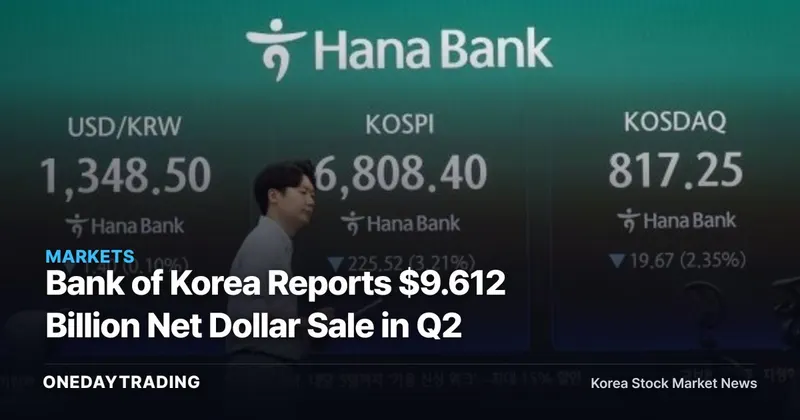

What the Bank of Korea Disclosure Means for Investors
The foreign exchange authorities’ $9.612 billion net dollar sale in the second quarter, disclosed by the Bank of Korea, should be viewed first in terms of the persistence of intervention rather than the KRW/USD exchange rate at a single point in time. According to figures reported by Asia Business Daily Securities, the quarterly net sale was smaller than in the previous two quarters, but the authorities continued selling dollars. The real message is not that the exchange rate’s direction has been settled, but that market stabilization measures have yet to end.
Net sales in the foreign exchange market represent the dollars sold by the authorities minus the dollars they purchased. Investors should not translate the size of the net sale directly into an exchange rate forecast, but instead assess its scale, continuity, and the figures disclosed next. The data contain no information on the earnings or share-price reactions of individual listed companies, providing no basis for determining which specific stock (ticker) may benefit or suffer.
Authorities’ $9.612 Billion Sale Equals 14.437 Trillion Won
On the 30th, the Bank of Korea disclosed details of its market stabilization measures, saying the foreign exchange authorities sold a net $9.612 billion in the second quarter to stabilize the foreign exchange market. Applying the quarter’s average KRW/USD exchange rate of 1,502 won gives an equivalent value of 14.437 trillion won. The figures show the scale of the intervention in both dollars and won.
The second-quarter net sale was the fifth-largest quarterly amount on record. Looking only at the decline from the previous quarter could suggest that the intensity of intervention eased. While the amount decreased on the surface, the underlying net-selling position remained in place. A reduction is not the same as an end.
Seven Consecutive Quarters of Net Sales and the Quarterly Trend
The foreign exchange authorities have been net sellers of dollars for seven consecutive quarters since the fourth quarter of 2024. Net sales reached a record $22.467 billion in the fourth quarter of last year, followed by $13.628 billion in the first quarter of this year. The second-quarter figure of $9.612 billion was smaller than both, but remained part of the continuing net-selling trend.
The market has already seen net sales decline from quarter to quarter. What remains unclear is whether this trend will lead to net purchases or reverse into renewed growth. Continued net sales would indicate that market stabilization measures remain in effect, while a shift to net purchases would provide grounds for reassessing the trend. Either way, one quarter’s amount alone offers too narrow a data set to establish a direction.
The disclosure covers only the total net sales amount. The published information does not identify net sales by individual institutions within the foreign exchange authorities, or the timing and exchange rate of individual transactions. The second-quarter average exchange rate of 1,502 won is therefore a benchmark for converting the amount into won, not evidence that every transaction was executed at the same rate.
What to Watch in the Next Market Stabilization Disclosure
The next key data point will be the actual amount of net dollar sales in the third quarter. Since the current disclosure does not provide that figure, it is too early to conclude that net sales declined further or ended. Rather than relying on forecasts, investors should examine the Bank of Korea’s next market stabilization disclosure to determine whether the trend continued, how much sales declined if they did, or whether the authorities shifted to net purchases.
- Scale: If the next disclosed figure exceeds the second quarter’s $9.612 billion, it would indicate expanded intervention; a lower figure would indicate a further reduction.
- Direction: Whether net dollar sales continue or shift to net purchases is central to assessing the trend’s continuity.
- Benchmark: Do not conflate the dollar amount with its won equivalent; review each unit together with the exchange rate applied.
- Limitation: Do not infer the timing of individual transactions or the actions of individual institutions from the total net sales amount alone.
This figure is not a definitive signal of where the exchange rate is headed. It is a record of how long and at what scale the foreign exchange authorities have continued selling dollars on a net basis. The next macro trigger to watch is not an estimate, but the actual market stabilization data released by the Bank of Korea.
KRW/USD Exchange Rate IndicatorsAs of 2026-09-30
| Performance by Period | 1 Week +0.15% 1 Month -1.04% |
|---|
Index, commodity, and exchange rate figures are based on global markets and reflect values at the time of publication.
This article was automatically summarized and analyzed based on the original news report. View the original article (Asia Business Daily Securities)