
At a Glance
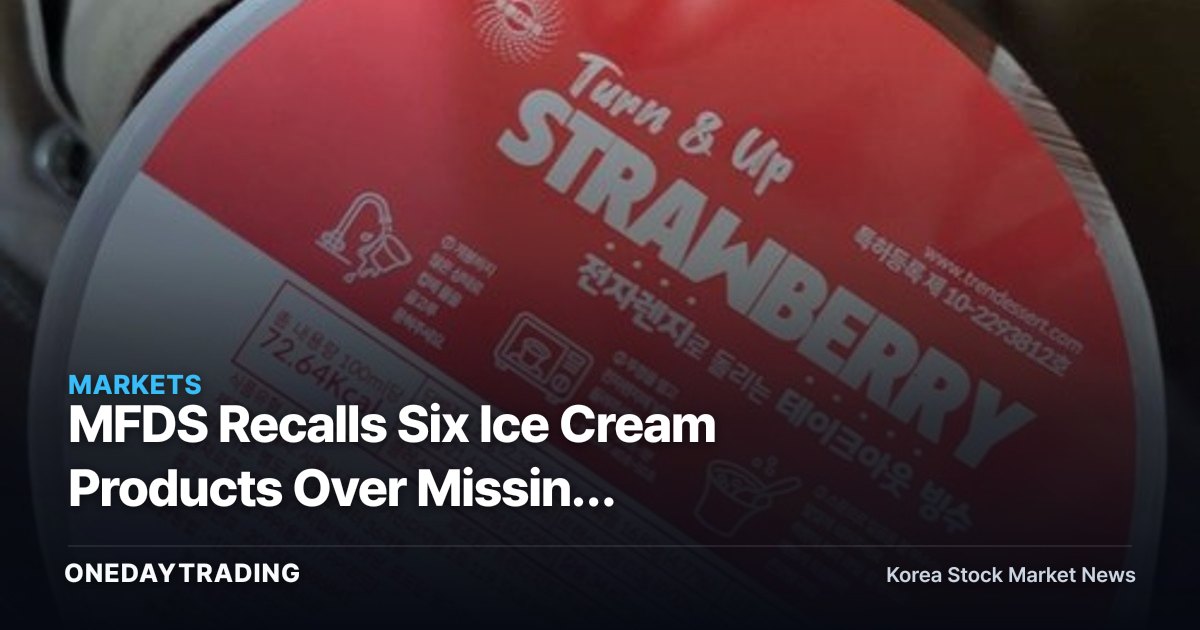
On the 16th, South Korea's Ministry of Food and Drug Safety (MFDS) recalled six ice cream products that did not display manufacturing dates. While the incident itself is small in scale, what matters more to investors is that it can be read as a signal of tightening food-labeling enforcement ahead of summer, the peak season for ice cream.
Based only on the information disclosed so far, the specific manufacturers behind the products have not been identified, so it is premature to conclude that any individual listed company will take a direct earnings hit.
Why It Matters Now
Displaying manufacturing dates and use-by dates is mandatory under the Food Sanitation Act, and omitting them is grounds for recall and administrative penalties. Recalls are often limited to the affected lots, so the direct impact on revenue tends to be contained. The key mechanism, however, is that repeated violations can place a cumulative burden on brand trust and distribution-channel bargaining power.
The ice cream industry has a high concentration of sales during the summer peak season and depends heavily on distribution channels such as convenience stores and large supermarkets. If labeling issues cause specific products to be temporarily pulled from shelves, peak-season opportunity costs can arise. Conversely, tighter labeling enforcement can also work relatively in favor of large manufacturers that have robust sanitation and quality-control systems in place.
Since the manufacturers behind this case have not been disclosed, it is more reasonable to base investment decisions on the trend of future enforcement intensity and whether additional violations emerge, rather than on the incident itself.
Frequently Asked Questions
- Will this recall significantly shake the earnings of listed ice cream companies? — It appears to be a recall limited to six products and specific lots, and since the manufacturers have not been identified, the impact on any individual company's earnings is limited for now.
- Why is the manufacturing-date label an issue? — Violating labeling requirements is grounds for recall and administrative penalties, and because it directly concerns consumer safety, it is an item that regulators scrutinize closely.
- Why should this draw more attention in summer? — Because ice cream sales are concentrated in summer, tighter enforcement just before the peak season can affect supply and shelf placement.
- Which companies are relatively better positioned? — Large manufacturers with sanitation and quality-control systems and automated labeling processes are relatively more stable in a phase of tighter regulation.
Impact on Related Stocks and Sectors
- Binggrae — As the owner of flagship ice cream brands such as Melona and Together, it is a direct subject of observation on ice cream labeling-enforcement issues. That said, this case has not been identified as involving the company's own products.
- Lotte Wellfood — A large manufacturer with an ice cream lineup that includes Jaws Bar and Screw Bar, it has high peak-season sales weighting and significant exposure to distribution channels.
- The broader food and beverage sector — Tighter labeling and sanitation regulation is a short-term cost burden, but over the medium to long term it creates a competitive landscape favorable to large, trust-based companies.
- Distribution (convenience stores and large supermarkets) — Should recalls occur, some shelving and return costs may be passed on, placing this group within the indirect impact zone.
Points to Watch When Investing
- Concluding that this is a positive catalyst or negative catalyst for a specific stock at a stage where the manufacturer has not been identified risks over-interpretation.
- The impact differs greatly depending on whether the recall is at the lot level or covers all products, so follow-up disclosures and announcements should be checked.
- Ice cream stocks are more sensitive to summer weather, crude oil prices, and sugar input costs, and these variables often drive earnings more than labeling issues.
- If valuations have already priced in peak-season expectations, a one-off negative catalyst can amplify short-term volatility.
Overall Outlook
If tighter enforcement leads to market-share gains for companies with a quality-control edge, it could create a favorable environment for large ice cream and food-and-beverage firms. On the other hand, if additional violations continue or spread to specific brands, damaged trust and recall costs could act as a short-term burden. The appropriate approach is to narrow down the scope of the impact while watching the next MFDS announcement, whether manufacturers are identified, and summer peak-season sales trends.
Binggrae Through Real-Time Data
Binggrae's latest closing price is 69,200 won (-1.14% versus the previous day), and the signal light that combines foreign and institutional supply-demand (order flow) with news and momentum is 🔴 Caution. With foreign investors, institutional investors, and momentum all negative, caution is warranted right now.
- ▼ Dual-front selling — Foreign investors −700 million won and institutional investors −100 million won selling in tandem
- ▼ 52-week position — 12% near the 52-week bottom
※ Price and foreign/institutional supply-demand (order flow) data are provided by Korea Investment & Securities (KIS), as of the time of publication.
This article is content automatically summarized and analyzed based on the original news report. View original (Yonhap News, Industry)