
3-Line Briefing
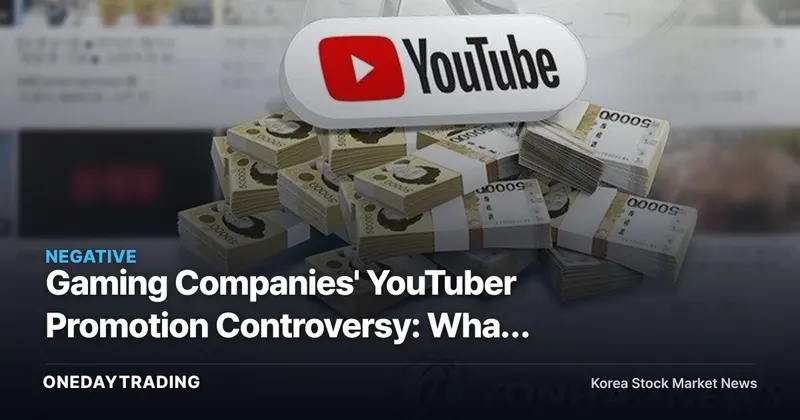
- In the mobile MMORPG market, a growing trend of game developers paying internet streamers to promote their titles is fueling an overheated race for app store rankings.
- The core concern is not simply higher ad spending — it's that marketing costs are hardening into quasi-fixed expenses relative to revenue, which can erode gaming companies' operating profit margins.
- The ranking-inflation controversy could escalate into regulatory variables such as stricter self-regulation or mandatory ad disclosure requirements, making stocks (tickers) with high marketing dependency particularly vulnerable.
What's Changing
The real issue here is not the surface-level shift in promotional channels from TV and portal banners to individual streamers. What investors need to focus on is the structural change in user acquisition (UA) costs. Streamer promotions are used as a tool to rapidly spike downloads and concurrent users during a title's early launch window, quickly pushing it up the app store revenue rankings. A higher ranking drives organic installs, which in turn lifts rankings further — a virtuous cycle that developers are deliberately engineering.
The problem is that once all competitors adopt the same strategy, the cost of simply maintaining a given ranking keeps rising. When marketing spend shifts from a variable cost that generates revenue to a quasi-fixed cost required to defend rankings, operating leverage weakens. Mid-tier game companies with frequent new title launches and wide variation in lineup performance are especially exposed, as this burden translates directly into quarterly earnings volatility.
A second change involves credibility costs. As awareness spreads that undisclosed paid promotions have been used to fuel ranking competition, confidence in app store rankings as a metric is undermined. This reduces marketing efficiency, requiring ever-greater spending to achieve the same effect.
By the Numbers and Context
In game company income statements, marketing costs and personnel expenses are the two pillars of cost of revenue and SG&A. When marketing's share of revenue rises during a period of weakening new title momentum, operating profit can fail to keep pace even as revenue grows. This issue is therefore less an isolated incident and more a structural checkpoint: investors should track the marketing-cost-to-revenue ratio alongside the payback period for each new title when reviewing quarterly earnings.
Winners and Losers by Stock (Ticker)
- Netmarble: Heavy exposure to mobile MMORPG and RPG titles, with a high frequency of new releases, makes earnings highly sensitive to marketing cost swings. Intensified ranking competition may support short-term launch performance, but if the payback period lengthens, it becomes a drag on profit margins.
- NCSoft: High reliance on the Lineage franchise means that as competition for new user acquisition intensifies, the cost of defending existing revenue streams could increase.
- Kakao Games / Wemade: Their significant dependence on external IPs, publishing deals, and aggressive early-stage marketing leaves them more exposed to earnings swings during periods of rising promotion costs.
- Com2uS / Pearl Abyss: Depending on their global revenue mix and the strength of their proprietary IP, the direct impact of domestic ranking competition may be relatively limited.
Risk Checklist
- A scenario where rising marketing costs fail to translate into hit titles, eroding profit margins while revenue stagnates.
- The possibility that promotional practices themselves become constrained by regulatory variables such as mandatory ad disclosure requirements or stricter self-regulation.
- A negative feedback loop in which falling app store ranking credibility reduces marketing efficiency, requiring greater spend to achieve the same outcome.
- Conversely, for select stocks (tickers) with superior marketing efficiency, rivals' cost hemorrhaging could represent a relative opportunity to gain market share — making this difficult to characterize as a uniformly negative catalyst across the board.
Bottom Line
Streamer promotion competition can boost short-term rankings but may weigh on profit margins — making this a period where gaming stocks warrant a closer look at marketing-cost-to-revenue trends and new title payback periods in quarterly earnings, rather than focusing solely on whether a launch is a hit.
Netmarble — Real-Time Data Snapshot
Netmarble's most recent closing price was ₩35,150 (−2.36% vs. prior day). The signal integrating foreign investor and institutional supply-demand (order flow) alongside news and momentum reads 🟡 neutral — wait-and-see. Positive and negative signals are mixed, warranting a monitoring stance.
- ▲ Supply-demand (order flow) continuity — Foreign investors have been net buyers for 7 consecutive sessions (+1.3 billion won)
- ▼ Trend alignment — Short- and medium-term downtrend alignment (day: −2.4% · 1 week: −14.0% · 1 month: −14.8%)
- ▼ 52-week position — Within 2% of the 52-week low
Recent related news: 1 positive catalyst, 0 negative catalysts — a supportive backdrop.
※ Price and foreign investor/institutional supply-demand (order flow) data are provided by Korea Investment & Securities (KIS) and are current as of the time of publication.
This content was automatically summarized and analyzed based on the original news source. View original article (Yonhap News — Industry)