
Key Takeaways
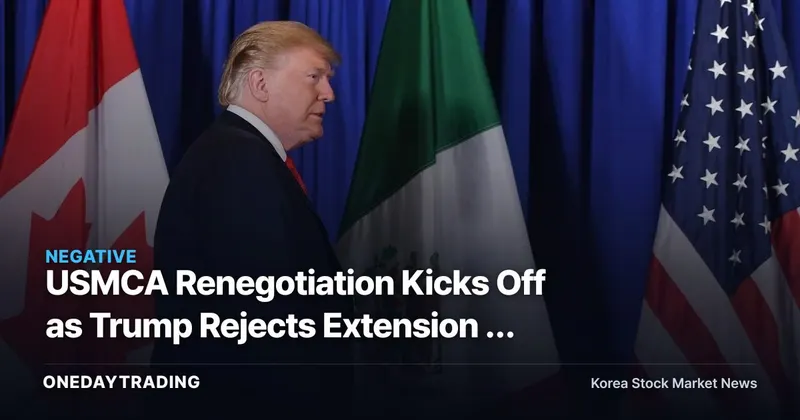
The U.S. government has announced that it will not automatically extend the United States-Mexico-Canada Agreement (USMCA) and will instead enter a renegotiation process. A senior White House official confirmed that President Trump's core grievance lies in the trade deficit with Canada and Mexico. What matters for the market is not whether the agreement itself survives, but the fact that the cost structure of companies that have used Mexico as a bypass production base for tariff-free exports to the U.S. is now back on the review table.
What Happened
The USMCA took effect on July 1, 2020, replacing the former North American Free Trade Agreement (NAFTA). The agreement includes a clause requiring the three countries to jointly review whether to continue the pact at the six-year mark after its effective date, and under its sunset structure, the agreement automatically terminates 16 years later if no such review takes place. This announcement means the first step of that review process has begun with the U.S. side refusing an extension.
Renegotiation does not immediately translate into new tariffs. Procedurally, it requires consultation among the three countries and notification to Congress, and actual changes to the text of the agreement could take anywhere from several months to one or two years. Still, the market tends to react first not to the pace of the process but to the sheer uncertainty that tariffs could once again be put back on the table as a negotiating card. That uncertainty begins to be priced in from the moment renegotiation talks start.
Background and Context
The core appeal of the USMCA was that specific categories of products — such as automobiles, auto parts, and home appliances — could enter the U.S. market tariff-free if they met the rules of origin (regional value content, or RVC, ratio). Taking advantage of this structure, numerous global manufacturers built production lines in Mexico, and Korean companies are no exception. The "trade deficit" grievance singled out by the Trump administration is likely to translate into negotiating pressure aimed at narrowing these rules of origin and the scope of tariff exemptions.
Impact on the Market and Stocks (Tickers)
- Kia — has exported a significant portion of the vehicles produced at its Nuevo León plant in Mexico to the U.S. tariff-free. If rules of origin are tightened, tariff costs would be directly reflected in production costs.
- Hyundai Mobis — operates a parts supply chain linked to Kia's Mexico production line, putting it in the line of impact alongside any adjustment to finished-vehicle production.
- LG Electronics — is exposed to tariff risk given that it supplies refrigerators, washing machines, and other appliances to the U.S. from its Reynosa and Monterrey manufacturing bases in Mexico.
- Samsung Electronics (005930) — faces a similar cost-pressure scenario given the share of U.S.-bound exports from its Querétaro appliance plant.
- Domestic auto parts suppliers — if automakers' production adjustments in Mexico become a reality, order volumes for tier-2 and tier-3 suppliers could also be shaken.
Investor Checkpoints
- The timing of the U.S. Trade Representative's (USTR) official announcement of the start of renegotiations and the release of a schedule.
- Whether the automotive rules of origin (currently a 75% regional value content requirement) will be adjusted, and whether any grace period will be included.
- The likelihood of countermeasures or retaliatory tariffs from Mexico and Canada.
- Exchange rate trends for the Korean won and U.S. dollar against the peso and Canadian dollar — a potential signal that discussions over relocating production bases are gaining momentum.
Outlook
In the optimistic scenario, this announcement turns out to be merely a pressure tactic aimed at securing favorable terms at the renegotiation table, and the existing tariff-free framework ultimately survives with only partial revisions. In that case, the damage to Korean companies with production bases in Mexico would be limited. Conversely, if the rules of origin are substantively tightened or negotiations fall into prolonged deadlock, tariff uncertainty could persist through the next earnings season, acting as a valuation discount factor for the companies involved. The market does not yet appear to have priced in even half of this risk.
This article is auto-summarized and analyzed content based on the original news report. Read original (CNBC)