
Starting Points for Assessing SK Hynix and Samsung Electronics
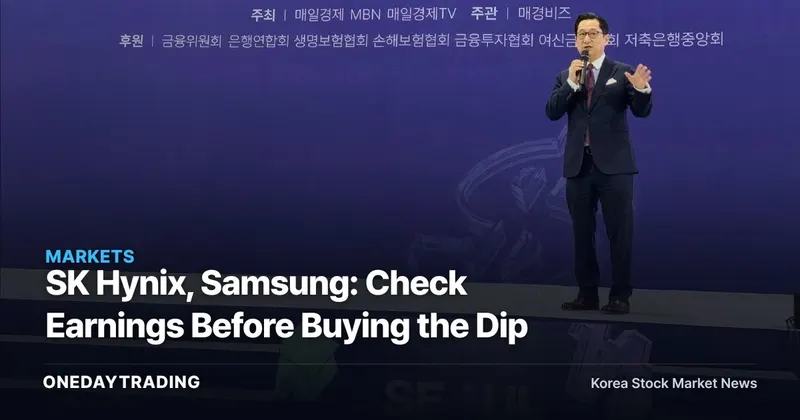
Investors in SK Hynix and Samsung Electronics should look beyond the size of a share-price decline and first determine whether AI demand is translating into corporate revenue and profit. Yoo Dong-won, managing director and head of Global Asset Allocation at Yuanta Securities, said at the “2026 Seoul Money Show” on 2026-10-29 that the scale of investment alone does not prove that AI spending is excessive. Investors should consider both a company’s ability to fund the investment and the path through which returns on that investment flow into earnings.
According to Maeil Business Newspaper’s securities coverage, all roughly 350 seats in Seminar Room 2 at the 2026 Seoul Money Show were filled, with dozens of attendees standing at the back to listen. While this confirms strong interest at the event, it does not validate semiconductor companies’ earnings or future share prices. Investment decisions should rest on corporate profitability and competitiveness, not audience enthusiasm.
AI Investment Is About Recovering Costs, Not Spending Levels
Assessing AI investment means determining whether companies can recoup their spending through revenue and profit. Even a large investment is difficult to characterize as excessive if the company can afford it and convert it into returns. Conversely, if spending continues without contributing to earnings, the gap between the growth narrative and corporate value widens.
When Yoo asked the audience whether they used AI, more than half raised their hands. He said he had asked the same question for four years as of the date of the lecture. Broader adoption is a starting point for evaluating AI-related companies, but it becomes an investment thesis only when increased usage can be shown to translate into those companies’ revenue and profit.
Diversification Matters More Than Picking One Memory Chipmaker
Among AI-related businesses, memory semiconductors offer exposure to demand for computing equipment and data storage. Yoo proposed spreading investments across Samsung Electronics, SK Hynix, and Micron. The reasoning is that even with a positive view of the industry’s direction, it is difficult to know with certainty which company will lead.
This approach may reduce stock-selection risk but could also limit investors’ exposure to the outperformance of an individual company. Diversification alone should therefore not be the reason to buy; investors should separately assess whether each company’s earnings and competitiveness remain intact. The shared memory-semiconductor theme and each company’s underlying strength are distinct considerations.
What Matters More Than Samsung Electronics and SK Hynix P/Es
During the post-lecture Q&A, a question noted that Samsung Electronics and SK Hynix were trading at price-to-earnings ratios of 4 to 5 times. A low P/E alone does not establish undervaluation because the durability of earnings and the portion ultimately returned to shareholders are separate variables. The materials did not provide specific revenue or operating profit figures for the two companies, leaving no numerical basis for comparing earnings quality.
Yoo identified shareholder returns as a condition that could drive a valuation change. He said that if Samsung Electronics and SK Hynix expand and sustain shareholder returns, they could become more attractive to global investors. His remark, “Once that is proven, the share price changes,” emphasized execution over promises.
Why Investors Should Pause Additional Buying During a Decline
A lower share price provides pricing information; it does not prove that a company’s competitiveness remains intact. Yoo proposed pausing additional investment during a decline, checking earnings and competitiveness, and then considering investment as the stock recovers. This approach separates the impression that a stock looks cheap from confirmation of its fundamentals.
This does not mean investors should automatically buy when the share price recovers. Earnings and competitiveness must be confirmed first, with the recovery serving as a signal for when to reassess the opportunity. Reversing that sequence risks treating a decline as an opportunity while following a deterioration in corporate value.
What Semiconductor Investors Should Monitor
- Revenue and profit conversion: Check upcoming corporate earnings to determine whether AI-related investment is generating actual revenue and profit.
- Capacity to absorb costs: Assess whether the company can afford its AI spending rather than focusing solely on the amount invested.
- Sustained competitiveness: During a share-price decline, first examine whether corporate earnings and industry competitiveness have weakened before investing more.
- Execution of shareholder returns: Review upcoming announcements to determine whether Samsung Electronics and SK Hynix are expanding and sustaining shareholder returns.
What Will Determine the AI Growth Case
The bullish scenario depends on broader AI adoption driving semiconductor demand and translating into corporate revenue and profit, while Samsung Electronics and SK Hynix expand shareholder returns. If both earnings and shareholder distributions are confirmed, the companies could become more attractive to global investors.
The risks are that investment spending fails to translate into earnings or that corporate competitiveness weakens. Specific shareholder-return amounts and schedules, future share prices, and investment returns have not been confirmed. The next assessment should begin with earnings releases and the execution of shareholder returns, rather than short-term price movements.
SK Hynix Key MetricsAs of 2026-10-29
| Period Return | 1 Week +23.22% 1 Month -14.76% |
|---|---|
| Trading Value · Trading Volume | 58.3 billion won · 7,072,127 shares |
| Supply-Demand (Order Flow) | Foreign Investors Net buying of 440.4 billion won Institutional Investors Net selling of 253.1 billion won |
| Recent News Tone | 13 Positive Catalysts · 1 Negative Catalyst |
Price and supply-demand (order flow) data are real-time figures from Korea Investment & Securities (KIS), while supply-demand (order flow) and news-tone tallies are calculated independently by One Day Trading.
Supply-Demand (Order Flow) and Momentum Assessment🟢 Buying Dominates
Foreign-investor activity, news, and momentum indicators are showing positive signals.
- ▲News Flow13 positive catalysts vs 1 negative catalyst — positive catalysts dominate
Upcoming Events to Monitor
- 11.12Index Options ExpirationLowKOSPI 200 options expiration
- 11.26Bank of Korea Monetary Policy BoardHighBenchmark interest rate decision meeting
- 12.09FOMC Policy Rate DecisionHighFederal Reserve monetary policy announcement — direction of interest rates and the dollar
- 12.10Futures and Options ExpirationMediumQuadruple witching — watch for volatility and supply-demand (order flow) disruptions
This article was automatically summarized and analyzed from the original news report. View original article (Maeil Business Newspaper Securities)