
Summary
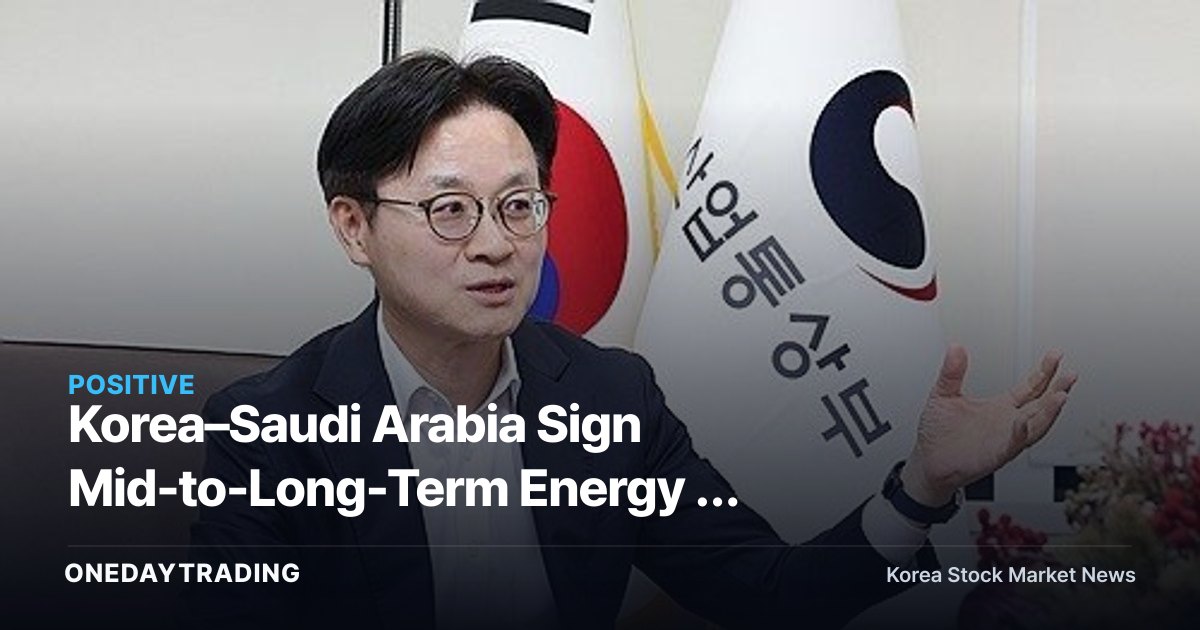
South Korea and Saudi Arabia have signed a memorandum of understanding (MOU) to strengthen mid-to-long-term cooperation in the energy and resources sector. Because it provides a comprehensive framework spanning everything from stable crude oil supply to hydrogen and renewables, as well as large-scale plant and construction contracts, it is viewed as a favorable signal for the oil refining, construction, and energy infrastructure sectors.
What Happened
The significance of this MOU lies in the fact that the two governments have formally codified a mid-to-long-term cooperation framework rather than a one-off transaction. Saudi Arabia is one of Korea's largest crude oil suppliers, and for Korea, securing a stable source of supply is a key priority from an energy-security standpoint.
Through Vision 2030—its national reform project aimed at a post-oil era—Saudi Arabia is broadening its investments into upgraded oil refining and petrochemicals, new cities and industrial complexes, and clean-energy fields such as hydrogen and ammonia. Korean companies have built up a deep track record of construction work in Saudi Arabia's refining and plant markets, and this cooperation framework could translate into additional contract opportunities.
That said, an MOU itself is often merely a statement of cooperative intent with weak legal binding force. It is important to bear in mind that actual results will only become clear as follow-up definitive contracts, specific project sizes, and financing terms are finalized.
Structural Background
In an environment of heightened international oil price and exchange rate volatility, securing a stable source of crude oil supply is directly tied to the cost structure of the entire Korean economy. Moreover, amid the global energy transition, next-generation areas such as hydrogen, ammonia, and renewables offer ample room for mutually complementary cooperation between the two countries. Their interests align well: Saudi Arabia brings capital and resources, while Korea brings construction and plant-engineering capabilities along with energy technology.
Impact on Stocks & Sectors
- Oil Refining: S-Oil, with Saudi Aramco as its largest shareholder, is a direct link to cooperation on stable crude supply and refining upgrades.
- Construction & Plant Engineering: Hyundai E&C, Samsung Engineering, and GS E&C could see contract momentum if Saudi Arabia expands orders for refining, petrochemical, and infrastructure projects.
- Energy & Trading Companies: SK Innovation, GS, and POSCO International have potential to benefit on the crude/resources trading and business-development fronts.
- Hydrogen & Renewables: Doosan Enerbility and others could secure mid-to-long-term growth drivers if clean hydrogen and ammonia cooperation takes concrete shape.
Bullish vs. Bearish Scenarios
In the bullish scenario, the MOU leads to actual large-scale plant and infrastructure definitive contracts, improving the order backlogs and earnings of construction, refining, and energy companies. If Vision 2030–related orders expand, a re-rating of the relevant stocks becomes possible.
In the bearish scenario, there is a risk that the MOU remains at a declaratory level and follow-up commercialization is delayed. A sharp drop (plunge) in oil prices, changes in Saudi Arabia's fiscal conditions, or intensifying global competition for orders could erode expected profitability, so investors should be wary of approaching this on short-term expectations alone.
Investor Action Points
- Distinguish between the MOU stage and the announcement of actual definitive contracts, and track follow-up news for whether specific project sizes and order schedules emerge.
- Take a selective approach focused on stocks with large Saudi exposure—S-Oil in refining, and Hyundai E&C and Samsung Engineering in construction and plant engineering.
- Monitor international oil prices alongside the won/dollar exchange rate to gauge shifts in the margin environment for refining and energy stocks.
- Rather than chasing short-term, theme-driven sharp gains (surges), consider a phased approach timed to when actual order results are confirmed.
This article is content automatically summarized and analyzed based on the original news report. View original (Yonhap News, Industry)