
Three-Line Briefing
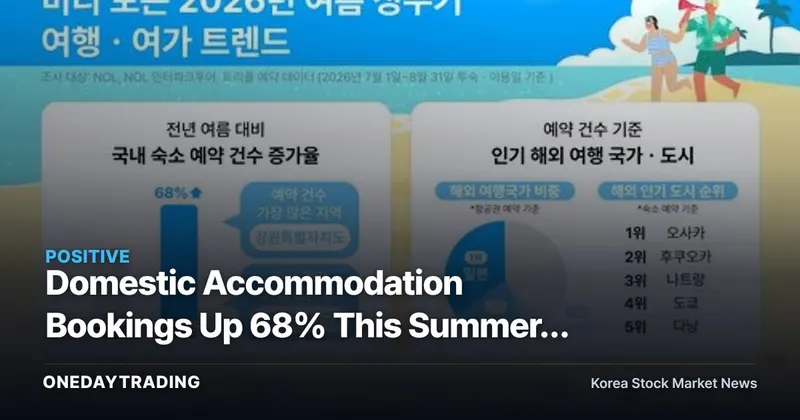
- On July 3, Nol Universe announced that domestic accommodation bookings this summer rose 68% year-over-year.
- Gangwon Province ranked as the top travel destination, reflecting strong demand for nearby getaways centered on valleys and beaches.
- However, the absolute number of bookings underlying that growth rate, along with average transaction value and length of stay, were not disclosed.
What's Changing
The press release frames the 68% figure as evidence of a recovery in domestic travel demand, but what that number reflects is booking volume, not revenue. The fact that platform traffic increased is a separate question from how much of that traffic converted into sales and profit for accommodation and leisure businesses in Gangwon. Even if the number of bookings rose, if the amount spent per booking fell, the business conditions felt by operators on the ground could look quite different.
The reason Gangwon emerged as the top destination is also worth examining. Given that a weak yen has drawn some domestic travel demand toward overseas trips — particularly to Japan — in recent years, this data may signal a partial return of that demand to nearby domestic destinations. Still, this is only a snapshot from a single peak summer season, and the trend could shift again if exchange rate conditions change.
Numbers in Context
The 68% growth rate is impressive on its own, but it comes with the limitation of being based on a single platform, Nol Universe. Since the domestic accommodation booking market is split across multiple platforms, an increase in bookings on one particular platform does not necessarily mean overall market demand has expanded. It's also possible that the figure blends in effects from market-share shifts between platforms or marketing promotions. Without cross-referencing data such as actual visitor inflow to Gangwon or card spending figures, it would be premature to conclude that regional business conditions have improved based on this announcement alone.
Stocks to Watch: Winners and Losers
- Kangwon Land: While an increase in visitors to Gangwon is a favorable backdrop, casino revenue is driven more by high-stakes customers and the share of foreign visitors than by the volume of domestic accommodation bookings, limiting the direct correlation.
- Ananti: Operating resorts in areas such as Goseong, Gangwon, the company is seen as a potential beneficiary of growing near-distance domestic travel demand. However, since membership sales make up a large portion of its revenue mix, there is likely a time lag between a short-term rise in accommodation traffic and any resulting earnings improvement.
- Hana Tour, Mode Tour: These travel agencies derive more revenue from overseas package tours than domestic travel demand, so the direct benefit from this rise in domestic accommodation bookings is relatively limited.
- Notably, most of the domestic accommodation platforms actually at the forefront of this growth — Nol Universe, Yanolja, and Yeogi Eottae among them — remain unlisted, leaving investors with few listed vehicles to directly ride this trend.
Risk Check
- The 68% growth figure comes from the company's own disclosure, and without the absolute scale of last year's comparison-period bookings being made public, it's difficult to verify whether a base-effect distortion is at play.
- Whether the rise in booking volume actually translates into higher average transaction value and occupancy rates for accommodation and resort operators requires separate confirmation.
- Since this data reflects only the peak summer season, the split between domestic and overseas travel demand could shift again depending on changes in exchange rates and economic conditions.
- Listed companies tied to Gangwon have significant business lines — such as casinos and membership-based resorts — with revenue structures that differ from the broader domestic accommodation trend, making it hard to assume that rising booking volume will directly flow through to earnings.
Bottom Line
The 68% rise in domestic accommodation bookings can reasonably be read as a sign of recovering near-distance travel demand, but whether that benefit flows through to the earnings of listed companies tied to Gangwon is a separate matter that still needs to be confirmed with additional data.
Kangwon Land: A Real-Time Data Snapshot
Kangwon Land's most recent closing price was KRW 14,960 (+1.42% from the previous session), and the signal light combining foreign/institutional investor supply-demand (order flow) with news and momentum reads 🟢 Buy-leaning. With foreign investors, institutional investors, and momentum all positive, the stock (ticker) may be worth watching.
- ▲ Twin-engine buying — Foreign investors +KRW 1.9 billion · Institutional investors +KRW 0.8 billion, bought in tandem
※ Price and foreign/institutional investor supply-demand (order flow) data are provided by Korea Investment & Securities (KIS) and reflect figures as of publication time.
This article was automatically summarized and analyzed based on the original news report. View original (Yonhap News, Industry)