
What Falling Korea Treasury Yields Mean in Kang Su-ji’s Report
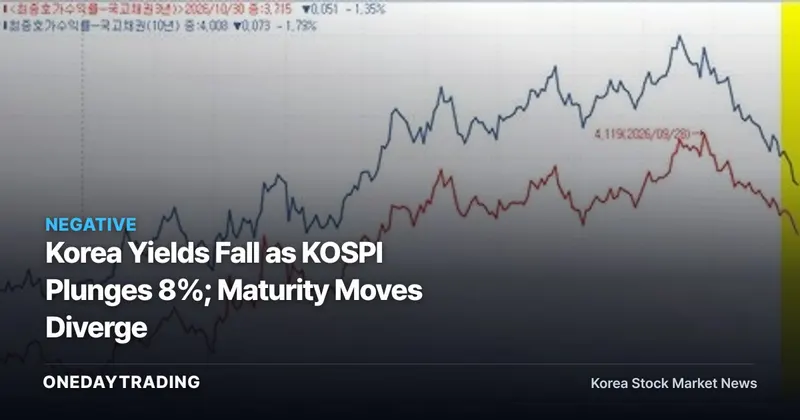
On the morning of November 6, 2026, Korea Treasury yields fell across all maturities. According to figures reported by Kang Su-ji of Yonhap News Securities, the 3-year Korea Treasury bond yield stood at 3.623%, down 4.6bp from the previous day. This means more than a simple decline in yields. It shows that bond prices moved across the entire maturity spectrum while the KOSPI experienced a sharp drop (plunge).
At the same time, the 10-year Korea Treasury bond yield stood at 3.866%, down 2.1bp from the previous day, according to Yonhap News Securities. Falling Korea Treasury yields correspond to rising bond prices. Investors should focus first on the size of the decline by maturity rather than simply the direction of yields. The 3-year yield fell more than the 10-year yield, showing that the change was not equally pronounced across all maturities.
KOSPI Falls Below 5,000 as Trading Is Halted
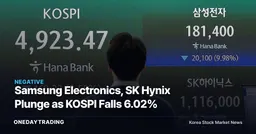
The Nasdaq Composite fell 5.52% overnight. The KOSPI then dropped more than 8% shortly after the open, falling below the 5,000 level. The sharp decline triggered a circuit breaker that halted KOSPI trading for 20 minutes, followed by a sell-side program trading curb after trading resumed.
The KOSPI subsequently recovered above 5,000 and narrowed its decline to the 4% range. The morning session captured both the peak of the shock and an attempted recovery. Even though the stock market pared its losses, there is no basis for reversing the interpretation that Korea Treasury yields fell across all maturities. Closing prices for the day were not provided.
The distinction between confirmed and unconfirmed developments is clear. Confirmed events include the sharp drop (plunge) immediately after the open, the trading halt, the sell-side program trading curb, and the subsequent narrowing of losses. Korea Treasury closing yields, the KOSPI closing price, and individual investors’ trading records fall outside the scope of the available data. Extrapolating morning figures to the full session would misalign the timing of any investment judgment.
Yield Declines Reveal Diverging Conditions Across Maturities
The 2-year Korea Treasury bond yield fell 3.7bp from the previous day to 3.618%, while the 5-year yield also declined 3.7bp to 3.732%. The 20-year yield fell 1.2bp to 3.973%, the 30-year yield dropped 1.9bp to 3.979%, and the 50-year yield declined 1.5bp to 4.006%. Although all maturities moved in the same direction, the declines were relatively larger in the short- and intermediate-term segments.
These figures reveal differences within the yield curve that cannot be captured by simply saying bonds were strong. The 4.6bp decline in the 3-year yield and the 1.2bp drop in the 20-year yield show that the direction was the same but the magnitude differed. Rather than applying the movement of a single maturity to the entire bond market, investors should assess the 2-, 3-, and 5-year Korea Treasury bonds separately from the 20-, 30-, and 50-year maturities.
Yields also declined outside the Korea Treasury market. The 2-year Monetary Stabilization Bond yield and the yield on 3-year AA- unsecured corporate bonds also fell from the previous day. However, the available data are insufficient to determine how relative risk assessments between Korea Treasury and corporate bonds changed or whether the same trend continued in subsequent trading.
Closing Yields and Prices Will Determine Bullish and Bearish Scenarios
A bullish bond scenario would emerge if the morning decline in Korea Treasury yields persisted through the close. Investors should then examine closing yields across all maturities and the size of each maturity’s decline. If KOSPI weakness intensifies again, they should also compare whether the morning’s inverse movement between equities and bonds remains intact.
The opposite scenario becomes possible if the KOSPI recovers further. The fact that the stock market regained the 5,000 level and narrowed its decline to the 4% range shows that the morning shock did not move in only one direction. This does not mean Korea Treasury yields will necessarily rebound. Subsequent movements in yields and share prices were not available.
- Korea Treasury closing yields: Compare them with the morning figures to determine whether yields remained lower across all maturities.
- KOSPI closing price: Check whether the recovery above 5,000 and the narrowing of losses continued through the close.
- Maturity spreads: Compare how the declines in the 3-year, 10-year, and ultra-long Korea Treasury yields changed by the close.
- Market stabilization: Assess whether the KOSPI weakened again after the trading halt and sell-side program trading curb.
The morning market had already priced in the abrupt decline in equities and lower Korea Treasury yields across all maturities. What remains uncertain is whether those trends persisted. The next assessment should begin with Korea Treasury closing yields and the KOSPI closing price, not forecasts.
KOSPI Index MetricsAs of 2026-11-06
| Performance | 1 Week -11.07% 1 Month -25.10% |
|---|
Index, commodity, and exchange rate figures are based on global markets and reflect values at the time of publication.
This article was automatically summarized and analyzed from the original news report. View original article (Yonhap News Securities)